


MSG Celebrity Nuptials: Policy Wonks & Pop Culture
When Madison Square Garden hosts a celebrity wedding, policy wonks take notice. Explore the implications of blurring private and public lives, the power of pop culture, and global attention shifts.

POLICY WIRE — NEW YORK — In an era rife with geopolitical earthquakes and sputtering global economies, some might find it curious—or perhaps perfectly predictable—that the hallowed halls of Madison Square Garden recently echoed not with the roar of a 54-year championship drought ending, but with wedding vows. Yes, the legendary arena, usually reserved for sporting glory or musical mega-tours, played host to a marital union so prominent it nearly eclipsed all other news cycles, proving once again that in America, spectacle often trumps substance.
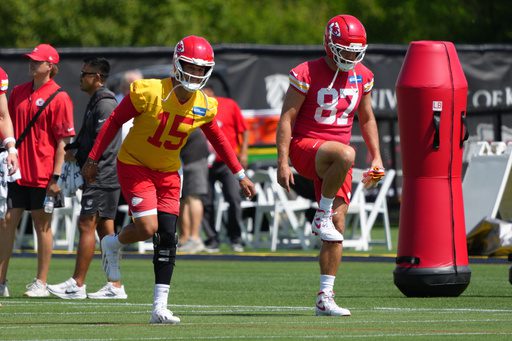
It was a Friday evening affair, drawing an eclectic mélange of gridiron giants and glitterati, ostensibly for the much-ballyhooed wedding of Kansas City Chiefs star Travis Kelce and pop icon Taylor Swift. The guest list reads like a sports almanac collided with a Grammy ballot. There was JuJu Smith-Schuster, a receiver known for his digital-savvy persona. And Cooper Kupp, fresh off winning the Super Bowl—you know, actual football achievements. The kind of guest list that confirms celebrity is now its own sovereign state, with diplomatic ties to both the NFL and the recording industry.
Sources, in what could only be described as a painstaking effort of observation and hearsay, confirmed that Kareem Hunt was one of Kelce’s many current or former Kansas City Chiefs teammates spotted in New York ahead of the wedding. Because, hey, what’s a high-profile, allegedly private event without a well-leaked guest manifest, right? The assembly also reportedly included Kelce’s retired Philadelphia Eagles Super Bowl-winning brother Jason and San Francisco 49ers tight end George Kittle, among a horde of others from football, golf and beyond. Even soccer had a presence, though admittedly it was “Ted Lasso” actor Jason Sudeikis, himself a big Chiefs fan—an intriguing meta-commentary on the blending of fiction and athletic reality.
The choice of venue itself raises an eyebrow or two. This isn’t some quaint chapel in the Hamptons. This is Madison Square Garden, the very ground where titans clashed — and legends were forged. It’s where the Knicks won their first NBA title in 1970, with Willis Reed famously returned from injury to spark their Game 7 victory against the Los Angeles Lakers. It’s also where Joe Frazier beat Muhammad Ali in the first of the legends’ three boxing matches against each other, the “Fight of the Century,” in 1971—a stark contrast to matrimonial pledges, wouldn’t you say? Ali won the rematch in ’74. The Rangers ended their 54-year championship drought at the Garden in 1994, defeating the Vancouver Canucks to win the Stanley Cup. And here we’re, exchanging rings. It’s a pretty rich bit of repurposing, if you ask this old hack.
But the Garden has seen its share of high-stakes, non-athletic drama too. Just imagine the pressure of saying [QUOTE_PLACEHOLDER] in a building that can pivot from hosting political conventions to a Cirque du Soleil show in mere hours. Swift herself, ever the trailblazer, attended Game 4 of the NBA Finals there, sitting courtside as the Knicks pulled off the biggest comeback at that stage of the playoffs in league history by rallying from down 29 to beat San Antonio. That’s a verified statistic from NBA records, by the way. This isn’t just a building; it’s a statement, a temple to American exceptionalism — and relentless spectacle. Policy analysts are often more focused on venues like the United Nations General Assembly Hall or parliament buildings, not multi-purpose arenas, but the convergence here is undeniable. Global sport, in all its economic glory, increasingly dictates not just entertainment, but public attention, drawing focus away from say, protracted negotiations over global economic games at international forums.
What This Means
The melding of high-wattage celebrity with iconic public spaces like Madison Square Garden—for what’s traditionally an intensely private affair—isn’t just a sign of the times; it’s a symptom. It highlights the growing commodification of private lives, a sort of turbo-charged public-private partnership where the ‘private’ aspect becomes little more than marketing collateral. Economically, this event, regardless of its private nature, translates into a windfall for New York City: tourism, luxury services, security, media saturation—it all feeds a consumerist beast that’s always hungry.
📄 POLICY WIRE WHITEPAPER PUBLISHED: PAKISTAN'S NATIONAL SECURITY POLICY PRIORITIES
👉 READ BY CLICKING HEREBut there’s a subtler implication too, one often lost amidst the confetti — and flashbulbs. In many parts of the world, particularly across South Asia and the Muslim world, such blatant displays of individualistic spectacle are viewed with a certain cynicism, if they’re even registered. While the West marvels at how much money two people can generate through their union, discussions in places like Pakistan might revolve around infrastructure development, humanitarian aid, or the delicate balance of regional diplomacy. And frankly, the idea of a stadium-sized wedding, where the sheer number of ‘prominent sports figures’ seems to validate the event’s worth, feels decidedly alien when contrasted with the communal, often less flashy, traditions of marriage that prioritize familial bonds over sheer celebrity draw. It’s a vivid illustration of differing cultural priorities and the immense, almost gravitational pull of Western entertainment—a soft power tool of unprecedented reach that makes a New York wedding feel, in some warped sense, globally significant.
This trend toward ever-grander, more public private moments suggests that the line between personal and public is not just blurred—it’s essentially erased for those at the apex of fame. It also signals an evolving landscape where traditional news, political or otherwise, increasingly struggles to compete for mindshare against the sheer kinetic energy of pop culture. It’s a world where a touchdown pass and a new power ballad can sometimes carry more weight than legislative policy or economic indices, which, if you’re charting the course of nations, presents quite a headache. But then, as veteran observers know, that’s just how it’s going right now. We’ve seen it before; we’ll see it again. It’s not a question of ‘if’ but ‘when’ some other celebrity coupling commandeers global attention, shifting our focus from the real political games to something far more, well, performative.