


Beyond the Finish Line: Wisconsin Prep Athletics and the Geopolitics of Grit
POLICY WIRE — La Crosse, USA — When lightning crackled over Veterans Memorial Stadium, forcing a pause in Wisconsin’s state track and field championship, it wasn’t just a brief...

POLICY WIRE — La Crosse, USA — When lightning crackled over Veterans Memorial Stadium, forcing a pause in Wisconsin’s state track and field championship, it wasn’t just a brief inconvenience for a handful of aspiring young athletes. Oh no. It was a momentary, if metaphorical, jolt to the meticulously orchestrated theater of human ambition—a tiny echo of the larger, less predictable disruptions that regularly derail plans from Islamabad to Jakarta.
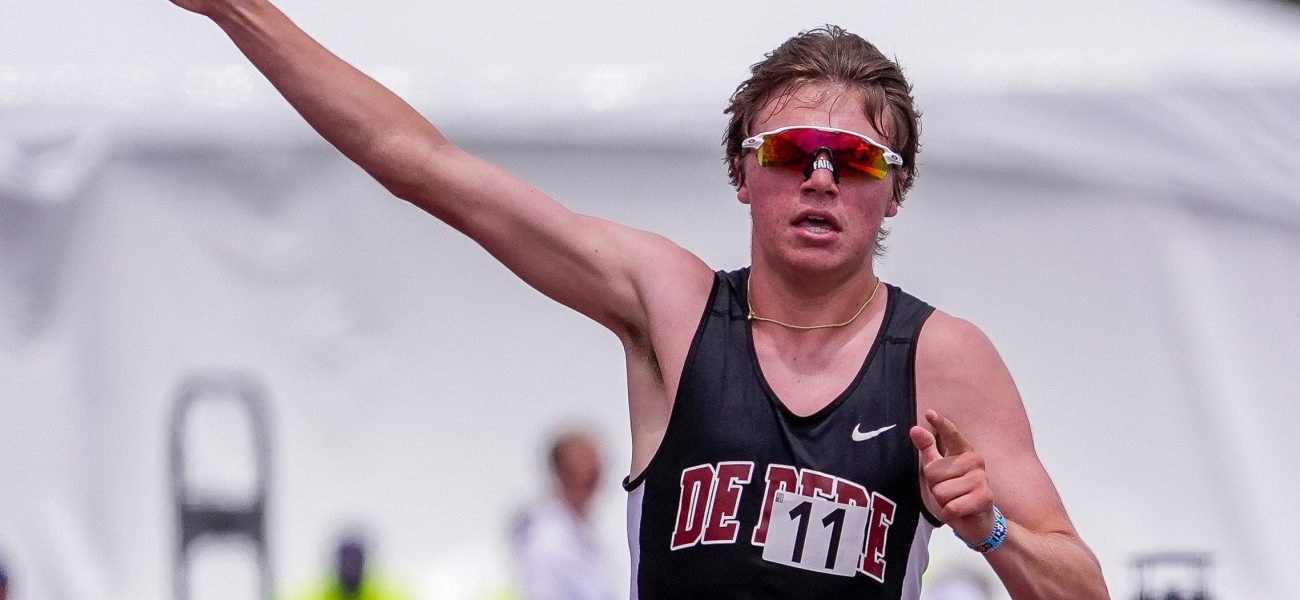
Day one wrapped, but not without some remarkable feats that probably didn’t need the grand meteorological drama to stand out. Take Grady Lenn, for instance. The De Pere senior—a veritable force of nature on the track—didn’t just win; he put a neat little bow on what’s been a seriously decorated prep career. And he did it by smashing records, for crying out loud. His Division 1 3,200-meter championship time of 8 minutes, 49.15 seconds, officially recorded at the WIAA state track and field meet, didn’t just win, it broke his own previous state best. And then, he celebrated with gestures of love—a subtle flourish, really—even blowing a kiss to the stands as he cruised in.
It’s almost as if he knew he had it in the bag. He let another competitor, Milwaukee Marquette senior Brendan Reardon, lead the early leg. “I think I just had a little bit of a different race plan,” Lenn said later, almost casually. But, then, with 800 meters left, Lenn flicked a switch. Bang. He overtook Reardon, leaving him — and everyone else in the dust, more than 13 seconds ahead of the runner-up. “It feels great, just a cherry on top,” he mused, post-race. But don’t think he’s resting on laurels, not yet. He still had the 1,600m in his sights, another chance to deepen a legacy already solidified by back-to-back state titles, a feat shared by only a handful in De Pere history.
Then there’s Richie Flanigan, a Notre Dame junior who decided his family’s track and field legacy needed another discus title. His old man, Jim, stacked up three straight Class B titles from 1988 to 1990. His brother, James, snagged two D2 discus wins. Now Richie? He tossed a 176 feet, 8 inches, adding his name to a dynasty that’s pretty much built on throwing heavy things. This isn’t just about athletic genes, is it? It’s about an environment, a culture that cultivates — even expects — such sustained performance, much like certain political families carve out perpetual influence, generation after generation.
The day wasn’t solely about gold. Green Bay Preble’s Maximus Davis, a pole vaulter, soared to a runner-up spot after a dramatic showdown. Defiance and grit define his rise, considering he was sixteenth as a sophomore. “I was super confident,” Davis declared, even after narrowly missing first place. His coach, Brad Boockmeier, called him a [QUOTE_PLACEHOLDER] The implication here is plain: raw talent alone rarely suffices; the grinding, often unseen, effort in preparation determines eventual elevation. That’s true for athletes, it’s true for nascent economies, and it’s especially true for political reform in nations striving for stability.
But the day did deliver some complex calculations. Pulaski’s senior, Emerson Fabry, had to make a hard choice. Running both the 1,600m — and her signature 800m? That meant sacrificing something. She finished fifth in the 800m, clocking a 2:14.11, roughly the same as last year. But here’s the kicker: she ran a personal-best in the 1,600m earlier, effectively using up some precious juice. “I definitely know I could have been state runner-up today [in the 800] had I not done the mile,” she admitted. Yet, she’s not regretting it, happy she did both. It’s a strategic decision—the athlete as a living, breathing policy wonk, making trade-offs between competing priorities. That’s a decision political leaders, whether in Washington or Karachi, grapple with daily, balancing immediate needs against long-term gains, sometimes sacrificing a smaller, certain win for a shot at something larger, more expansive.
📄 POLICY WIRE WHITEPAPER PUBLISHED: PAKISTAN'S NATIONAL SECURITY POLICY PRIORITIES
👉 READ BY CLICKING HEREAnd yes, the weather. The late-day lightning delay that postponed several Division 2 and 3 events was a sharp reminder that external forces, entirely outside human control, can mess with even the most perfectly laid plans. For South Asia, grappling with the intensifying realities of climate change’s relentless march—monsoon floods, scorching heatwaves—this sporting disruption pales. But the principle stands. We make our best efforts, we train, we plan, but ultimately, Mother Nature, or geopolitical tremors, can always have the final say.
What This Means
The microcosmic world of Wisconsin prep athletics, as witnessed on this particular day, serves as an unexpected lens into macro-level policy and economic dynamics. The emergence of multi-generational champions like the Flanigans isn’t merely about good genetics; it speaks to sustained institutional support, community investment in infrastructure, and the creation of fertile ground for excellence. You see, stable societies—ones with functioning athletic programs and quality education—tend to be more prosperous. It’s a feedback loop.
Consider the strategic choices, like Fabry’s decision to run both races. This isn’t unique to sport. Nations often face resource constraints, forced to allocate scarce funds between competing sectors: healthcare versus infrastructure, education versus defense. Prioritizing individual accolades over a holistic national development plan, or vice versa, presents a perpetual dilemma. Even in resource-rich states, the political economy of sport often mirrors broader national aspirations. Just look at the significant state investment in sports infrastructure across the Middle East, particularly in countries like Saudi Arabia and Qatar, or the fervour for cricket in Pakistan and India; these aren’t just pastimes, they’re expressions of national identity and soft power. And when disruptions occur—whether a lightning storm here, or, say, a sudden surge in global food prices, or a political upheaval in regions far from La Crosse—the adaptability and resilience of institutions, and individuals, get tested. It’s a common, human equation, just scaled up or down.