



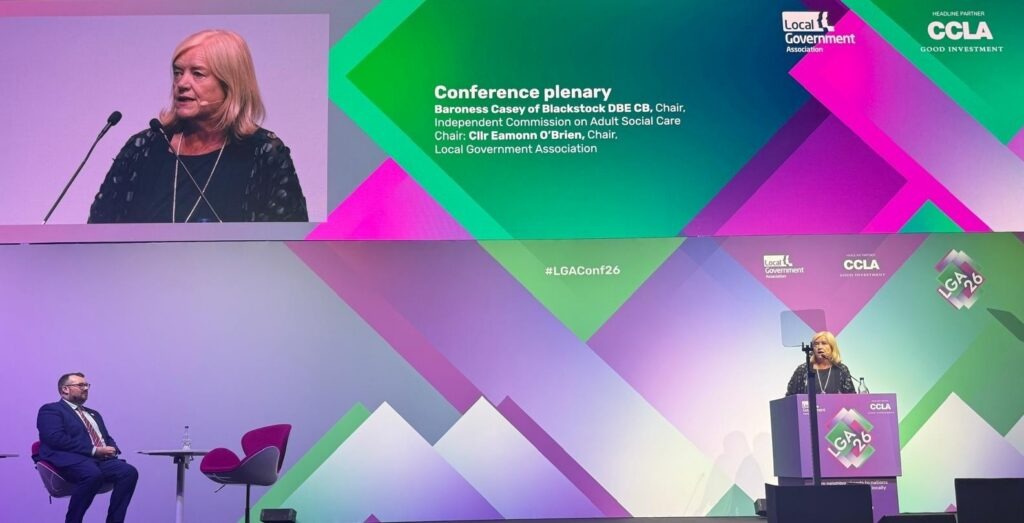
Baroness Casey Slams Governments for ‘Asleep at the Wheel’ on Social Care Crisis
Baroness Louise Casey condemns decades of government neglect in social care, calling for a new national settlement to fix a fragmented care system.

POLICY WIRE — Liverpool, UK — Baroness Louise Casey, leading a major review into social care reform, is set to launch a scathing critique of successive administrations for remaining “asleep at the wheel” regarding the sector.
Speaking at the National Children and Adult Services Conference (NCASC) on Wednesday, Casey Casey will present findings from new research that describes the current landscape as a fundamentally fragmented system lacking centralized leadership.
The Baroness intends to characterize the handling of the Covid-19 pandemic as a national shame, noting that the virus spread rapidly through care homes while many elderly residents passed away without family present.
In her address, Casey is expected to state that the Covid-19 Inquiry debunked the notion that a protective ring existed for care homes, resulting in tragic losses and workers fleeing the profession due to the trauma they witnessed.
She will emphasize that the research reveals a profound lack of stewardship, concluding that no single entity is currently in charge of the care system’s direction.
To move forward, Casey is calling for a “new settlement for care” rooted in shared national values of decency, contribution, and a collective duty to care for neighbors and loved ones.
The underlying study, conducted by the Nuffield Trust and the Institute for Government, finds that England’s adult social care is a complex web of responsibilities scattered between central departments, local authorities, and various non-public providers.
The report highlights that this lack of a single point of responsibility leads to opaque decision-making, a structural weakness that was severely exposed during the recent global health crisis.
While the sector employs over 1.5 million people across approximately 19,000 employers, England remains the only UK nation without a mandatory register for care workers.
The research also notes that private providers dominate the market in a manner that has been largely uncontrolled and unintended, and unlike the NHS, social care is not free at the point of use.
Prohibitive costs often force individuals to liquidate their homes to fund care, as those with savings exceeding £23,250 are ineligible for local council assistance.
Furthermore, the report warns of a lack of transparency regarding fees, revealing that those paying for care privately face an average cost 40 per cent higher than those whose care is funded by a council.
The document asserts that creating a new national care service requires political bravery, noting that the momentum generated by Prime Minister Andy Burnham—who accelerated the Casey Commission—must be sustained to succeed.
While Burnham has conceded that difficult tax decisions may be necessary, he maintains that stabilizing the social care system could save the NHS billions of pounds annually.
Reporting by Policy-Wire (PW)