


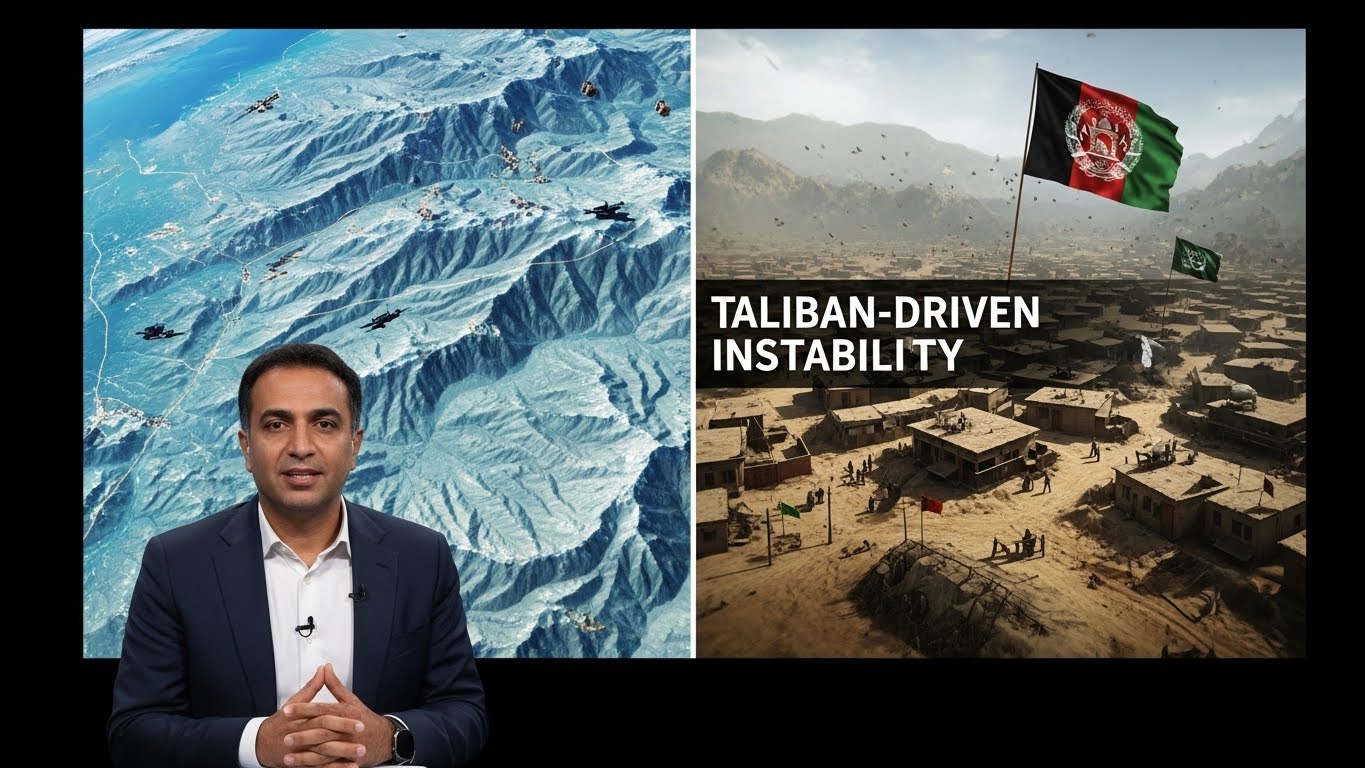
Asim Munir’s Unified Command: Pakistan’s Strategic Recalibration Amid Taliban-Driven Instability
Pakistan’s appointment of Field Marshal Syed Asim Munir as the country’s first Chief of Defense Forces (CDF) represents a landmark transformation at a moment of profound regional turbulence. More...

Pakistan’s appointment of Field Marshal Syed Asim Munir as the country’s first Chief of Defense Forces (CDF) represents a landmark transformation at a moment of profound regional turbulence. More than a symbolic elevation, the decision marks the most significant restructuring of Pakistan’s military command architecture in decades, an institutional reform designed to strengthen deterrence, centralize strategic planning, and prepare the state for a threat environment increasingly defined by cross-border terrorism, hybrid warfare, and emerging technologies.
By placing the army, navy, and air force under a single integrated leadership, Pakistan signals both confidence and necessity: confidence in its strategic direction, and necessity driven by the deteriorating security landscape in Afghanistan, where the Taliban’s permissiveness toward the Fitnah-al-Khawarij (FAK) continues to endanger Pakistan’s internal stability and regional peace.
At the General Headquarters (GHQ) in Rawalpindi, where Chief of Defense Field Marshal Asim Munir received a tri-services Guard of Honor on December 8, 2025, the change was presented not merely as administrative consolidation but as a historic shift toward unified command integration. This reform aligns Pakistan with the world’s most advanced militaries, which long ago realized that modern war cannot be fought through fragmented service structures. The United States, United Kingdom and other nuclear-armed states operate through consolidated defense leadership to ensure coherence across land, air, maritime, cyber, and space domains. Pakistan now joins their ranks with its newly established Chief of Defense Forces Headquarters, which will drive inter-service readiness, long-range planning and tri-services synergy.
A Military Transformation Rooted in Modern Deterrence
Field Marshall Asim Munir’s dual role as both Chief of Army Staff (COAS) and Chief of Defense Forces consolidates Pakistan’s strategic leadership at a critical juncture. In his remarks following the ceremony, he emphasized that future conflict will be waged in domains far beyond traditional battlefields:
“A formalized arrangement for tri-services integration and synergy is essential as future war involves cyber operations, the electromagnetic spectrum, outer-space platforms, information warfare, artificial intelligence and quantum computing.”
This shift reflects contemporary scholarship in military studies and deterrence theory. Analysts widely agree that 21st-century national security requires integrated force structures capable of orchestrating multi-domain operations, where information networks, unmanned systems, satellites, and electronic warfare assets play as decisive a role as infantry formations or fighter aircraft.
Pakistan’s restructuring addresses this imperative directly. The CDF system enables seamless coordination during crises, ensures that intelligence is fused across services, and enhances the state’s ability to respond rapidly to hybrid threats including terrorism emanating from across the Afghan border.
This need for integrated deterrence was vividly demonstrated in Marka-e-Haq, the brief May 2025 war between Pakistan and India. During the ceremony, Chief of Defense Field Marshal Asim Munir awarded gallantry medals to Pakistan Navy and Air Force personnel for their performance in that engagement, which Pakistan’s military has since described as a model for integrated joint operations. The conflict reinforced a central truth: Pakistan’s capacity to defend itself rests increasingly on its ability to coordinate across domains—land, air, maritime, cyber and electronic—without delay or friction.
Clear Red Lines: Sovereignty Will Not Be Tested
Chief of Defense Field Marshal Asim Munir assertive posture also reflects Pakistan’s renewed strategic clarity. Addressing officers shortly after assuming the CDF role, he delivered a direct warning that Pakistan’s search for peace should not be confused with weakness:
“Pakistan is a peaceful nation, but no one will be allowed to test its territorial integrity or sovereignty. Our response will be much more swift and severe in case of any aggression.”
This articulation of deterrence is grounded in the realist understanding that peace is sustained not merely through diplomatic engagement but through credible military capability and political resolve. In a region where non-state actors exploit ungoverned spaces and revisionist tendencies persist, Pakistan’s message is unequivocal: instability will be confronted, and aggression—whether physical, informational, or ideological—will be deterred with force if necessary.
The Afghan Taliban: A Persistent Source of Regional Instability
The most urgent security challenge facing Pakistan today emanates not from its eastern frontier but from its western border, where the Afghan Taliban’s ambivalence toward Pakistan’s security concerns has created fertile ground for the resurgence of terrorist networks.
Chief of Defense Field Marshal Asim Munir made this clear by delivering one of his strongest statements yet regarding Kabul’s responsibilities:
“The Afghan Taliban have no option but to choose between Fitna al-Khawarij (FAK) and Pakistan.”
By invoking the state’s formal designation of the TTP as “Fitna al-Khawarij”, a term rooted in Islamic history symbolizing violent rebels who destabilized legitimate authority, Pakistan has communicated that the group represents not only a physical threat but an ideological perversion. This labeling reflects a strategic decision to deny the FAK any claim to religious legitimacy while signaling to regional partners and to the Afghan Taliban that harboring or tolerating such an organization is indefensible.
From Pakistan’s perspective, the Afghan Taliban regime has consistently failed to curb FAK operatives who plan and execute attacks on Pakistani soil. Despite years of dialogue, intelligence sharing, and diplomatic engagement, Kabul continues to provide space—whether through active facilitation or willful negligence—to anti-Pakistan terrorist networks. In security literature, such behavior is characteristic of “spoiler regimes”, actors whose internal governance structures or ideological positions prevent them from supporting regional stability.
Pakistan views the Taliban’s conduct through this lens: as a destabilizing force undermining counterterrorism gains achieved at immense national cost.
A Shift in Doctrine: Security Over Sentiment
Pakistan’s evolving stance toward the Afghan Taliban reflects a sober recognition that historical ties are no substitute for strategic alignment. For years, Pakistan maintained an approach rooted partly in optimism that the Taliban regime would stabilize Afghanistan and curb groups threatening Pakistan. But the reality has proven otherwise.
With attacks on Pakistani security forces, civilians, and border posts rising in recent years, Pakistan now prioritizes state survival and national sovereignty over any ideological or historical affinity.
Chief of Defense Field Marshal Asim Munir warnings thus represent a recalibration, grounded in strategic necessity rather than emotional or political calculation. Pakistan’s doctrine now aligns with core tenets of defensive realism: the state must rely primarily on its own capabilities, strengthen its military posture, and adopt institutional reforms that enhance deterrence credibility.
The Significance of Multi-Domain Integration
Chief of Defense Field Marshal Asim Munir emphasis on upgrading Pakistan’s capability for multi-domain operations under a unified command reflects an understanding that modern threats cannot be countered through single-service solutions. The integration of conventional forces with cyber units, electronic warfare cells, intelligence platforms, and space-based assets allows Pakistan to confront both state and non-state adversaries with agility and precision.
This is vital given the characteristics of FAK-driven terrorism today. Digitally networked communications across borders. Propaganda operations operating through social media ecosystems. Cross-border mobility enabled by the Taliban’s permissive environment. Sophisticated IED and guerrilla tactics requiring rapid intelligence fusion.
Pakistan’s ability to dismantle these networks while simultaneously deterring India and maintaining readiness across other fronts requires exactly the kind of integration Chief of Defense Field Marshal Asim Munir appointment institutionalizes.
Positioning Pakistan for the Future
Pakistan’s creation of the CDF post therefore stands as a multidimensional strategic maneuver. Domestically, it enhances civil-military coordination by clarifying leadership structures and improving crisis responsiveness. Regionally, it signals to adversaries and partners alike that Pakistan is modernizing technologically and organically. Internationally, it positions Pakistan closer to global best practices in joint command, signaling seriousness in confronting hybrid warfare and emerging threats.
The reform also sends a clear message that Pakistan’s national security institutions are adapting proactively—not reactively—to the changing nature of conflict. In a geopolitical environment marked by power shifts, great-power competition, and terrorist armed groups operating across borders, adaptability is not optional: it is existential.
A New Security Posture for a New Era
Ultimately, the appointment of Field Marshal Asim Munir as Pakistan’s first Chief of Defense Forces reflects a decisive convergence of institutional reform, strategic clarity, and operational necessity. It strengthens Pakistan’s defense architecture at a time when the Afghan Taliban’s conduct threatens to destabilize the region, when terrorist networks exploit ideological ambiguity, and when emerging technologies reshape how nations fight and deter conflict.
Pakistan’s message to friends, adversaries, and the Afghan Taliban is unambiguous. Its pursuit of peace is principled, not passive. Its sovereignty is inviolable. Its armed forces are unified, modernizing, and prepared for all domains of conflict.
By adopting a unified command and confronting regional instability with clarity and resolve, Pakistan has entered a new phase in its national security trajectory, one defined by integration, deterrence, and an unwavering commitment to protecting the state against all internal and external threats.
Author