


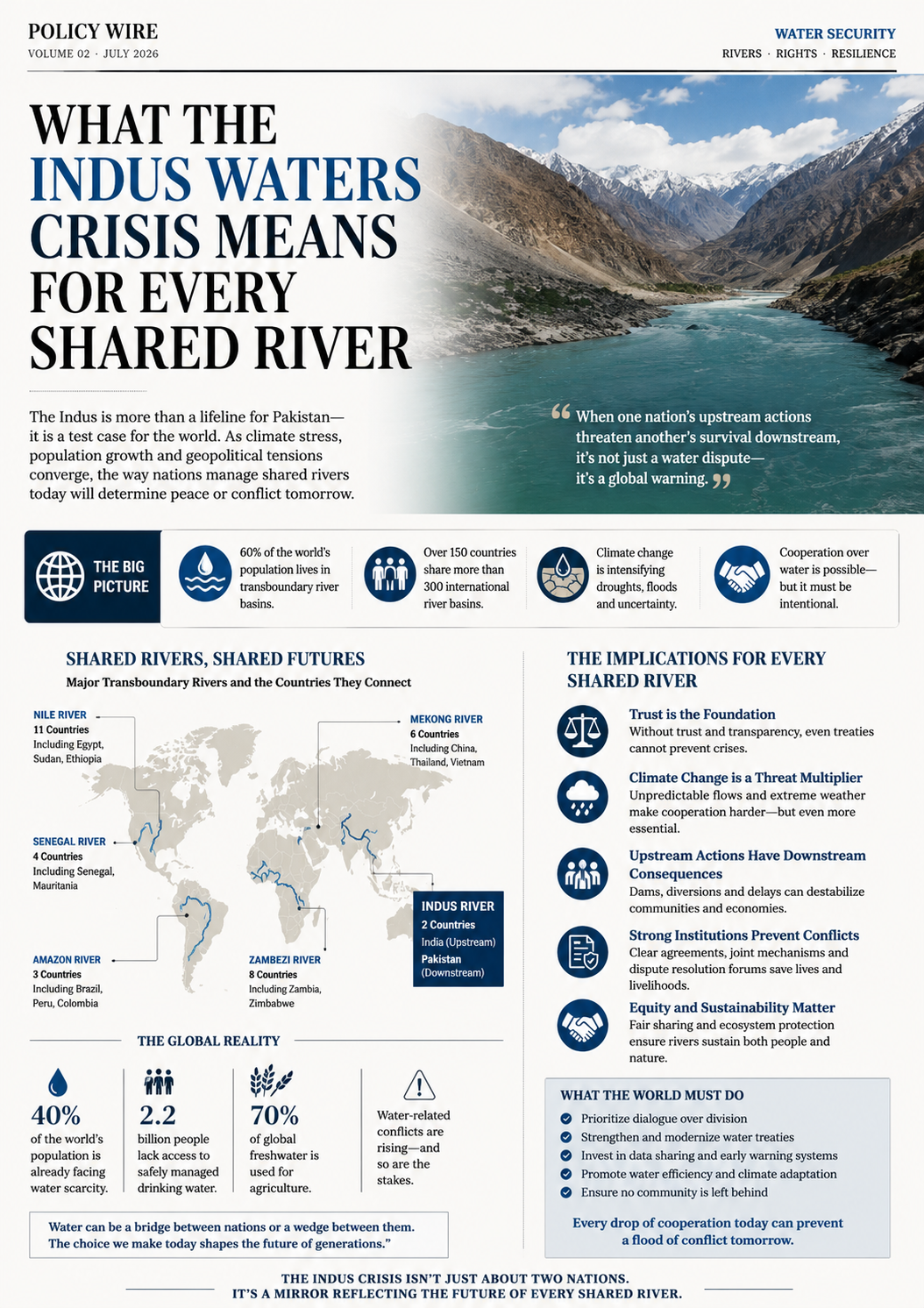
What the Indus Waters Crisis Means for Every Shared River
For sixty-five years, India and Pakistan handled their water disputes through an agreed process rather than on the battlefield. The 1960 Indus Waters Treaty, brokered by the World Bank, gave the two...

For sixty-five years, India and Pakistan handled their water disputes through an agreed process rather than on the battlefield. The 1960 Indus Waters Treaty, brokered by the World Bank, gave the two countries a joint commission to manage everyday questions and a path to neutral arbitration when they disagreed. The treaty held through three wars. Since April 2025, the rivers have kept flowing at close to their normal volume. What has faltered is the agreed process that governed them, and whether that process still binds either side is now an open question.
That question matters well beyond South Asia. Governments around the world rely on similar arrangements to share rivers they cannot divide by force. If a landmark treaty can be set aside and its court dismissed without cost, every other basin inherits the lesson.
The immediate story is straightforward. On 23 April 2025, one day after gunmen killed 26 people at Pahalgam in Indian-administered Kashmir, India announced it would hold the treaty “in abeyance.” New Delhi tied restoration to a single condition: that Islamabad credibly and permanently end its support for cross-border militancy, an accusation Pakistan rejects. India had already served formal notices in 2023 and 2024 seeking to modify parts of the treaty it considers outdated, citing population growth, rising energy demand, and a changing climate. Pakistan had declined to renegotiate.
Islamabad took the dispute to the treaty’s court of arbitration. That court has now ruled against India’s position twice, first on its own authority to hear the case in 2025, and again in May 2026 on the technical limits governing Indian hydropower projects. India rejects the court as illegally constituted and treats its rulings as void. The treaty itself contains no clause allowing either side to suspend it.
Much of the public alarm has focused on a frightening picture: India shutting off the rivers, or releasing them in a sudden flood. That picture outruns the facts. India has kept the water flowing. As the upstream country, it accepted tight limits on storage when it signed, and it does not currently hold the dams or reservoirs needed to withhold or dump water on a scale that would devastate Pakistani agriculture. Building that capacity would take years and enormous investment.
The real loss since April 2025 is quieter and already underway. The commission that coordinated the two governments has stopped meeting. Routine data-sharing, including the flood warnings that let downstream communities prepare for a surge, has lapsed. The damage is to cooperation, and cooperation is harder to rebuild than a reservoir.
This is where the danger sits. The treaty’s value came from more than the water it allocated. It came from shared machinery that let two hostile, nuclear-armed neighbors send a combustible dispute to an outside authority and accept the answer. That machinery worked because both governments treated it as binding.
India and Pakistan now read the same situation in opposite ways. New Delhi describes its move as limited, reversible pressure tied to security, well short of war. Islamabad reads it as a threat to its survival, and its National Security Committee has warned that any attempt to stop Pakistan’s water would be treated as an act of war. When each capital is certain of its own reading and no neutral body can issue a ruling both will accept, the gap between those readings has nowhere to go. A working court narrows that kind of gap. A rejected one leaves it open, in a region where the two armies have already fought.
South Asia is not the only place learning this. On the Mekong, the main cooperative body has no binding authority over the upstream country that controls the largest dams, so coordination rests on goodwill rather than obligation. On the Nile, Ethiopia filled the Grand Ethiopian Renaissance Dam without an agreement with Egypt and Sudan downstream, because no treaty governing them existed in the first place. Each case shows a different way the same model gives out.
Pakistan itself now faces this pressure from two directions. To its west, Afghanistan is expanding dams and irrigation on the Kabul River, which flows into Pakistan and feeds a densely populated stretch of the country. No treaty governs that river. Kabul is under no obligation to share data or coordinate releases, and it has little incentive to accept the kind of limits that India and Pakistan spent a decade negotiating on the Indus. If upstream development on the Kabul accelerates while the Indus framework weakens, Pakistan could find its water squeezed from both sides at once, with a functioning treaty on neither. The country that has leaned most heavily on the Indus arrangement has the most to lose if the idea behind it stops working.
For governments in Washington and Europe, this is not a distant regional quarrel. The Indus Waters Treaty is one of the clearest successes of a model those governments underwrite: a neutral broker to write the terms, and an arbitration process to settle disputes when the two sides cannot. If a powerful state can walk away from that model and reject its court without paying a price, the precedent does not stay in South Asia. It reaches every basin where an upstream government weighs whether its own commitments still hold.
Repairing this does not call for a new grand treaty. It calls for two changes that existing agreements can adopt. Water data should be shared automatically and verified by satellite, so that flow records and flood warnings survive even when political relations collapse. And the arbitration written into these treaties needs real weight, so that refusing to take part carries a cost rather than offering an exit.
The Indus dispute may yet be settled, and the water may keep flowing. But the demonstration is already complete. A treaty that survived three wars has been suspended, and its court dismissed, with no penalty so far. Other governments are watching, along other rivers, and drawing their own conclusions. Water is simply where the test came first.
Author