

Ash and Uncertainty: New Mexico’s Seven Cabins Fire Drags On, Defying Control
POLICY WIRE — Capitan, N.M. — It’s a relentless, low-grade siege, this one. Not the kind that makes international headlines daily, but an insidious conflict nevertheless, where 1,055 personnel fight...

POLICY WIRE — Capitan, N.M. — It’s a relentless, low-grade siege, this one. Not the kind that makes international headlines daily, but an insidious conflict nevertheless, where 1,055 personnel fight a burning landscape, often losing ground to an unseen, unthinking adversary: the wind. Weeks after its initial spark, the Seven Cabins Fire in the Capitan Mountain Wilderness stubbornly persists, a stark testament (if we were allowed to use that word) to nature’s raw power and, more chillingly, humanity’s persistent knack for initiating its own catastrophes.
Progress is measured in percentages, and right now, the number stands at a tentative 49% of the Seven Cabins Fire
contained. That sounds encouraging, perhaps. But take a beat, — and consider the backdrop: warmer, drier weather returns
across the region. And because of it, the battle feels less like a decisive victory lap and more like an anxious pause before the next offensive. [QUOTE_PLACEHOLDER]
This isn’t some act of God, a bolt from the blue. No. We know what it’s. It’s a human-caused fire
, an accidental or deliberate transgression that has already burned 28,907 acres since May 14
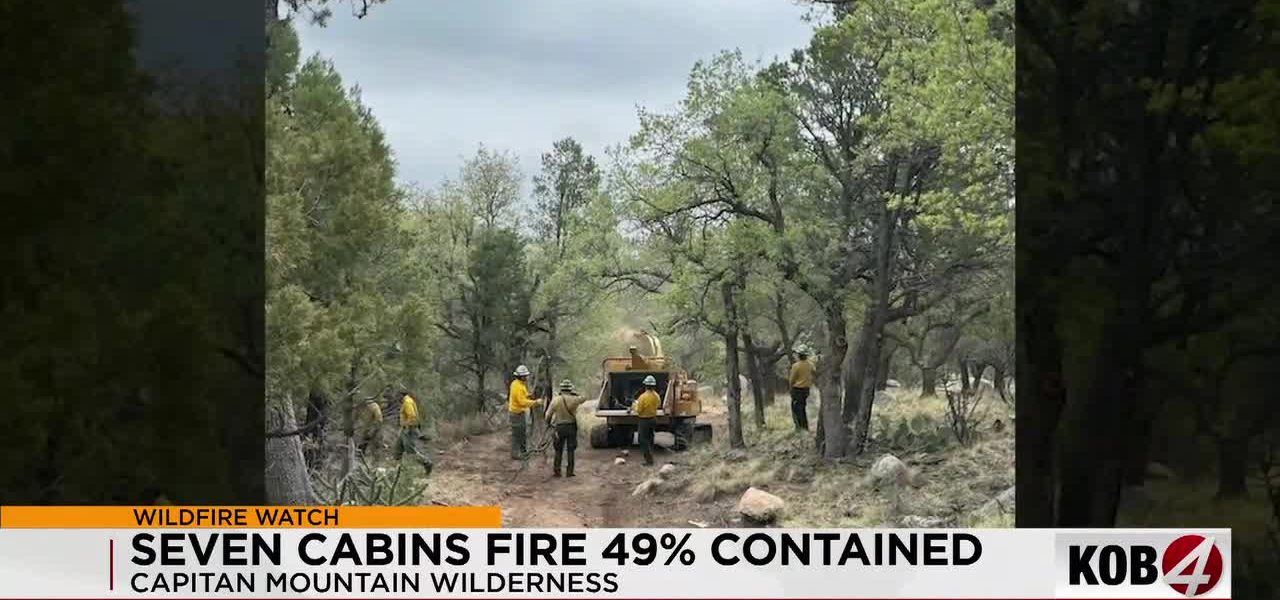
. That’s a footprint equivalent to almost a fifth of Washington, D.C.’s land area — not a small parcel by any measure, and a number sourced directly from official reports detailed by local media. Think of the sheer resource drain; not just the financial cost, but the exhaustion etched onto the faces of those fire crews. They’ve managed more progress on containment lines where crews could work safely
, which is good. They’re nearly finished line preparation along Forest Road 57
and kept working along Forest Road 536 to improve access on the far east side
. Hard work, dirty work, lonely work.
But the gains are fragile. Just as some of those tired souls, some of the 1,055 personnel assigned
, begin their trek home — Some firefighters are starting to head home
, the wire reports — the forecast pivots. We’re looking at warmer temperatures, lower humidity — and stronger winds through the weekend
. It’s like breathing a small sigh of relief only for a fist to tighten in your gut. Sure, Scattered thunderstorms brought measurable moisture to much of the fire area
, but every seasoned hand knows: fuels can dry quickly
.
And then there’s the peculiar absurdity of modern firefighting. Imagine you’re staring down a wall of flame, your aircraft roaring overhead, — and suddenly, everything grinds to a halt. Why? Because a civilian drone — likely flown by some gawking amateur with a selfie stick and too much time — has entered the restricted airspace. The update warns: if a drone enters restricted airspace, all firefighting aircraft must be grounded to keep crews safe
. A momentary, digital blunder that can cost hours, if not acres, in a fire’s unyielding advance. It’s almost darkly comic, isn’t it?
The landscape of control, for what it’s worth, isn’t just about burning earth. There’s a pervasive forest closure remains in effect across the Capitan Mountain area east and south of Highway 246 to the Forest Service boundary and south to Forest Service Road 57
. The Baca campground remains closed
, — and Stage 1 fire restrictions also remain in place
. For those living on the fringes, it’s a constant, unsettling hum. Evacuation status remains under daily review
. Areas like Fort Lone Tree down to Padilla Ranch, — and along State Highway 246, are still under SET status. Residents there? They should stay alert, be ready to leave and monitor official alerts as conditions change
. A phrase that holds more dread than its polite phrasing suggests.
What This Means
The Seven Cabins Fire, a human-ignited blaze in New Mexico’s rugged terrain, isn’t just a local issue. It’s a microcosm of a larger, global struggle, reflecting escalating pressures on ecosystems — and economies everywhere. We’re talking resource allocation, climate change’s insidious creep, — and the stark reality of human fallibility. Politically, the recurring cycle of fire and rebuilding strains local government budgets and forces difficult conversations about land management and climate resilience, especially in a state like New Mexico already wrestling with water scarcity.
Economically, the impact extends beyond the immediate loss. Businesses reliant on tourism — think camping, hiking, hunting — take a direct hit when an area is under perpetual forest closure
. Property values in affected zones dip, and the long-term ecological damage requires decades, if not centuries, of recovery, influencing timber industries or grazing lands. The cost of containing fires like this one — mobilizing over a thousand personnel and fleets of aircraft — eats into budgets that could be allocated elsewhere, for infrastructure or education. But they can’t. They’re simply stuck.
Look further afield, — and the narrative resonates with concerns in regions like South Asia. Pakistan, for instance, has battled its own devastating wildfires, many of them human-caused, exacerbated by changing weather patterns. In 2022, a fierce heatwave combined with deforestation led to massive blazes in Balochistan, displacing communities and destroying valuable pine nut forests – a similar struggle of communities caught between a harsh climate and sometimes-preventable disasters, mirroring the New Mexico situation’s core challenge: balancing immediate relief with long-term climate adaptation strategies. They’ve also seen increasing climate-induced displacements, as documented by UNHCR’s reports on climate migrants in the region. The lessons from Capitan, N.M. — the imperative of proactive prevention, robust emergency response, and honest assessments of anthropogenic impact — are hardly exclusive to the American Southwest. This battle against the blaze, you see, is a shared one.
The situation serves as a grim reminder. Our increasing interface with wildlands, coupled with climate patterns that favor hotter, drier conditions, means that human errors now have disproportionately disastrous consequences. The choice isn’t if we’ll face more fires, but how effectively we’ll adapt to live with them, how wisely we’ll allocate resources, and, crucially, how we hold ourselves accountable for starting them. We don’t have forever to figure this out.