


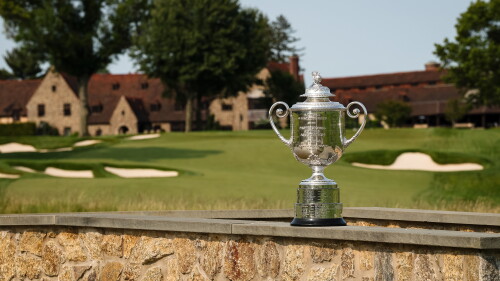
Aronimink’s Crucible: The Subtle Politics Behind Golf’s Sudden-Death Fortune
POLICY WIRE — Aronimink, Pennsylvania — You’d think an extra hole or three in a golf tournament is just a bit of bonus sport, right? A technicality. A tidy way to sort out who gets the massive check...

POLICY WIRE — Aronimink, Pennsylvania — You’d think an extra hole or three in a golf tournament is just a bit of bonus sport, right? A technicality. A tidy way to sort out who gets the massive check — and who gets a runner-up handshake. But what plays out on the immaculate fairways of Aronimink this Sunday, particularly if the leaderboard ends in a snarl, isn’t just about a championship. It’s a finely calibrated drama, a high-stakes corporate ballet designed to captivate eyeballs, pump up broadcast numbers, and — perhaps most importantly — protect a burgeoning global enterprise that now dwarfs many national economies.
It’s about how an arcane rule, set by a governing body, morphs into a narrative engine. We’re talking about the PGA Championship’s playoff format, a system that, for the uninitiated, boils down to a three-hole aggregate showdown. Think of it as a mini-match within the larger contest. If two or more players are level pegging after 72 holes, they’re trotted back out for a three-hole sprint across the 10th, 17th, and 18th. Lowest score wins. If they’re still tied after that? Then it’s sudden death, round-robin style, repeatedly hitting the 18th until one poor soul cracks. Or, rather, until one brilliant golfer finds glory. This isn’t just a sport; it’s an emotional roller-coaster, manufactured by design.
And it works. Because the raw, unscripted drama of sudden death, even in its aggregate preamble, is gold for broadcasters. It’s what keeps casual fans glued to the screen when they might otherwise click away. We saw its brute efficiency in 2000 at Valhalla, when Tiger Woods — because, of course — vanquished Bob May, delivering ratings that sports executives still dream about. But let’s not pretend this format is merely some ancient, chivalrous tradition. It’s a commercial imperative.
“The modern playoff structure isn’t just about fairness; it’s a strategic choice for fan engagement,” offered Mr. Lawrence Fitzwilliam, Chief Marketing Officer for the PGA of America, in a rare candid moment this week. “We’re crafting moments that transcend golf, moments that become part of popular culture. The aggregate stage builds suspense, — and then the sudden-death kicker? That’s pure, unfiltered excitement. It’s designed to ensure maximum exposure right when it counts most.” He wasn’t wrong. The PGA Tour itself boasted record viewership numbers for the 2023 season, driven in no small part by tight finishes. That kind of reach translates directly into revenue.
Contrast this method with the other majors: the Masters favors pure sudden death, brutal in its instantaneity. The U.S. Open uses a two-hole aggregate. The Open Championship, four. Each choice reflects a slightly different philosophy on drama — and exhaustion. But Aronimink’s format, a blend of extended aggregate and eventual sudden-death, often gets the nod for striking the optimal balance between a sustained battle and a knockout blow.
“It’s not just about a trophy; it’s about monetizing narrative,” quipped veteran sports agent, Ms. Zara Khan, reflecting on the escalating prize money. “This year’s purse alone hit a record $20.5 million. Think of the sponsorships, the media rights, the ancillary merchandise — all boosted by an engaging playoff scenario. A protracted finish ensures maximum eyeballs on those sponsor logos. A one-hole sudden-death might be too abrupt, losing momentum. But this? This is primetime television extended for a premium price.” Ms. Khan’s agency represents several top players on the global circuit.
📄 POLICY WIRE WHITEPAPER PUBLISHED: PAKISTAN'S NATIONAL SECURITY POLICY PRIORITIES
👉 READ BY CLICKING HEREBut how does this American golf spectacle reverberate beyond the lush greens of Pennsylvania? Well, the business model it embodies — where drama is packaged and sold for global consumption — finds fertile ground across the world, including in the rapidly expanding sports markets of South Asia. Nations like Pakistan, often associated primarily with cricket, are seeing a quiet but consistent growth in interest for other international sports, especially among younger, increasingly affluent demographics. Investment follows interest, and structured formats that guarantee tension, much like the T20 version of cricket, are seen as the blueprint for global appeal. It’s a template for capturing market share wherever disposable income — and media access are on the rise.
Because ultimately, this isn’t just a game for elite athletes. It’s an economic machine, polished to a mirror sheen. Globally, golf’s economic impact exceeds $84 billion annually, according to a 2022 Golf Course Superintendents Association of America report, a figure influenced heavily by professional tournaments and their carefully curated appeal. When you’ve got that much cash on the line, you don’t leave the climax to chance.
What This Means
The seemingly pedestrian rules of golf playoffs are, in fact, sophisticated tools of political economy. For policymakers, sports governance, like any regulatory framework, isn’t benign. It shapes market behavior. The PGA Championship’s playoff format at Aronimink isn’t just a solution for ties; it’s a meticulously engineered broadcast event, maximizing suspense to drive viewership, thereby inflating media rights values and sponsorship deals. It’s an implicit recognition that drama sells, and if it means bending traditional tournament structures to wring out every last drop of commercial potential, so be it.
This approach isn’t isolated to golf. It mirrors strategies in other global sports, from European football leagues to the IPL in India, where rules and season structures are constantly evaluated for their impact on engagement and profitability. It’s a reminder that sports aren’t just arenas for athletic competition, but also for economic competition — where the ‘best’ format isn’t always the simplest, but the one that generates the most capital and captures the largest audience, even in burgeoning markets. It’s a quiet war waged in boardroom meetings, just as much as on the green. And the consumer, hooked on the thrill, is the ultimate prize.