


Vietnam Vet’s Welcome Home: A Grandson’s Legacy
A Vietnam vet finally gets his welcome home, decades later, on an Honor Flight with his grandson. Discover their powerful journey of honor, sacrifice, and American identity.

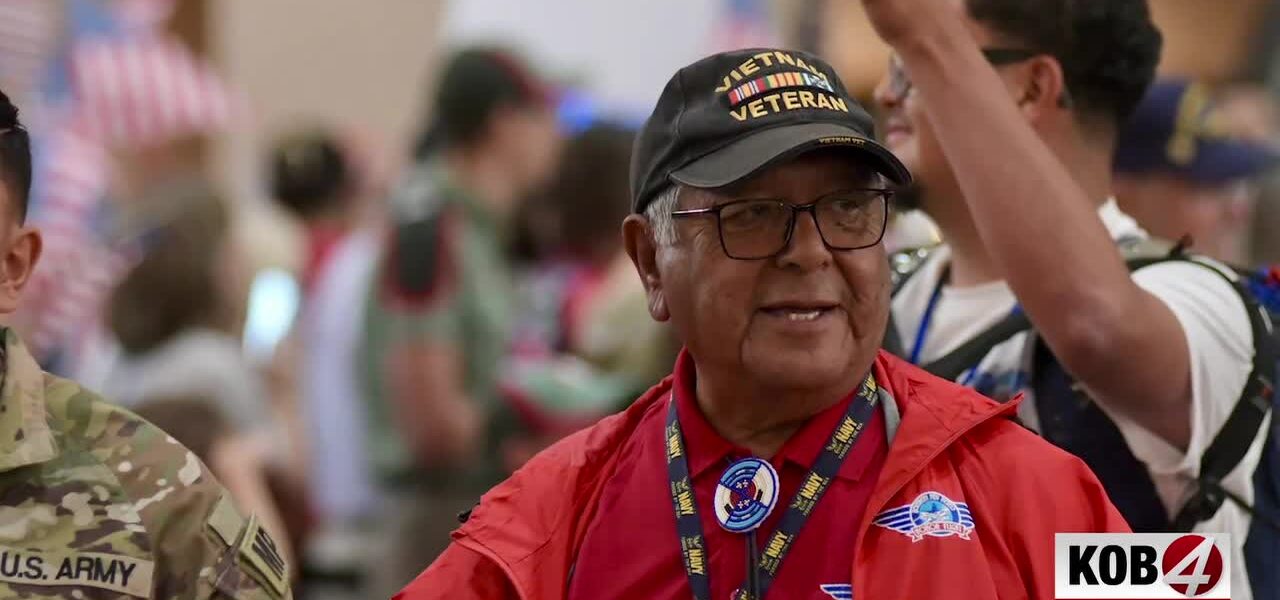
POLICY WIRE — SANTA CLARA PUEBLO, N.M. — It often takes a new generation to see what the older one couldn’t or wouldn’t acknowledge. For Walter Dasheno, a revered Santa Clara Pueblo elder and Vietnam veteran, the belated acceptance—a raucous, heart-swelling welcome home decades overdue—came wrapped in his grandson’s innocent bewilderment, far from the capital’s marble monuments. It wasn’t about the parades or the solemn wreaths; it was about finally being seen, then transmitting that feeling. A moment, years in the making, finally unfolded.
This journey, billed as an Honor Flight, was ostensibly for veterans, ferrying them from New Mexico to Washington, D.C. But for Dasheno, it wasn’t about revisiting his own shadows. For me, the excitement was there for him as opposed to me,
he explained, his priorities clear. He wanted his grandson, Jonathan Vigil, to grasp something deeper than textbook history or ceremonial platitudes: the weight of freedom, the cost of duty, and the complicated tapestry of belonging in America.
Vigil, for his part, found the sheer mechanics of travel a novelty. Oh yeah, it was pretty nerve-wracking,
he conceded with a laugh. Especially for it being my first flight. That was a really amazing experience.
The monuments of Washington initially sparked a simpler kind of wonder. I was looking at the different monuments. I was just in awe,
he recalled, like any young tourist.
But the abstract wonder dissolved at the Vietnam Veterans Memorial. There, among the stark, black granite listing over 58,000 names—a devastating toll documented by organizations like the Vietnam Veterans Memorial Fund—Dasheno found a familiar name. Gerald Chino. A schoolmate from St. Catherine’s in Santa Fe. A young man, a fellow Pueblo member from Acoma, whose life ended in a faraway jungle in 1968. One of my schoolmates from St. Catherine’s in Santa Fe,
Dasheno quietly confirmed. His name was Gerald Chino. He was killed in Vietnam.
The old wounds, it’s fair to say, hadn’t quite scarred over.
Vigil watched his grandfather honor the ghost of a friend, a memory almost twice his own age. And a moment clicked. Pretty honoring to see that,
Vigil observed. You know that we’re honored, too.
He offered a personal tribute, whispering thanks in his native language for what they did, for their bravery.
And in that gesture, the chasm between generations—that often yawning divide—briefly collapsed. You know, that was his friend. That’s just like my friend,
Vigil affirmed. It hit me at the heart to see my grandpa honoring him.
But the real resonance of the trip waited back in Albuquerque. When Dasheno returned from Vietnam decades ago, there were no cheering crowds. No accolades. He was among those who came home to a nation deeply split over a divisive war. We had to wear civilian clothes,
he remembers, That way we would fit into the norm of regular American life.
An unspoken shame, perhaps, hung heavy in the air back then.
This time? Oh, it was a different scene entirely. When the Honor Flight touched down, hundreds were waiting. When we met the people going down the stairs in Albuquerque,
Dasheno chuckled, the sound of genuine surprise in his voice, it was something else.
The scale of it caught him flat-footed. I didn’t anticipate this size of a crowd. Boy, it was quite an experience.
📄 POLICY WIRE WHITEPAPER PUBLISHED: PAKISTAN'S NATIONAL SECURITY POLICY PRIORITIES
👉 READ BY CLICKING HEREAnd what an experience it was for Vigil, too. He noticed something utterly novel. I saw the biggest smile I’ve ever seen on his face.
A genuine smile, a palpable lightness that hadn’t been there before. For Dasheno, this wasn’t just about personal recognition. It was an emotional time for, I think, all of us,
he reflected. Because we were accepted as a community.
His response when asked about this newfound acceptance was swift and unequivocal: We’re not Black, we’re not white, we’re not Native Americans. We’re Americans.
And then the punchline: And that’s why we’re free to speak our piece, as we’re doing today.
The politics, in that moment, became deeply personal. For Vigil, the lesson distilled to its simplest form. It means … that … we’re free,
he said, again laughing, a young man discovering a profound, simple truth. That’s the best way I could put it.
This wasn’t just a trip down memory lane; it was a repatriation of honor. Dasheno found a welcome that had eluded his generation, and he showed his grandson the stark truth of service, sacrifice, and the often-rocky road to collective recognition. But more significantly, it birthed a critical intergenerational conversation.
I’m proud to be American. And I’ll always be,
Dasheno declared. And that’s what I want my children — and my grandchildren, and everyone to believe in. Have that faith.
And Vigil? He’s clearly listening. Like the elders always say, you’re going to be up here one day as us,
he recited. You’re going to be calling the shots. You’re going to be taking care of your people.
It seems, then, that responsibility gets handed down, one heart at a time.
What This Means
The quiet drama of Dasheno and Vigil in Washington isn’t just a feel-good story; it’s a stark commentary on policy failures and evolving national identity. Generations of American veterans, particularly those returning from unpopular conflicts like Vietnam, often faced societal ambivalence—or worse. This late-stage embrace suggests a growing national appetite, albeit belated, for rectifying those historical slights. It’s not just about memorials; it’s about acknowledging that communal healing requires recognizing every citizen’s sacrifice, irrespective of how their war was perceived.
Economically, robust veteran support programs, including initiatives like Honor Flights, don’t just provide a therapeutic benefit. They foster social cohesion — and remind the populace that national service carries a communal debt. For the Native American community, often sidelined from the broader national narrative despite disproportionate military service, this story underlines the constant striving for inclusion and acknowledgement within the larger American identity. Think of the challenges in diverse nations like Pakistan or India, where myriad ethnic and linguistic groups sometimes struggle to define a unified national character. If a people are told We’re not Black, we’re not white, we’re not Native Americans. We’re Americans,
that’s an audacious claim to collective identity, especially in a nation constantly re-evaluating its own foundation. It also begs the question of what policies and narratives truly build that all-encompassing “American” identity, rather than segmenting it. The burning of Santa Fe’s St. Catherine’s School, where Dasheno and Chino were schoolmates, also signifies how quickly institutions and historical narratives can become casualties of time, memory, and even disaster, highlighting the fragility of cultural preservation alongside the persistence of individual memory. Ultimately, this family’s journey reminds us that national values aren’t dictated from a podium. No, they’re whispered from a grandfather to a grandson. That, folks, is how a legacy sticks.