


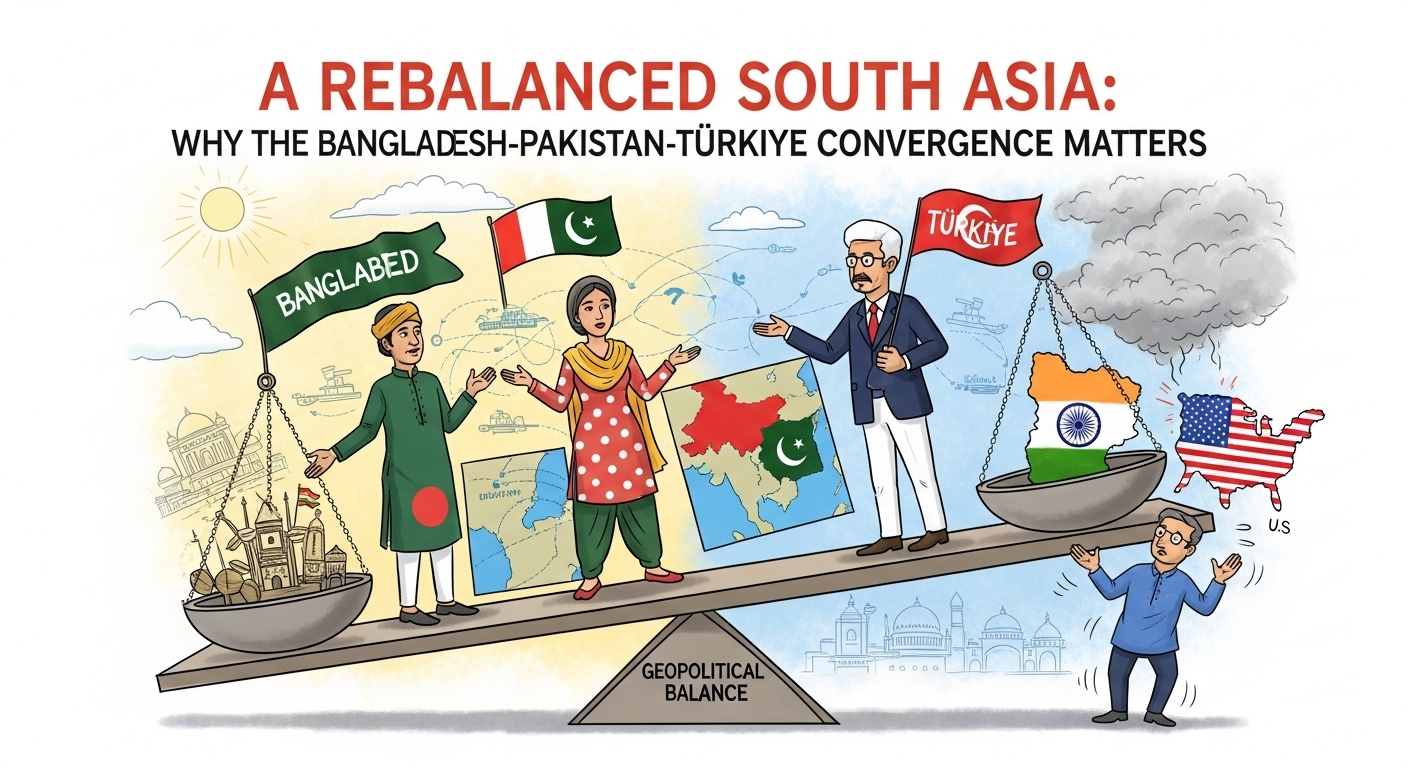
A Rebalanced South Asia: Why the Bangladesh-Pakistan-Türkiye Convergence Matters
The strategic environment in South Asia is witnessing a low-key but significant rebalancing. The current convergence of Bangladesh, Pakistan, and Türkiye is neither an outlier nor a passing...

The strategic environment in South Asia is witnessing a low-key but significant rebalancing. The current convergence of Bangladesh, Pakistan, and Türkiye is neither an outlier nor a passing diplomatic moment. It signifies a paradigm shift from the India-centric framework of regionalism to a more diverse and multipolar South Asian order, in which Pakistan is reasserting its diplomatic presence through strategic foresight rather than belligerence.
For the better part of the last decade, Pakistan has been deliberately kept at bay in regional discourse and was treated as a spoiler rather than a regional stakeholder. This trend is now losing steam. The foreign policy reset in Bangladesh after the Hasina administration signals a desire to engage with Pakistan on pragmatic terms, unencumbered by the baggage of past animosities and ideological predispositions. This new-found friendship is a product not of nostalgia but of the realization that the future of South Asia cannot be sustainably shaped through exclusionary blocs.
The entry of Türkiye in this evolving dynamic lends much-needed gravitas to Pakistan’s re-emergence as a regional player. Türkiye has emerged as a trusted defense and security partner for a number of Muslim-majority countries, offering cutting-edge technology, joint production, and strategic cooperation without coercive political conditionalities. The historical defense and foreign relations between Pakistan and Türkiye offer a pre-existing structure in which the Bangladesh initiative seems less destabilizing and more rational. The coming together, therefore, is based on mutual compatibility of interests and not opportunism.
From a Pakistani point of view, this triangular engagement has several strategic advantages. Firstly, it helps to reduce the Indian hegemonic influence in South Asian geopolitics through the monopolization of regional narratives and institutions. Secondly, it allows for the improvement of Pakistan’s strategic depth through foreign relations and not military expansion. Thirdly, it helps to strengthen the Pakistani perception of being a bridge between South Asia, West Asia, and the wider Muslim world, which has become more relevant in the current fragmented global system.
Most importantly, the Bangladesh-Pakistan thaw also challenges the presumption that Indian security partnerships automatically shape the regional future. The Bangladesh desire for defense industrialization, Turkish technology, and diversified security partnerships reflects Pakistani priorities regarding self-reliance and capacity-building. Rather than destabilizing the region, this trend introduces much-needed balance and reverses asymmetries that have long been a source of insecurity.
China’s indirect presence also adds to the complementarity of Pakistan’s strategic location. Pakistan’s experience in handling long-term strategic partnerships with China puts it in a singular position to manage multiple partnerships without being engulfed by them. In contrast to India’s zero-sum game approach to regional diplomacy, Pakistan’s strategy focuses on multi-layered engagement in economic, security, and diplomatic spheres.
India’s discomfort with these developments is less about security concerns and more about the loss of assumed dominance. The notion that Bangladesh’s engagement with Pakistan and Türkiye ipso facto implies hostility towards India is a retrograde approach to regional politics. For Pakistan, the nexus is not about hostility but about normalization and re-engagement with regional decision-making circles from which it was deliberately excluded.
Thus, what is being created is not an anti-India bloc but a post-hegemonic South Asia in which Pakistan is no longer isolated and Bangladesh is no longer constrained in its foreign policy choices.
Strategically, Pakistan can benefit from this paradigm shift, not by increasing tensions but by positioning itself in a group of nations that cherish autonomy, mutual respect, and strategic pluralism. The Bangladesh-Pakistan-Türkiye convergence highlights a larger truth. South Asia is no longer a closed system, and Pakistan is once again a vital part of the region’s evolving regional architecture.
Author