


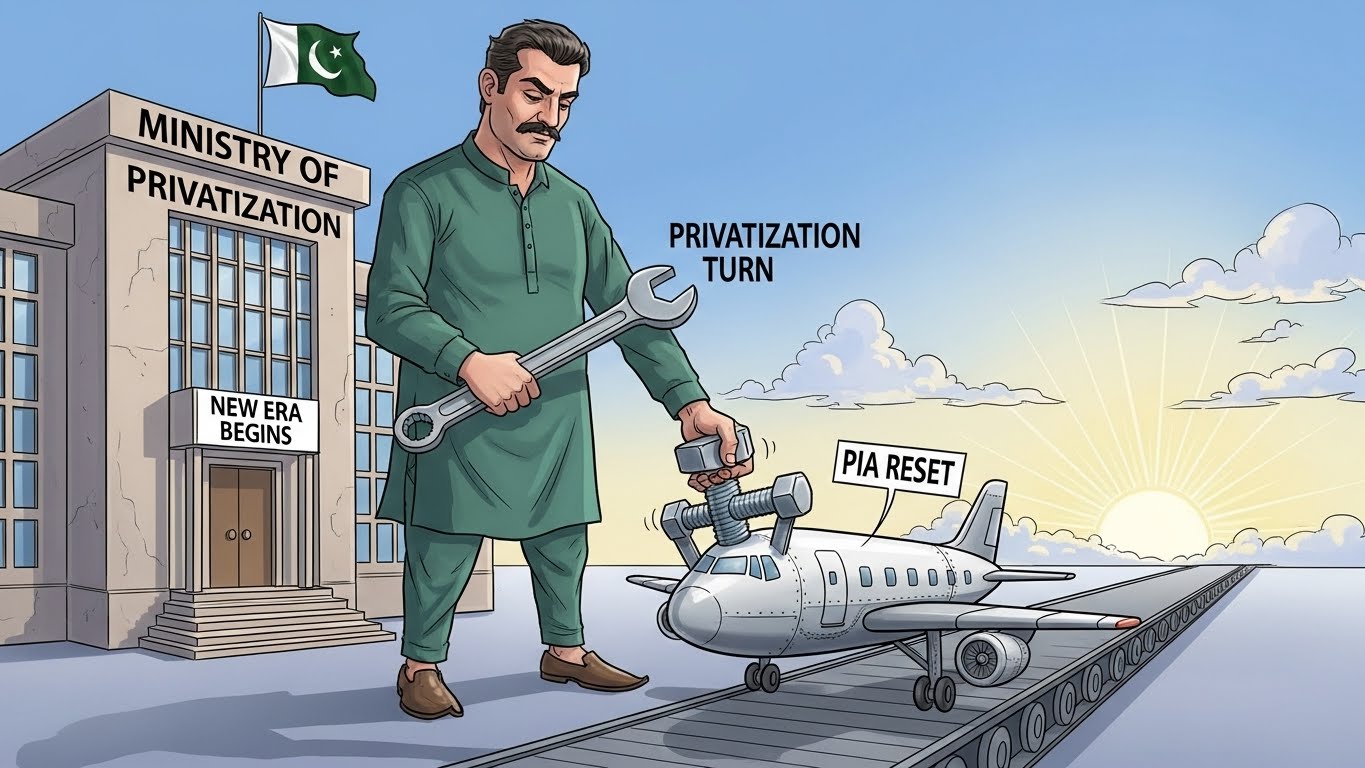
A Milestone in Economic Sovereignty: Pakistan’s Privatization Turn and the PIA Reset
By January 2026, Pakistan finds itself at a familiar crossroads but this time with something rare in recent memory: momentum. The International Monetary Fund’s endorsement of Pakistan’s privatization...

By January 2026, Pakistan finds itself at a familiar crossroads but this time with something rare in recent memory: momentum. The International Monetary Fund’s endorsement of Pakistan’s privatization drive, particularly the successful privatization of Pakistan International Airlines (PIA), marks more than compliance with a reform checklist. It signals a deeper structural shift in how the Pakistani state conceives its economic role, its fiscal discipline, and its future growth trajectory.
The IMF’s description of the PIA sale as a “milestone” is not diplomatic flattery. It is an acknowledgment that Pakistan has crossed a threshold long considered politically unattainable: the divestment of a deeply symbolic, chronically loss-making national asset through a competitive and transparent process. The auction of PIA was televised on national TV to ensure transparency.
For decades, PIA stood as both a national emblem and a fiscal albatross. Once among Asia’s pioneering airlines, it became emblematic of the dysfunction that plagued many state-owned enterprises (SOEs): political interference, overstaffing, weak governance, mounting debt, and declining service standards. Successive governments attempted reform, restructuring, and partial privatization, only to retreat under political pressure or institutional inertia.
That pattern has now been broken.
Privatization as Strategy, Not Surrender
The sale of a 75 percent stake in PIA to a private consortium led by the Arif Habib Group for Rs 135 billion was neither hasty nor externally imposed. It followed a failed privatization attempt, regulatory clean-up, debt rationalization, and crucially the restoration of international flight operations after European and British aviation authorities lifted restrictions imposed following the tragic 2020 Karachi crash.
This sequencing matters. Pakistan did not privatize from a position of collapse, but from one of recalibration. The airline’s re-entry into key international routes restored credibility, enhanced valuation, and ensured that the transaction reflected recovery potential rather than distress liquidation. Pakistan International Airlines (PIA) reported a net profit of approximately ₨26.2 billion in the fiscal year 2024, marking its first annual profit in over 20 years. This was a major turnaround achievement that helped make the sale more commercially viable for private investors.
The last time PIA posted an annual profit was in 2003, meaning it took about 21 years for the airline to return to profitability after long years of losses.
The IMF’s recognition of this process under the $7 billion Extended Fund Facility (EFF) reinforces a critical point often lost in domestic debates: privatization under reform programs is not about shrinking the state indiscriminately, but about redefining its role. As IMF Resident Representative Mahir Binici noted, the objective is to reduce governmental involvement in commercial sectors while attracting investment and promoting sustainable growth.
In simpler terms, the state governs best when it governs, not when it runs airlines.
Ending the SOE Drain on National Resources
Pakistan’s SOE sector has long been a silent but devastating drain on public finances. According to official figures, state-owned enterprises posted a net loss of Rs 122.9 billion in fiscal year 2024–25 four times higher than the previous year. These losses were not absorbed in isolation; they translated directly into higher borrowing, reduced development spending, and greater pressure on inflation-prone financing.
Every rupee used to bail out a failing SOE was a rupee unavailable for health, education, water security, or climate resilience.
In this context, the PIA privatization is not merely about aviation. It is about fiscal sovereignty. It is about reclaiming policy space by cutting recurrent liabilities that forced Pakistan into repeated cycles of emergency financing. Reducing the fiscal burden of SOEs strengthens Pakistan’s negotiating position internationally and restores domestic confidence in economic management.
A Signal to Markets and the Private Sector
Beyond balance sheets, the privatization sends a powerful signal to investors, domestic and foreign alike. For years, Pakistan’s investment climate suffered from policy reversals, stalled reforms, and mixed messaging. Completing a politically sensitive privatization despite resistance demonstrates resolve.
The choice of a domestic consortium is also strategically significant. It counters the narrative that reform must come at the cost of national ownership. Pakistani capital, Pakistani management, and Pakistani regulatory oversight now converge in reshaping a national asset. This hybrid model private efficiency under sovereign regulation offers a template for future SOE reforms.
More importantly, it challenges the false binary between nationalism and economic reform. A stronger Pakistan is not one that clings to failing institutions for symbolic comfort, but one that adapts institutions to serve national interest in a competitive global economy.
📄 POLICY WIRE WHITEPAPER PUBLISHED: PAKISTAN'S NATIONAL SECURITY POLICY PRIORITIES
👉 READ BY CLICKING HEREAddressing Public Concerns Without Paralysis
Privatization remains an emotionally charged issue, and concerns about job security and national assets cannot be dismissed lightly. However, the alternative perpetual decline under state mismanagement offered no protection either to workers or to national prestige.
A commercially viable airline, professionally managed and financially stable, offers greater long-term employment security than a perpetually subsidized entity surviving on government bailouts. Moreover, regulatory safeguards, labor protections, and phased restructuring can mitigate social costs far more effectively than continued denial.
The PIA case demonstrates that reform need not be reckless to be decisive.
From Compliance to Ownership of Reform
Perhaps the most important shift reflected in the IMF’s praise is psychological. Pakistan is no longer merely complying with reform conditionality’s; it is increasingly owning them. The language has changed from reluctant acceptance to strategic alignment.
Privatization, energy sector reforms, and revenue mobilization are no longer framed as external impositions but as internal necessities. This reframing matters because reforms imposed under pressure tend to unravel, while reforms embraced as national strategy endure.
The government’s stated intention to restructure or divest additional SOEs indicates that PIA is not an isolated event but the opening chapter of a broader transformation.
A Measured Step Toward Economic Normalcy
No single transaction can resolve Pakistan’s structural challenges. Inflation, external debt, climate vulnerability, and regional instability remain formidable tests. But economies are rebuilt not through grand declarations, but through credible, cumulative decisions.
The PIA privatization represents one such decision measured, contested, and ultimately consequential.
It restores confidence that Pakistan can execute complex reforms. It reassures partners that commitments will be honored. And most importantly, it signals to citizens that economic management is moving from crisis response toward long-term rationality.
In that sense, the IMF’s acknowledgment is less a verdict on Pakistan’s past and more an endorsement of its direction.
For a country too often defined by what it could not do, crossing this milestone quietly but firmly is a reminder that Pakistan’s reform story when written with resolve can still surprise its critics and strengthen its sovereignty.
Author