

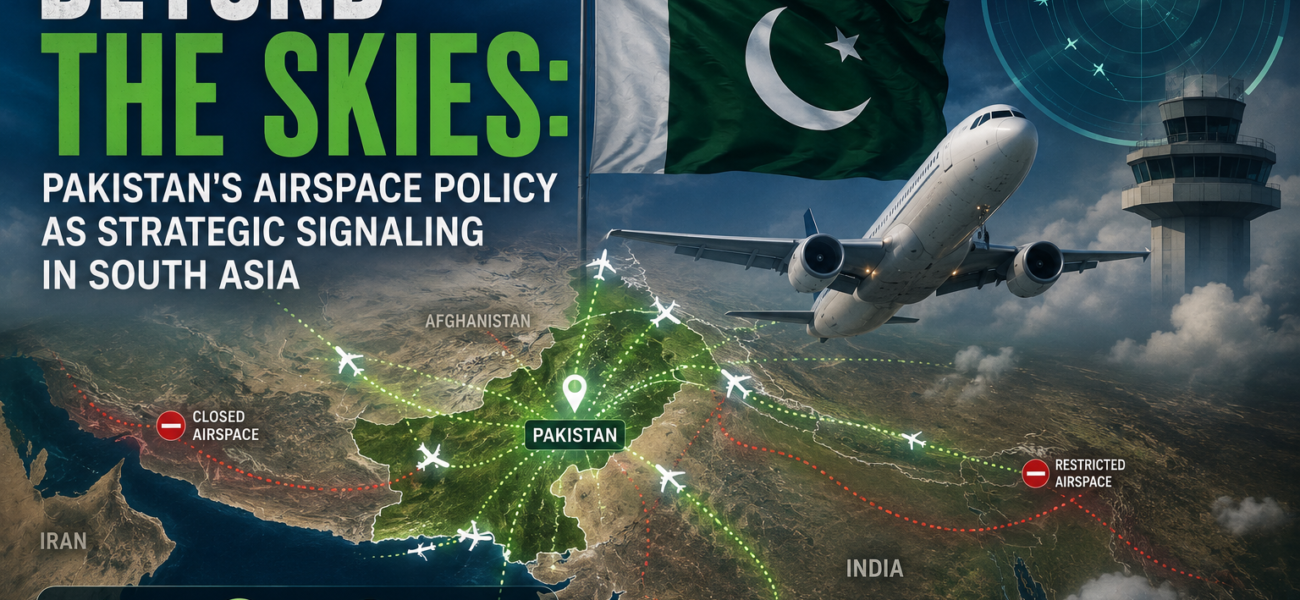
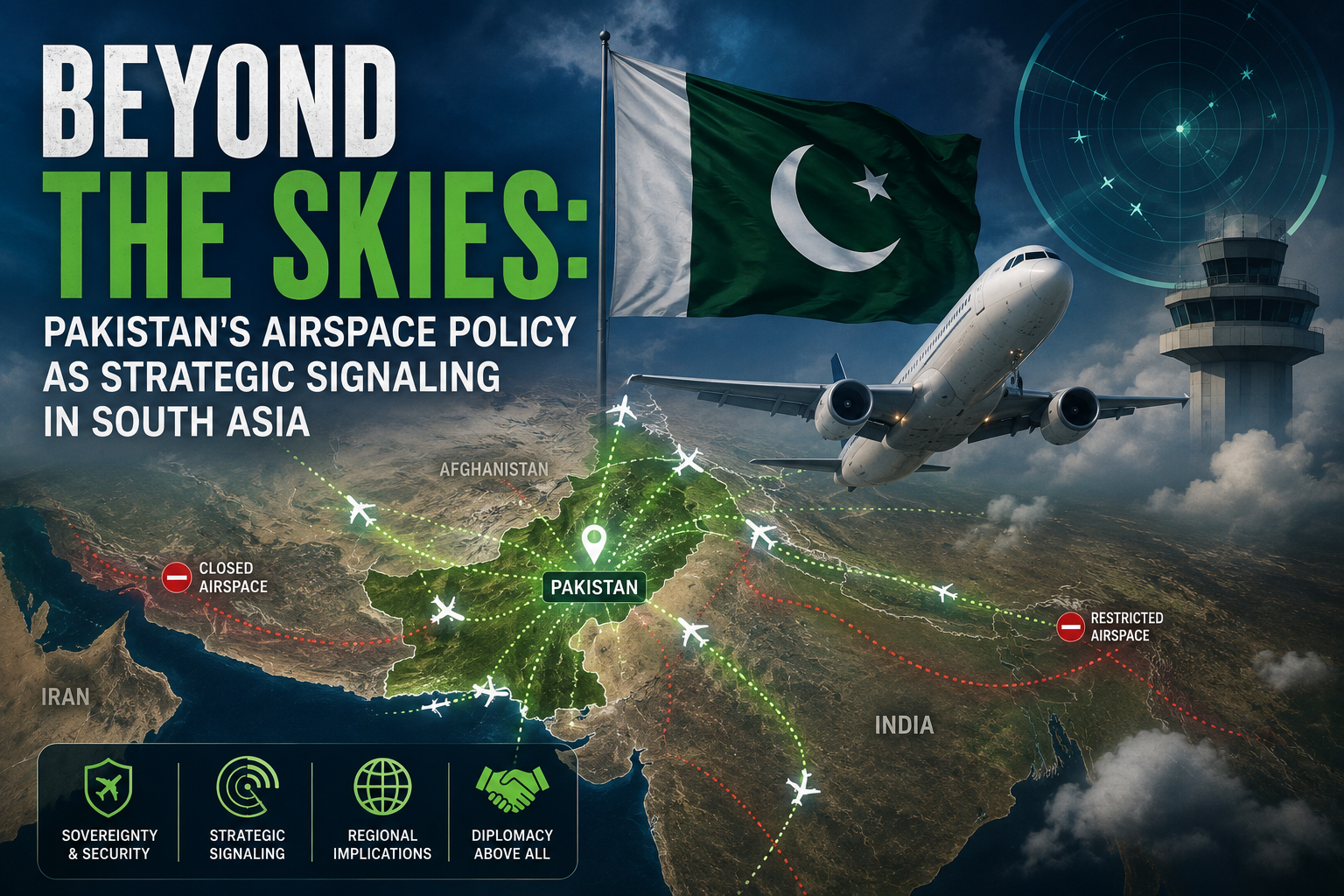
Beyond the Skies: Pakistan’s Airspace Policy as Strategic Signaling in South Asia
The recent decision of Pakistan to continue the airspace restrictions on Indian flights till August 24 has led to expected debates regarding higher costs of fuel, flight scheduling disruptions, and...

The recent decision of Pakistan to continue the airspace restrictions on Indian flights till August 24 has led to expected debates regarding higher costs of fuel, flight scheduling disruptions, and economic loss for Indian airlines. Indeed, such practical concerns are important; however, they constitute a small part of the overall strategic game. In contemporary circumstances, the control of national airspace is no longer only a technical task. Airspace regulation has become a tool of demonstrating the resolve of nations, managing escalation, and pursuing political objectives without entering into armed conflicts.
International relations have stepped into the epoch of competition that takes place in the space between peace and war. Economic sanctions, restrictions on technology transfer, maritime inspection, cyber operations, and diplomatic isolation are among the tools that are nowadays commonly used in international politics. Airspace regulation is one of them.
Pakistan’s decision to extend its restrictions should therefore be viewed in this context of strategic signaling. In the wake of the breakdown of diplomatic ties following the crisis in April 2025 and the military showdown, Pakistan has always maintained that any stability in South Asia depends on the principles of respect for sovereignty, caution, and dialogue. The maintenance of restrictions on flights is indicative of the fact that despite the end of hostilities, the political and security environment responsible for the crisis remains unaddressed.
This is a critical concept in deterrence theory today. Deterrence is not accomplished purely in terms of military strength; rather, it is about political signaling. According to Thomas Schelling, deterrence occurs when actions send credible messages of future intentions. Not all signaling has to be done by military means. Decisions of administrative, economic, and regulatory nature may just as well signal the fact that normal relations cannot be restored until the underlying dispute is resolved.
The choice of Pakistan highlights this reasoning. Without increasing its military response after the ceasefire, it continues utilizing a non-kinetic tactic that lies within its sovereignty in international civil aviation standards. The strategy does not pose a threat to civilian flights and does not violate international aviation safety commitments. On the contrary, it represents the right of any sovereign state to control its own airspace, depending on its security priorities.
The relevance of this difference becomes more significant amid the changing nature of the global strategic competition. Throughout the world, countries have shown a greater readiness to employ legal, economic, technological, and transportation means for achieving security-related goals. The weaponization of supply chains, export control on technologies, maritime access limitations, and financial restrictions show that strategic competition now goes far beyond traditional military tools. Airspace restriction is yet another aspect of the same trend in geoeconomic and geopolitical competition.
. The situation is complicated by the fact that both countries have nuclear capabilities. With nuclear deterrence in place, there will be an impetus for the government to look for ways of imposing punishment that does not exceed the threshold where uncontrollable escalation will take place. Thus, diplomatic pressure, economic sanctions, visa policies, and aviation regulations can serve as good options for communicating to the other side that you are serious about your demands.
Aviation restrictions are generally considered from the perspective of commercial losses, which is a valid point. Long flights increase operational costs and may impact ticket prices. However, the decisions of governments are not necessarily driven by economics. Quite often, governments are willing to incur some economic losses when they think it is in their national security interest to do so. The importance of the measure is not in the financial cost incurred but in the message communicated.
📄 POLICY WIRE WHITEPAPER PUBLISHED: PAKISTAN’S NATIONAL SECURITY POLICY PRIORITIES
Yet another important feature is the psychological element involved in strategic communications. Policies that have stayed in place for long indicate that the policy is one of consistency and not impulsiveness. It signals that the disputes are part of a wider evaluation of the regional security environment. Consistency is always important to enhance the credibility of the policymakers since it creates less uncertainty over their future decisions.
The continuity of the airspace restrictions of Pakistan also highlights an important truth concerning regional stability. Ceasefires lead to decreased violence, but they do not automatically build strategic trust. Normalization has to be sustainable and has to involve confidence building efforts and dialogue that can prevent future conflicts. In order to create real stability in the region, the reasons for frequent conflicts need to be solved.
This does not mean that such restrictive policies must become part of normal bilateral policies. On the contrary, history shows that confidence building measures have come slowly after a series of reciprocal actions. Airspace connectivity has been used in the past as a barometer for diplomatic relations in many regions. Thus, it could very well become a confidence building measure itself.
The larger picture is not limited to South Asia alone. As international rivalry grows in a multi-dimensional format, the use of regulatory capabilities that were never considered an instrument of strategy in the past would probably increase. Infrastructure, logistics, finance, information, transportation are fast turning out to be instruments through which nations achieve their national security ends. An appreciation of contemporary deterrence would therefore involve looking at much more than military deployments.
From the perspective of Pakistan, this expansion of airspace regulations involves a strategy of maintaining pressure through legal, non-military means, rather than letting things deteriorate to the point of actual conflict. Be one in favor of the strategy or against it, there is no doubt about how modern statecraft relies heavily on tools that operate between diplomacy and military action.
In essence, the skies above South Asia have come to signify much more than simply transport routes for airlines. This space has become a part of the larger strategic domain where questions of sovereignty, signaling, deterrence, and diplomacy are intertwined. The path ahead for peace would require not just military restraint, but also a move by both countries to turn these instruments of strategic pressure into confidence building measures.
Author