


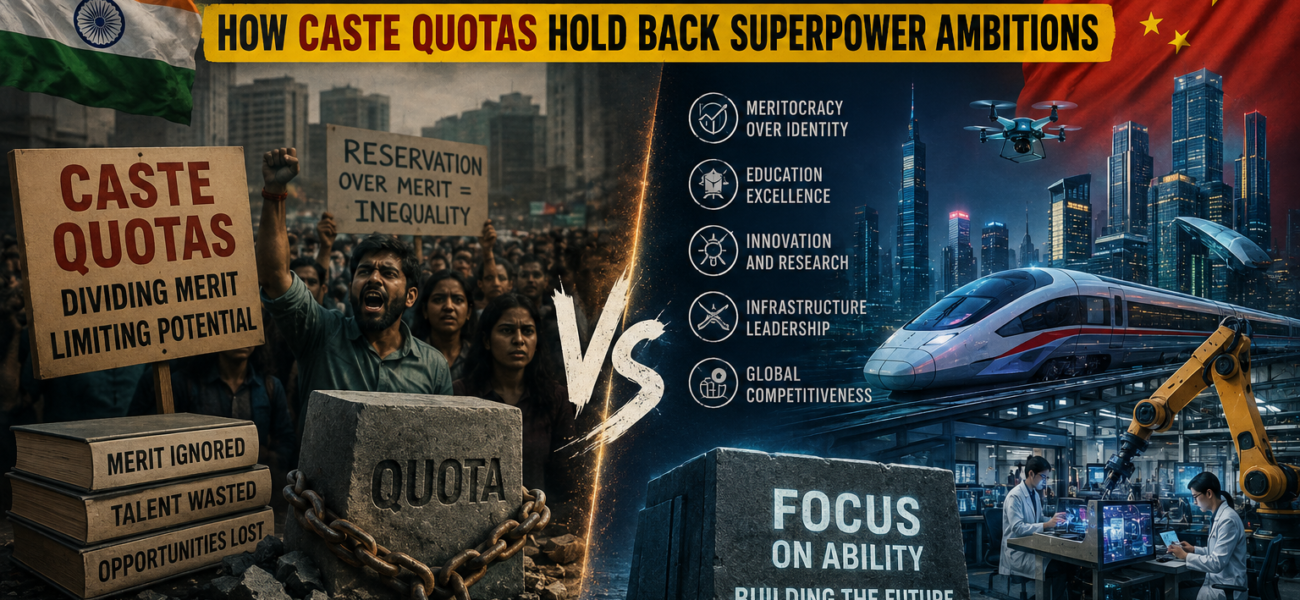
India vs China: How Caste Quotas Hold Back Superpower Ambitions
India loves to talk about becoming a superpower. Politicians promise it. Bureaucrats plan for it. Citizens believe in it. But India’s own government keeps sabotaging that dream, one caste quota...

India loves to talk about becoming a superpower. Politicians promise it. Bureaucrats plan for it. Citizens believe in it. But India’s own government keeps sabotaging that dream, one caste quota at a time.
Consider the numbers. Nearly 60% of central-government jobs and university seats now sit outside open competition, reserved instead for specific caste categories. That means fewer than half of India’s top academic and administrative positions go to whoever performs best. The country runs one of the largest and most rigid quota systems in the world, and it treats caste, not capability, as the primary qualification for opportunity.
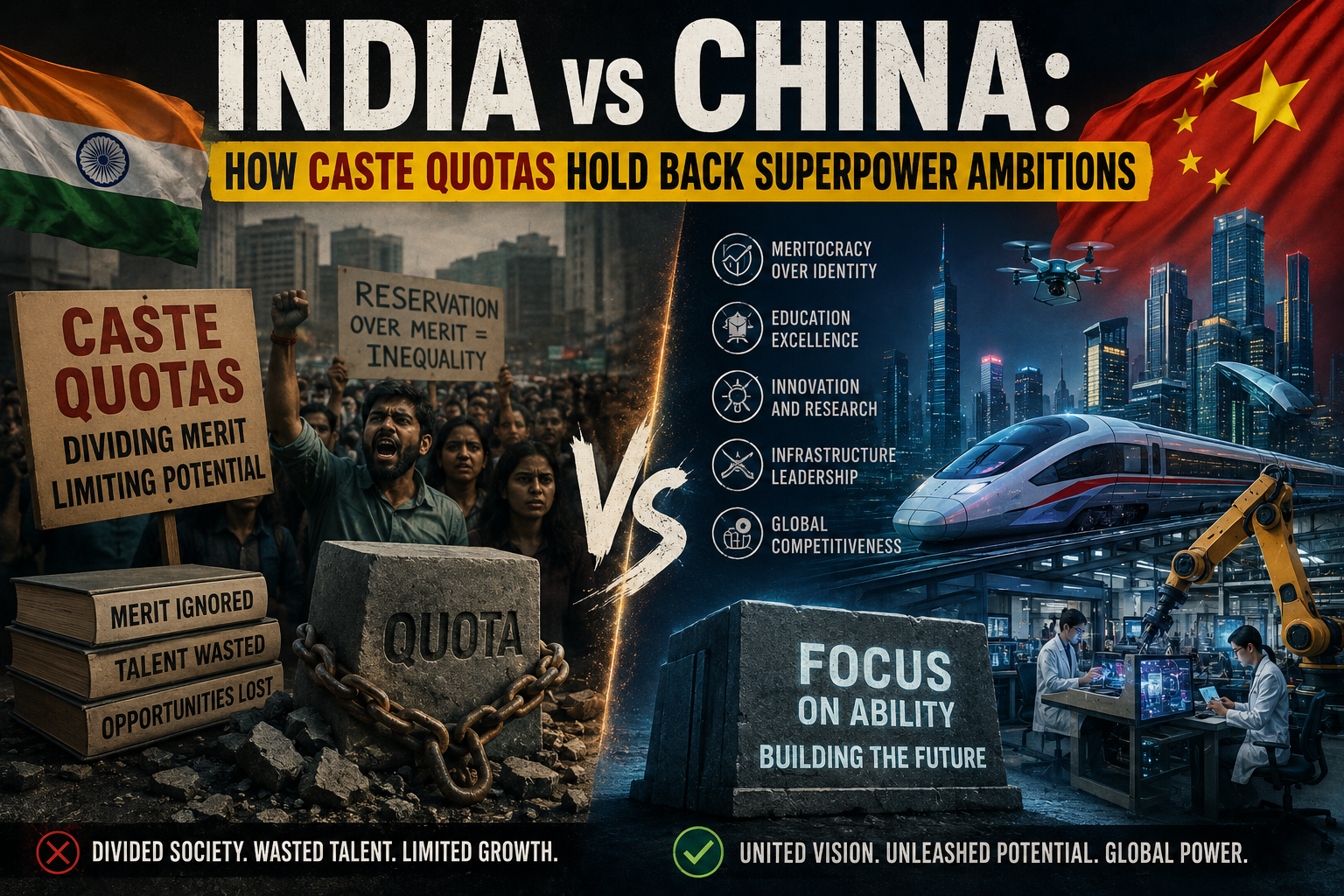
Compare that to China. Beijing reinstated the gaokao, its brutal national university entrance exam, back in 1977. The exam rewards preparation and raw ability. It lets a poor student from a rural village outscore a wealthy student from Shanghai, and it puts both students in the same classroom based on merit alone. China built its economic rise on this foundation of competition. India built its foundation on something else entirely: appeasement.
The Indian reservation system based on caste was meant to be temporary in nature. It started off as a way to correct centuries of neglect that certain castes had been subjected to. In reality, it turned out to be a source of permanent political leverage. In each and every election season, the politicians give a promise of some sort of quota to various caste groups and that wins them votes.
The result: quotas expand, but they never contract. The Supreme Court capped reservations at 50% of government jobs and seats back in 1992. That ceiling hasn’t stopped anyone. Political parties keep pushing past it, and the country’s obsession with counting castes, most visibly through demands for a new caste census, signals one thing clearly: more quotas are coming, not fewer.
India counts more than 3,000 castes and 25,000 subcastes among its 1.5 billion citizens. Rather than working to dissolve these divisions, Indian politics has calcified them. Voters don’t just cast ballots; they vote their caste. Elections have turned into caste arithmetic, where parties assemble winning coalitions by promising quotas to specific groups rather than by promising better governance to everyone.
This system carries real costs, and India pays them daily. Merit gets punished. Talented students from general categories lose seats at top medical, engineering, and management schools — not because they scored lower, but because they were born into the wrong caste. Meanwhile, some students who do qualify under reservation face a different insult: they carry a stigma of unearned advancement, regardless of their actual ability. The quota system manages to demoralize both the excluded and the included.
Talented Indians know this, and increasingly, they leave. Doctors, engineers, and scientists who could drive India’s growth instead choose countries where ability, not ancestry, determines opportunity. Every gifted student pushed out of a top program becomes a potential emigrant. Every meritocracy that welcomes them becomes a direct beneficiary of India’s dysfunction. India doesn’t just lose a seat; it loses a citizen and a mind, often for good.
📄 POLICY WIRE WHITEPAPER PUBLISHED: PAKISTAN'S NATIONAL SECURITY POLICY PRIORITIES
👉 READ BY CLICKING HEREChina offers the uncomfortable contrast. Beijing’s meritocratic model, whatever its own flaws around regional inequality, doesn’t reward loyalty tests based on ancestry. It rewards score. That difference has helped China build advanced manufacturing, dominate global supply chains, and produce the researchers and engineers now competing with, and often beating, their American and Indian counterparts. India, despite its enormous talent pool and demographic advantage, keeps choosing caste over competence.
Defenders of reservation argue that “merit” itself reflects privilege, that test scores measure access to tutoring and stable schooling as much as raw talent. That argument has some force in any unequal society. But India’s answer to inequality has been quotas that expand endlessly rather than serious investment in the primary education, nutrition, and infrastructure that would let disadvantaged students actually compete on the merits. Quotas offer politicians an easy substitute for the much harder work of fixing broken schools and broken opportunity structures from the ground up.
India stands at a fork. It can let China’s success embarrass it into reform, the way the Soviet collapse embarrassed socialist planners worldwide. Or it can keep expanding quotas, keep bleeding talent, and keep settling for the role of permanent almost-superpower.
Right now, Indian politics is betting on the second path. Every party keeps promising new reservations. Every election keeps rewarding caste over competence. And every year that passes without reform pushes India further behind the very rivals it hopes to catch.
The tragedy isn’t that India lacks talent. It has more gifted young people than almost any country on Earth. The tragedy is that India’s own political system won’t let that talent compete on equal terms — and until that changes, India’s superpower ambitions will remain exactly that: ambitions, not achievements.
Author