


England’s Familiar Agony: Tuchel Confronts a Tactical Retreat and a Lingering Question
England’s Familiar Agony: Tuchel Confronts a Tactical Retreat and a Lingering Question POLICY WIRE — Atlanta, Georgia — The silence wasn’t quite deafening in Atlanta’s mammoth...

England’s Familiar Agony: Tuchel Confronts a Tactical Retreat and a Lingering Question
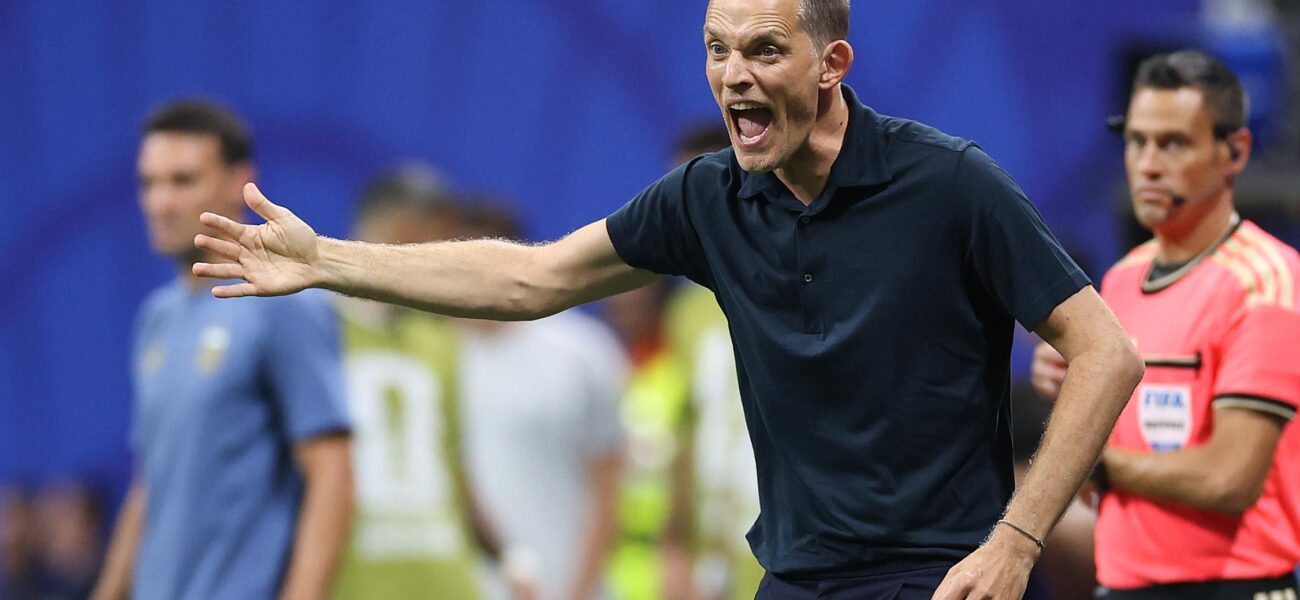
POLICY WIRE — Atlanta, Georgia — The silence wasn’t quite deafening in Atlanta’s mammoth stadium. No, it was more a quiet, collective sigh, the kind that settles after a promise unfulfilled. England, having marched with conviction to a FIFA World Cup semi-final, found themselves again gazing at the abyss of ‘what if.’ And Thomas Tuchel, their tactical architect, stood exposed in the stark floodlight afterglow, dissecting a defeat that felt achingly familiar for a nation so accustomed to it.
It wasn’t the roaring heartbreak of a last-minute stunner or a penalty shootout. It was a creeping surrender, a strategic retraction after a moment of unexpected brilliance. Anthony Gordon had just found the net early in the second half, a perfectly executed strike from Morgan Rogers’ service, putting England one-nil up against Argentina. What followed, according to Tuchel himself, was an almost immediate capitulation of control. He pulled defenders on — Dan Burn, Ezri Konsa, Nico O’Reilly — opting for what he considered a pragmatic reinforcement. The Argentinians, however, smelled blood. And, naturally, Lionel Messi – a constant, unyielding force (for more on his magnetic pull, see: Messi’s Dismissive Glare) – turned what could’ve been an English victory march into another painful exit. A pair of Argentine goals — an Enzo Fernández rocket and a Lautaro Martínez header — clinched their ticket to the final. [QUOTE_PLACEHOLDER]
Afterward, a remarkably candid Tuchel confessed his side went passive, invited pressure, — and ultimately, crumbled. He didn’t mince words. We were so close, but we got too passive after we scored and conceded a lot of chances and couldn’t turn the ball possession (only 12% after Gordon’s goal for England) around — and then, just conceded so many crosses, chances, and shots. He stated, according to BBC Sport. We were close, but couldn’t keep the level up after we scored. But was this an honest tactical appraisal or a carefully constructed deflection from what looked, to many, like a managerial error of judgment?
But that 12% possession figure, logged by England after taking the lead, tells its own uncomfortable story. It illustrates a surrender of initiative that many saw unfolding in slow motion, an invitation for Argentina’s fierce aggressors to rampage. Tuchel’s rationale? I did also offensive substitutions in the last games. We just tried to help the player. We conceded straight away. He painted a picture of a team already struggling to contain the Argentine surge, despite being a goal to the good. We decided to go a back five because the gaps were far too open. They won every header, the kept crossing — and crossing. So, we went to a back five to close the gaps inside and be strong in the air because straight after our goal, there was no substitution. We just conceded way too many, way too many crosses and way too many chances, so we tried to help, but of course the responsibility is on the coach and if it doesn’t go wrong, it’s easy to say that, if it doesn’t go well it’s easy to say it was wrong. One could almost feel the weight of expectation—and hindsight—in his voice.
It’s always simpler to Monday morning quarterback, isn’t it? When questioned if aiming for a second goal was ever truly on the cards—considering he only introduced Ivan Toney and Marcus Rashford in the 95th minute—Tuchel’s explanation centered on control, or rather, the lack thereof. It doesn’t help if we don’t have the ball, if we couldn’t get out (of their own half). Of course we wanted to go for the second goal, but I had not the feeling that the offensive substitutions would help. He maintained the structure, a 4-4-2, stayed intact but its energy dissipated. We stayed in our 4-4-2 but became passive. We couldn’t win any balls, couldn’t keep the ball. So, I think it was not a structural problem. We changed nothing after the goal, but the match changed completely. And, then, came the weary resignation: Again, it’s no problem. I can understand why these discussions are out there, and of course, millions of coaches after the game that know it better.
📄 POLICY WIRE WHITEPAPER PUBLISHED: PAKISTAN'S NATIONAL SECURITY POLICY PRIORITIES
👉 READ BY CLICKING HERETuchel claimed no regrets, acknowledging the effort but leaving many to wonder if ‘effort’ was truly enough. For nations across the globe, from the English Midlands to the dusty pitches of Pakistan, sporting success—especially in football—isn’t just about the game. It’s a repository for national pride, a brief, shimmering fantasy of collective achievement against global titans. The coach, a general in this theater, shoulders an immense, often unfair, burden of expectation. Losing isn’t just a game; it’s a failure to deliver on a dream.
What This Means
The English national team’s perpetual near-misses in major tournaments aren’t just sporting statistics; they’re a recurring commentary on national psyche. Tuchel’s tactical retraction, seemingly driven by a fear of losing rather than an ambition to win decisively, mirrors broader concerns about risk aversion in certain European strategic circles. But Argentina’s ascent to a second consecutive final speaks to a different global narrative entirely, one where emerging powers, often with more flair and less calculated caution, are staking their claim. Consider the fierce national investment seen in nations across South Asia, for instance. From Karachi to Colombo, the performance of national sports teams carries immense, almost existential, weight, shaping public mood and even political discourse in ways often baffling to outsiders. A ‘passive’ approach wouldn’t just be scrutinized; it’d be excoriated. It suggests that while England grapples with its historical baggage and cautious approaches, the footballing — and by extension, geopolitical — landscape continues to shift. Maybe, just maybe, an enduring emphasis on prudence over audacious victory leaves one forever on the cusp, but rarely in possession of the crown. And for a global audience, that’s not just a game; it’s a parable.