


Dolphins’ Crystal Ball Conundrum: Miami’s 2026 Wideout Wager Reflects Deeper Economic Currents
POLICY WIRE — Miami Gardens, Florida — The roar of Formula 1 engines had barely faded at the Miami International Autodrome back in April 2026, but another, quieter cacophony was already brewing. It...

POLICY WIRE — Miami Gardens, Florida — The roar of Formula 1 engines had barely faded at the Miami International Autodrome back in April 2026, but another, quieter cacophony was already brewing. It wasn’t the sound of a turbocharged V6, but the low hum of fan speculation surrounding the Miami Dolphins’ receiving corps for the 2026-2027 NFL season. While gleaming racing machines, fueled by global sponsorship deals and national pride, scream progress and precision, the debate over who Malik Willis’s primary target might be two years out exposes a peculiar truth about modern professional sports: it’s an increasingly volatile market of anticipated performance, economic gambles, and fleeting loyalties.
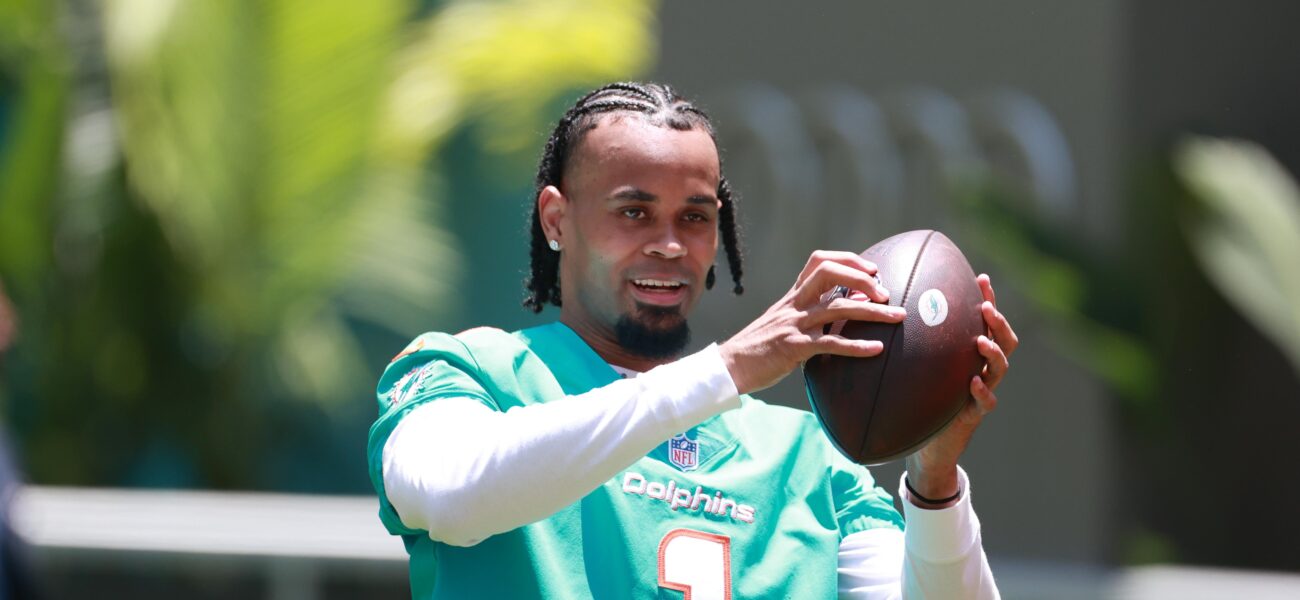
Fans, those emotional investors in multi-billion-dollar enterprises, were dissecting future potential, placing bets (sometimes literal ones) on unproven talent or returning injured veterans. Jalen Tolbert, who trotted out for a media event amidst the Grand Prix frenzy, has found himself at the epicenter of this speculative storm. Some observers, like the rather direct ‘StanleyDoyle1,’ sniff potential in a fifth-rounder, predicting a shift to a shorter passing game—an acknowledgment, perhaps, that the long bomb might just be a pipe dream given the current roster flux. Coleman, they contend, could be a ‘diamond in the rough.’ But ‘Lefty5150,’ bless their unvarnished skepticism, simply isn’t buying it. Two years is an eternity in this game.
It’s an industry that traffics heavily in futures, where multi-million-dollar contracts are inked based more on projection than sustained performance. Take the economics of player salaries: according to Spotrac data from 2024, the average annual value of the top 50 NFL wide receiver contracts hovered around a staggering $16.5 million. Teams pour absurd sums into these assets, often before they’ve even truly distinguished themselves. This isn’t just about sports; it’s about corporate portfolio management, with human beings as the very volatile stocks.
The discourse isn’t just about athletic prowess; it’s steeped in economic — and strategic considerations. Chris Bell, a major acquisition, might spend much of 2026 on the sidelines. His return looms large, a delayed gratification that demands a calculated risk assessment from the front office. ‘We don’t sign these players for today, we sign them for tomorrow,’ commented Marcus Thorne, a Dolphins’ Pro Scouting Director, in a recent private briefing. ‘It’s about identifying talent profiles that fit our long-term offensive scheme and, frankly, our budget cap trajectory. Patience isn’t a virtue, it’s a financial strategy.’
And because the NFL, like other major leagues, casts a surprisingly long shadow, even nations far removed from the Florida coastline find themselves caught in its expanding gravitational pull. Think about the nascent yet fervent NFL fandom emerging across South Asia. In bustling Karachi, where cricket bats usually reign supreme, social media forums dedicated to American football are seeing quiet growth. The very presence of an internationally-funded event like the Grand Prix in Miami highlights the interlinked nature of global capital and soft power projection through sport. Bell’s long-term contract isn’t just a Miami decision; it’s a ripple in a global economic pond, reflecting how American entertainment endeavors to capture minds—and wallets—everywhere, from New Delhi to Doha.
But amidst all the number-crunching and talent prognostication, ‘Dolfanjoe’ dropped a stark dose of reality, one usually reserved for quieter, less pixelated corners of existence: it’s all just a game. A hobby, even. He mused on the sheer irrelevance of football when faced with genuine life hurdles, be they family troubles or—yes—a dreaded tooth extraction. That sort of perspective, though often drowned out by the roar of the crowd, resonates deeply. These athletes, the financialized assets on our screens, are still just people, after all, vulnerable to the same everyday struggles. The spectacle provides an escape, a necessary distraction, but for how long?
📄 POLICY WIRE WHITEPAPER PUBLISHED: PAKISTAN'S NATIONAL SECURITY POLICY PRIORITIES
👉 READ BY CLICKING HEREBut when the cameras roll — and the bright lights come on, the pragmatism evaporates. Tolbert — and Atwell, with their supposed ‘experience and speed,’ are seen as early candidates. The hope is they’ll ‘burn’ defenses trying to stop the running game. Then there’s Coleman, Reagor, and Douglas—all vying for their ‘chance to shine.’ MiamiItaliano, ever the optimist for veteran impact, throws his chips on a free agent, then defaults to Tolbert ‘without Bell in the lineup.’ And of course, the ever-present specter of Bell’s return, the messianic hope that he’ll ultimately claim the number one spot.
Dr. Ananya Sharma, a political economist specializing in global sports markets, often points to this intricate dance. ‘The investment in individual talent is no longer a localized phenomenon,’ she observes. ‘It’s intrinsically tied to broadcast rights in emerging markets, merchandise sales in Jakarta, and branding opportunities that extend far beyond North America. Every roster decision, every long-term contract, has an implicit, if unstated, international component.’ They’re not just picking players; they’re building global franchises. Which makes the short-term, granular predictions about who catches a ball in two years feel almost quaint.
What This Means
The seemingly innocuous debate over the Miami Dolphins’ future wide receiver depth reveals far more than just football fan chatter. It’s a stark mirror to the hyper-financialization of modern sports, where player potential becomes a speculative commodity traded by both fans and front offices. For policy makers, it highlights the growing global reach of American cultural exports and the economic implications of sports-driven soft power, impacting everything from tourism revenue to international broadcasting agreements. And for the athletes themselves, it’s a world of immense pressure, where performance expectations are divorced from the very human vulnerabilities that Dolfanjoe so aptly articulated. We’re witnessing the evolution of sports into a globalized entertainment behemoth, a market-driven ecosystem where individual players are just incredibly valuable, immensely popular cogs in a colossal, profitable machine.