


Typhoon Bavi Forces China to Evacuate Millions
POLICY WIRE — BEIJING, China — Typhoon Bavi made landfall in China, prompting the evacuation of nearly two million people, marking the second powerful storm to ...

POLICY WIRE — BEIJING, China — Typhoon Bavi made landfall in China, prompting the evacuation of nearly two million people, marking the second powerful storm to strike the country within a week. The typhoon, which spans 1,000 kilometers (620 miles) at its widest point, first reached the coastal city of Taizhou on Saturday evening before making a second landfall in Wenzhou around midnight GMT, according to reports.
The storm, though weakened to a severe tropical storm, continues to pose a risk due to the substantial moisture within its rain bands. Chinese state media reported that the center of the typhoon reached Hangzhou City in Zhejiang province on Sunday morning. Forecasters indicated the typhoon was expected to move to eastern Anhui on Monday and then to the northern Yellow Sea from the Shandong Peninsula on Tuesday.
More than 1.7 million people were evacuated in Zhejiang province, with thousands more moved from neighboring provinces, state media said. Authorities in Zhejiang suspended schools, work, — and outdoor activities. 400 flights — and dozens of train services were canceled. In Wenzhou, a city with approximately 10 million residents and situated near the storm’s path, hundreds of thousands of residents were evacuated. Li Liangxing, a resident of Wenzhou, told Reuters, “We could hear roof tiles and tree branches falling,” adding, “of course we were scared.” Officials also stated that Beijing had ordered the evacuation of 100,000 people to “avoid risk.”
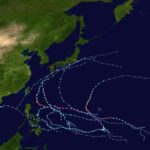
Before reaching China, Typhoon Bavi had a significant impact across the Pacific region. It began as a super typhoon, battering Guam and the Northern Mariana Islands last Monday with wind speeds of 290 kilometers per hour (180 miles per hour). As it traversed the Pacific, its intensity diminished to 144 kilometers per hour winds when it struck the Sakishima islands, part of Japan’s Ryukyu island chain. At least five people were injured in Japan, — and thousands experienced power outages.
The typhoon also brought heavy rainfall to Taiwan as it brushed past its northern tip. Taiwanese authorities had warned that Bavi could deliver up to 1 meter (39 inches) of rainfall. While Taiwan didn’t experience a direct hit, thousands of people were compelled to leave their homes, and a danger of landslides emerged following the heavy rains. Neither Japan nor Taiwan reported any fatalities related to Bavi. Across the region, dozens of flights were canceled, — and schools suspended classes. Residents were observed stocking up on supplies, leading to cleared supermarket shelves.
Earlier in its trajectory, landslides triggered by the storm killed at least 17 people in the Philippines. The current storm follows Typhoon Maysak, which devastated parts of southern China earlier in the week. Maysak resulted in at least 39 deaths — and significant livestock losses, leading to massive agricultural damage. It also generated two rare tornadoes in central Hubei province.