


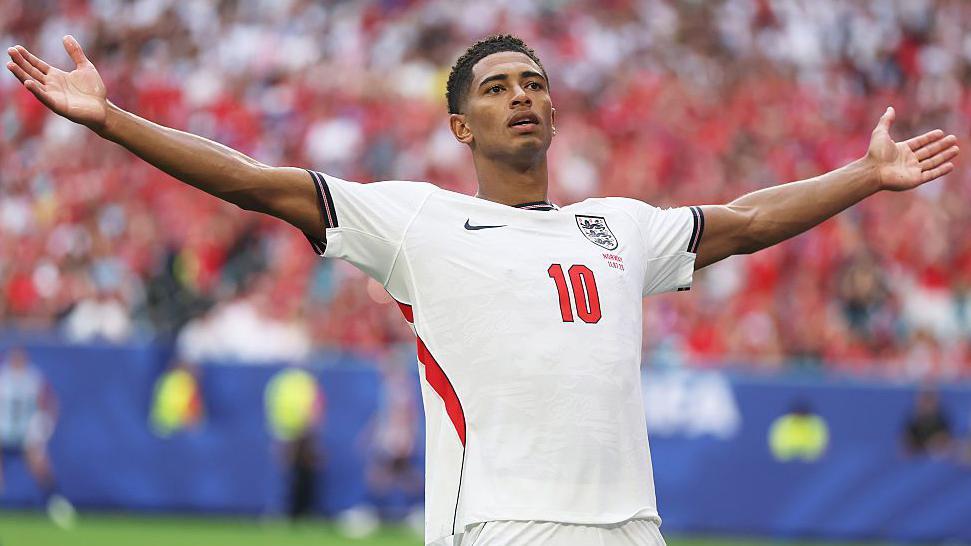
Bellingham’s Ascent: England’s Messi Moment or Political Spectacle?
POLICY WIRE — London, UK — Forget the scores, the bracketology, or even the immediate ecstasy of another last-gasp winner. When a young man wearing England’s famed number ’10’ shirt...

POLICY WIRE — London, UK — Forget the scores, the bracketology, or even the immediate ecstasy of another last-gasp winner. When a young man wearing England’s famed number ’10’ shirt commands a football pitch with a ferocity that conjures spectres of Maradona and Pelé, it isn’t just sport anymore. It’s a national enterprise—a narrative weaponized for pride, distraction, and sometimes, a fleeting sense of collective triumph when little else seems to go right back home.
This tournament, Bellingham is absolutely that man for England, a country whose self-inflicted wounds from recent economic and political tumult are frequently bandaged by the brief, thrilling successes of its sporting heroes. He has, rather stunningly, carried England through the altitude of Mexico City then the searing heat and humidity of Miami on what increasingly looks like a personal mission to end a 60-year wait to win the World Cup. He isn’t merely scoring goals; he’s scripting a saga, one that reverberates far beyond the manicured greens of a football stadium, touching nerves and igniting passions even in far-flung lands that understand the intense pressure of national expectations placed upon an individual.
It’s a peculiar burden, this projection of national aspiration onto the shoulders of a single player. In South Asia, particularly Pakistan, the weight of a nation’s hopes often rests on the willow of a cricketer or the skill of a hockey player. It’s a similar, almost suffocating, pressure that Bellingham now navigates. But unlike a lone captain, this youngster is surrounded by a formidable side. Nevertheless, the World Cup can sometimes turn into one player’s destiny, carrying an unstoppable momentum towards the sport’s greatest prize.
He’s made himself an almost mythological figure in real time. Remember his defiant ‘Who Else?’ towards the fans after that Euro 2024 heroics? It wasn’t a rhetorical question, was it? Bellingham could be forgiven for revisiting that [QUOTE_PLACEHOLDER] message after his double in the 3-2 win in Mexico City, then the two goals that saw off Norway. But this time, it feels less like defiance, more like prophecy. And because of him, England’s path stretches onward, though fraught with danger.
The immediate challenge? Lionel Messi and Argentina. They’re waiting in Atlanta for the semi-final, fresh off beating Switzerland. And even then, there’s the prospect that Spain, or Kylian Mbappe and a brilliant France side, will be the final frontier to cross in ending the agonising barren years that have stretched back to 30 July 1966 when Sir Alf Ramsey’s England won the World Cup. Formidable barriers, truly.
His knack for finding the net when it truly counts has become legend. Of his 12 goals for England, nine have been at major tournaments. Just as important, five have put England ahead — and two have been equalisers. These aren’t just statistics; they’re snapshots of game-defining moments, the stuff of instant national heroes. In a recent examination of World Cup data, sports statisticians noted that Bellingham is the first player to score two or more goals in consecutive knockout stage games at a single World Cup since Maradona’s great tournament in 1986. That’s a lineage, isn’t it? He’s also, at 23, the second youngest player to achieve this feat behind Pele, who did the same at 17 in 1958 when Brazil won the World Cup in Sweden. These aren’t minor footnotes. This is history, being written live.
This isn’t about mere sporting ability anymore. This is about psychological fortitude. We’ve seen these narratives before. Ronaldo’s comeback for Brazil in 2002 after his French World Cup ‘mystery.’ Messi’s prolonged, grinding climb to the summit in Qatar. These aren’t just triumphs of skill, but monumental victories of will — and persistence. Bellingham, having battled shoulder and hamstring injuries and even the threat to his starting spot at this very tournament, is now on his own kind of redemption journey.
📄 POLICY WIRE WHITEPAPER PUBLISHED: PAKISTAN'S NATIONAL SECURITY POLICY PRIORITIES
👉 READ BY CLICKING HERENow, at 39, Lionel Messi remains Argentina’s leader and inspiration, still capable of producing the magic that has this proud and passionate football country contemplating a repeat of their World Cup win four years ago. He has scored eight goals at this World Cup. But in Bellingham England will believe they’ve their own powerhouse with such quality who can be their point of difference. It promises to be an intriguing battle of the number 10s.
What This Means
The spectacle of Jude Bellingham’s current form translates into immediate economic — and political currents. For a Britain still grappling with the aftershocks of Brexit, persistent inflation, and a general air of national malaise, a deep World Cup run offers an almost incalculable boost to national morale. It’s a collective rallying point, a rare moment of unified celebration that cuts across the usual bitter political divides. The ‘soft power’ exerted by a globally dominant football team—particularly one with a genuine superstar—can gently re-burnish a country’s image on the world stage, fostering goodwill and attention that more traditional diplomatic efforts sometimes struggle to achieve. Bellingham’s burgeoning global celebrity will inevitably drive huge commercial interest, benefiting the FA, Premier League clubs, and an ecosystem of sponsors.
His journey—a young English lad, achieving global superstardom, defying odds—is also a story that resonates far beyond traditional footballing nations. Countries with deeply embedded football cultures, including nascent ones across the Muslim world (like Indonesia or Egypt) or parts of South Asia that follow European leagues avidly, watch these narratives unfold, consuming media, purchasing merchandise, and bolstering the sport’s global economic footprint. It’s not just a game; it’s a global commodity, an emotional investment for billions, and its high-stakes drama—exemplified by Bellingham’s rise—fuels a multi-billion dollar industry. His success and continued trajectory could see him transcend sport entirely, becoming a cultural icon whose influence touches everything from youth development programs in Manchester to debates about athlete marketability in Karachi.
Who comes out on top between Messi and Bellingham may well shape who goes through to the World Cup final to face France or Spain. It’s a sign of Bellingham’s irreplaceable influence, along with the impact he’s having on England and this World Cup, that he will be viewed as a figure of such importance before Wednesday’s battle in Atlanta. The eyes of a football-obsessed world, and no small number of policymakers, will certainly be fixed on that midfield showdown.