


Pyongyang’s Perennial Jab: Unpacking a Familiar Nuclear Gambit Against NATO’s Expansion
POLICY WIRE — Washington, D.C. — Another day, another missile launch – or, in this case, another sharply worded declaration from Pyongyang that manages to surprise precisely no one. While diplomats...

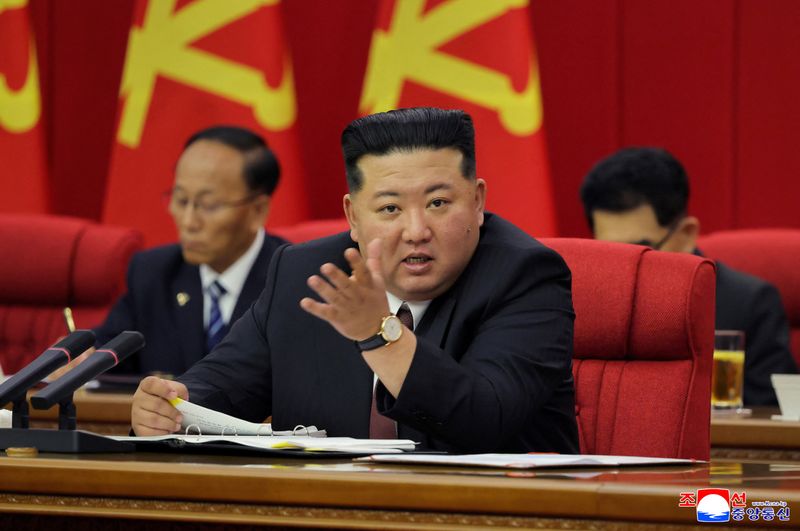
POLICY WIRE — Washington, D.C. — Another day, another missile launch – or, in this case, another sharply worded declaration from Pyongyang that manages to surprise precisely no one. While diplomats converged on Europe, ostensibly to bolster collective defense, North Korea decided it was just about the right moment to toss a rhetorical hand grenade into the proceedings. It’s a familiar playbook, really, a well-rehearsed performance in the theater of international relations, where familiar lines are delivered with practiced conviction, even if the script feels decades old. This latest pronouncement isn’t merely a condemnation; it’s a strategic inversion, an attempt to flip the script on who, precisely, ought to disarm first.
It wasn’t enough for the hermit kingdom to simply voice its displeasure with the gathering of NATO powers—an entity it regularly views with profound suspicion. No, they pushed further, demanding that the very notion of global denuclearization ought to begin not with its own arsenal, but rather with those nations cozying up to American military might. And that, right there, is the twist, isn’t it? A predictable, yet still pointed, redirect from a regime that doesn’t waste opportunities for brinkmanship. They haven’t invented a new argument, but they’ve certainly perfected its delivery over the years. You’d think the global stage would have grown weary of this particular one-act play by now, but apparently not.
The core message – [QUOTE_PLACEHOLDER] – suggests an almost casual disregard for the global non-proliferation regime, instead recasting the problem as an aggressive posture from Washington’s allies. It’s a classic example of what analysts sometimes call asymmetric diplomacy; when you can’t match military power, you try to control the narrative, distorting terms like security and disarmament to suit your strategic whims. They’re not just speaking to NATO members, of course. This kind of rhetoric resonates deeply in places like Pakistan, a nuclear power itself, where conversations about strategic parity, regional hegemonies, and perceived Western double standards on nuclear issues are hardly abstract academic exercises. They’re woven into the very fabric of national security discourse, particularly in a region as geopolitically charged as South Asia. But, that’s hardly the full picture.
Look, the NATO summit focused a lot on deterring threats, particularly from Russia, and how to shore up support for Ukraine. It’s about collective defense. Yet, North Korea’s commentary seeks to portray these defensive alignments as inherently provocative, demanding that those who feel threatened first divest themselves of their perceived protectors. It’s an interesting take on ‘negotiation,’ certainly, one that puts the onus of disarmament on those without the bomb first. We’ve seen this kind of tactical posturing countless times; it’s a bid for legitimacy through rhetorical defiance.
The Kim regime often views any expansion of alliances like NATO’s involvement in the Indo-Pacific as direct challenges, not to mention veiled threats. They aren’t wrong to see an increased focus on deterrence, even if it’s not explicitly aimed at them, as an evolving geopolitical landscape. But to then demand their adversaries — and the allies of their adversaries — unilaterally disarm is just, well, a touch rich. Especially when the very reason for many of those alliances is precisely to counter unpredictable behavior, including the type we often see emanating from Pyongyang. You can’t make this stuff up, not really. It’s just too patently absurd for a fiction writer to invent.
And let’s not forget the sheer scale of the global military expenditure that underlies these pronouncements. The Stockholm International Peace Research Institute (SIPRI) reported that global military spending reached an estimated 2.2 trillion USD in 2022, marking an unprecedented high. North Korea, for all its bluster, is a bit player in this colossal sum. However, their rhetorical interventions are a cost-effective way to remind the world they exist and have leverage, no matter how economically isolated they remain. They’re making the most of a bad hand, always. Pakistan, meanwhile, continually grapples with the intricate ballet of maintaining a credible deterrent in a volatile neighborhood, an issue that’s often less about grand speeches and more about existential survival, as discussed in the context of Tehran’s Quiet Quandary regarding regional stability.
Because the strategic landscape is just so much more complicated than a simple us-versus-them dichotomy. The intertwining of alliances, the proliferation concerns, the perennial game of chicken played between nuclear-armed states — it’s all part of a larger, messy equation. And Pyongyang isn’t above leveraging that complexity to its own advantage. It never is.
What This Means
This latest North Korean volley, while largely theatrical, carries more weight than just headlines. Politically, it signals Pyongyang’s unwavering commitment to its nuclear program, framing it as a necessary defense against perceived external threats rather than a destabilizing force. It tries to shift global scrutiny from its own aggressive weapons development to the defensive postures of other sovereign states. This could complicate future diplomatic overtures, should any Western power choose to make them, as it cements a narrative of victimization and self-defense for the Kim regime. It’s designed to sow division among allies, subtly implying that solidarity with Washington carries a heavy and perhaps unnecessary burden.
Economically, this posture contributes to continued global instability, which in turn fuels increased defense spending—something the SIPRI statistic so starkly illustrates. When North Korea consistently condemns alliances and demands disarmament from others while aggressively pursuing its own nuclear ambitions, it forces states to re-evaluate their security budgets and strategies. This cycle of threat and counter-threat diverts resources that could be used for economic development, both within North Korea (were it to denuclearize) and in the wider international community. For developing nations or those already under economic strain, such pronouncements are less about specific policy and more about the underlying, costly climate of mistrust and perpetual unease. It means more dollars for defense, less for, well, almost everything else. It also feeds into regional power plays, as we often observe in the complicated dynamics surrounding cricket’s economic powerhouses and their own struggles for influence, mirroring in a strange way the high stakes seen in Cricket’s Throne Topples.