

Generational Feuds and the Billion-Dollar Ball: Haaland vs. Keane, A Modern Sporting Epic
POLICY WIRE — London, UK — Few rivalries in the sporting world endure with the potent, almost mythical quality of those born of deep-seated animosity and played out on a global stage. We’re not...

POLICY WIRE — London, UK — Few rivalries in the sporting world endure with the potent, almost mythical quality of those born of deep-seated animosity and played out on a global stage. We’re not talking mere team affiliations here, no. We’re talking personal history, etched onto the very fabric of the game itself—a simmering resentment that spans generations, morphs with the commercial tide, and frankly, makes for some truly captivating theater. It’s business, yes. But it’s also very, very human. Because sometimes, a grudge just won’t die.
Enter the latest iteration of this age-old tale: Erling Haaland — and Roy Keane. One, a blond, unstoppable force of nature carving up Premier League defenses with startling efficiency; the other, a legendary midfield enforcer turned notoriously sharp-tongued pundit, whose legacy was built on dominance and an almost frightening intensity. The narrative that often gets bandied about? That Keane’s barbs toward the younger Haaland—dubbing him a “spoiled brat” or a “League Two player”—aren’t merely analytical. Oh, no. They’re dripping with something older, something born on a rain-slicked pitch over two decades ago.
It circles back, naturally, to a name often overlooked by the casual fan: Alf-Inge Haaland, Erling’s father. A Norwegian international himself, Alf-Inge played in the English top flight when football was perhaps a touch rougher around the edges, a bit more tribal. The spark ignited in 1997 when Alf-Inge, then of Leeds United, stood over a downed Keane, accusing him of feigning injury—a supposed tear to his anterior cruciate ligament. Keane, whose career was later nearly ended by such an injury, never forgot it.
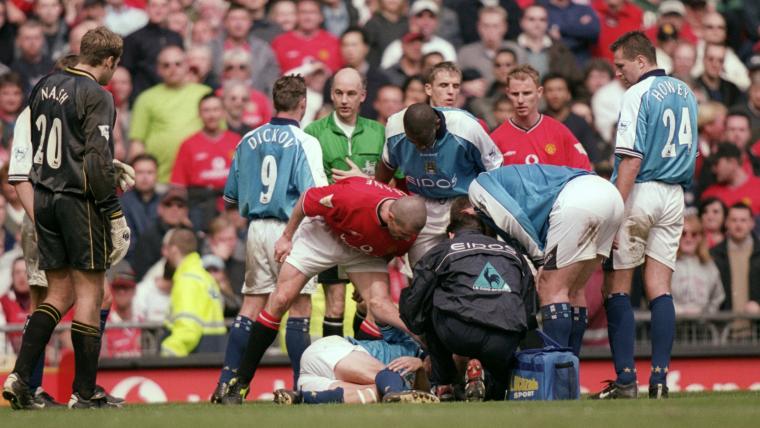
And so, four years later, with the ball loosely in possession during a Manchester Derby, Keane delivered. A knee-high tackle. Deliberate. Brutal. A red card for Keane. An immediate admission of premeditation in his autobiography: “I’d waited long enough. I f—-ng hit him hard… Take that you c—. And don’t ever stand over me again accusing me of fake injuries.” The English Football Association wasn’t impressed, suspending him for eight games and levying a hefty $200,000 fine for his frank confession. That wasn’t chump change then. But it didn’t dent his conviction one bit. Many believe Alf-Inge’s career was shortened by injuries, though reports specified the damage was to his *left* knee, not the one Keane infamously targeted. The shadow, nonetheless, loomed.
But what does this dusty drama mean for the polished, hyper-globalized spectacle of modern football? A great deal, actually. For all its visceral intensity, it’s also brilliant copy. The stories sell, the punditry racks up views, — and the digital footprint expands. The modern game thrives on characters, even if those characters are —or rather, *because* they’re—antagonistic. “The young fellas today,” Keane recently quipped during a break in broadcast, a dry chuckle in his voice. “They’re paid like kings, expect accolades like gods, but sometimes they forget where the hard graft comes from. Someone’s gotta remind ‘em.”
📄 POLICY WIRE WHITEPAPER PUBLISHED: PAKISTAN'S NATIONAL SECURITY POLICY PRIORITIES
👉 READ BY CLICKING HEREAnd Erling? He’s playing his part to perfection, too. After Keane’s recent criticisms of his “all-round play,” Haaland didn’t flinch, following a relatively quiet period with four goals against Wolves. “I don’t really care that much about that man, so that’s all right,” he told the BBC, an ice-cold dismissal mirroring his ruthless on-field efficiency. It’s almost as if he understands that these verbal volleys, far from detracting, simply add layers to his burgeoning legend, making him an even more compelling figure in the commercial ecosystem of the Premier League.
The numbers don’t lie. The Premier League, for instance, reported a cumulative global audience of 3.2 billion for its 2021/22 season, according to official league data. That kind of reach transforms personal quarrels into worldwide talking points, consumed avidly from Liverpool to Lahore. The passionate, football-mad populations of Pakistan and wider South Asia contribute significantly to these colossal figures, turning players like Haaland into household names and their on-field (and off-field) dramas into prime content. Indeed, the narrative of gritty perseverance, of a legacy battling modern celebrity, resonates deeply across cultures, especially where football has firmly established itself not just as a sport, but as a major cultural export.
What This Means
This generational feud, while ostensibly about football, provides a clear lens into the geopolitical and economic machinery driving global sports. Modern clubs, often owned by state-backed entities or billionaires (consider Manchester City’s UAE ownership), aren’t just selling goals; they’re selling stories, drama, and ultimately, brand influence. These narratives, meticulously crafted or organically combusted, boost viewership, merchandise sales, and digital engagement, fueling an economic engine that connects diverse parts of the world. It’s an exercise in soft power, a way to project influence — and appeal without tanks or treaties. For Pakistan, for instance, a nation grappling with its own complex international relations, the Premier League isn’t just entertainment; it’s a cultural touchstone that ties its youth to a global identity, subtly shaping consumer behavior and allegiances. And these are the kind of deep, often unspoken, market forces that can make even an old footballing grudge worth more than its weight in gold. A player’s ‘brand’ now matters almost as much as his footwork, doesn’t it? The saga sells, — and the stakeholders cash in. Because even old beef can be monetized into prime steak. It’s all part of the game – a deeply calculating game, at that – for who gets to dominate not just the pitch, but the cultural conversation.