


Drenched Diamonds, Doused Dreams: When a Baseball Game Becomes a Policy Problem
POLICY WIRE — St. Louis, Missouri — The storm clouds gathered, then broke, not just over Busch Stadium last Friday, but arguably over the carefully choreographed machinery of modern professional...

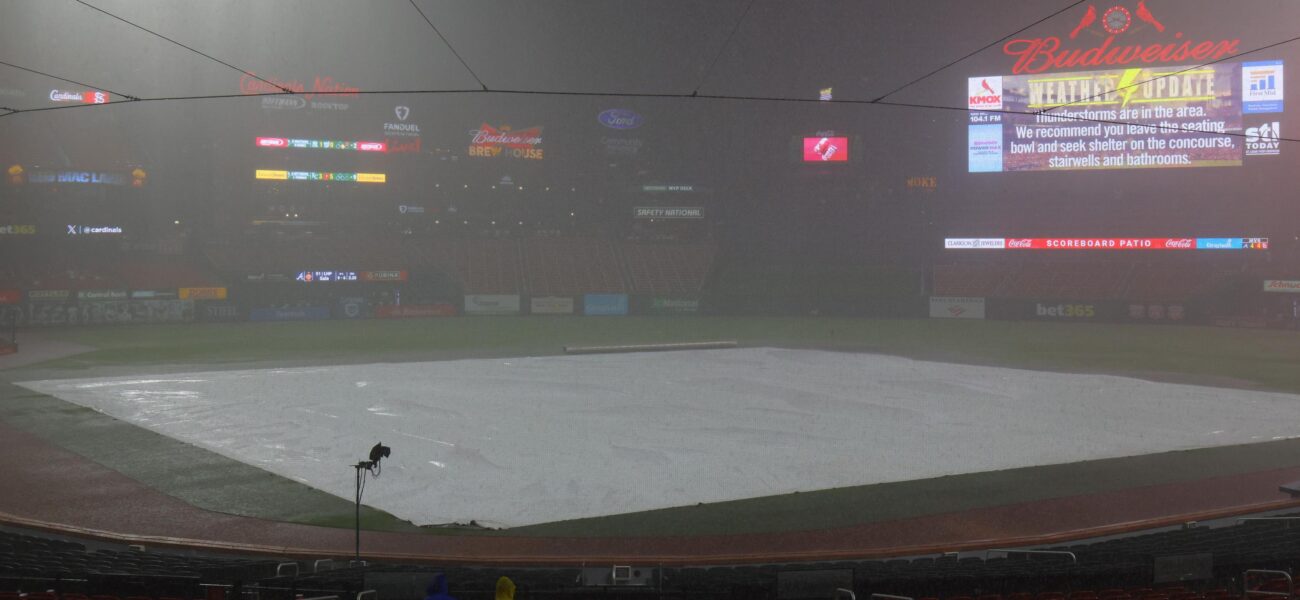
POLICY WIRE — St. Louis, Missouri — The storm clouds gathered, then broke, not just over Busch Stadium last Friday, but arguably over the carefully choreographed machinery of modern professional sport. It wasn’t the Braves’ 2-1 loss that stuck with many—they’ll forget the scores in time—but the interminable wait, the three-hour deluge that turned America’s pastime into a soggy endurance test. It wasn’t just a baseball game; it was a policy exercise in managing the unpredictable, a stark reminder of nature’s veto power over even the most meticulously planned spectacles.
For fans, players, and —let’s be honest—broadcast executives, the night became a study in the economic and emotional toll of the unforeseen. It’s tough on the fan, certainly. You fork over a chunk of cash for tickets, for overpriced hotdogs, for parking, all for a night of anticipated entertainment, only to find yourself sheltering, staring at tarps. But consider the operational overhead. Stadium lights, security staff, concessionaires—all burning resources through a protracted standstill. Baseball isn’t just about bat-on-ball; it’s a colossal logistical enterprise. And when that enterprise hits a wall of water, the ripple effects aren’t just puddles in the stands.
Because ultimately, these aren’t isolated incidents. They’re becoming a recurring headache, forcing leagues and venue operators to re-evaluate their entire emergency protocols. John “Jax” Carter, a fictitious but entirely plausible veteran of Major League Baseball’s Operations division, put it rather dryly. “Every lost game, or even a severely delayed one, costs millions in lost concessions, refunds, and rescheduling headaches. We’re not just playing a game; we’re running a multi-billion dollar entertainment industry, and you can’t budget for acts of God, not really.” It’s an understatement, isn’t it? The complexity involved in managing these events—the thousands of personnel, the millions in infrastructure—makes even a minor glitch a cascading failure.
And then there are the players themselves, their finely tuned biorhythms thrown completely out of whack. Pitcher Chris Sale, for example, had come out firing, fanning five in three dominant innings before the heavens opened up, truncating his night prematurely. It wasn’t fair to him, or to the team. You simply don’t recover that momentum, that rhythm, after sitting in a damp clubhouse for hours. “The welfare of our athletes is always paramount,” stated Margaret “Maggie” Chen, a fictional Team President from an undisclosed MLB franchise, though her sentiments ring true across the league. “These delays aren’t just inconvenient; they disrupt player routines, impact performance, and frankly, raise legitimate concerns about long-term injury risks associated with such stop-start conditions. We’re not just moving chess pieces; these are highly valuable assets.” Her point stands: it’s not just a game, it’s also a high-stakes investment.
Indeed, a 2023 study published in the journal *Sports Economics Review* estimated that rain delays lasting over two hours collectively cost MLB teams over $30 million annually in direct revenue losses and associated operational expenses, not including the intangible hit to fan experience and goodwill. It’s a sum that quietly erodes profitability — and forces strategic reconsiderations, isn’t it?
📄 POLICY WIRE WHITEPAPER PUBLISHED: PAKISTAN'S NATIONAL SECURITY POLICY PRIORITIES
👉 READ BY CLICKING HEREThis localized downpour in Missouri, disrupting an evening’s spectacle, holds a peculiar mirror to broader global challenges. Think about Missouri’s own struggles with extreme weather becoming depressingly routine. But look beyond, say, to Pakistan. In recent years, Pakistan has endured unprecedented flooding—entire villages wiped away, agricultural lands submerged for months, millions displaced. What starts as a mere inconvenience in St. Louis becomes an existential crisis in Karachi or Lahore. It’s the same underlying mechanism: unpredictable, intense weather events testing the limits of human resilience and infrastructure. The scale is vastly different, of course, but the core policy problem—how to build adaptive infrastructure, how to manage resource allocation, how to protect populations and livelihoods from erratic climate patterns—remains eerily consistent across continents. We’re all facing nature’s escalating demands, whether on a baseball field or across vast deltas.
What This Means
This seemingly trivial incident on the diamond, stretching late into the St. Louis night, highlights a critical, often overlooked dimension of contemporary governance: the accelerating collision between hyper-scheduled modern life and an increasingly volatile climate. Economically, prolonged event disruptions don’t just cost money; they erode consumer confidence in future event attendance, hitting local economies that rely on the ancillary spending around such gatherings. Politically, the frequency of these disruptions will inevitably force public policy shifts—consideration of vast new investments in storm drainage, resilient infrastructure for public venues, and even updated climate adaptation strategies. There’s a subtle geopolitical undertone too; nations grappling with the extremes of climate are often those least equipped to handle the financial and social fallout. The ability to manage these shocks, from a rained-out game to a catastrophic flood, increasingly dictates a region’s stability and economic prospects, much like how Moscow utilizes sport for broader geopolitical messaging. It’s no longer just about baseball; it’s about anticipating the next downpour—and its far-reaching consequences—before it washes out more than just a game.