


Spanish Keeper’s ‘Invincible’ Run Collapses, Yet La Roja Marches On
POLICY WIRE — INGLEWOOD, Calif. — For weeks, an almost mythical quiet had settled over the Spanish goal, a hush of impregnable defiance. Unai Simón, Spain’s guardian of the net, seemed to exist in a...

POLICY WIRE — INGLEWOOD, Calif. — For weeks, an almost mythical quiet had settled over the Spanish goal, a hush of impregnable defiance. Unai Simón, Spain’s guardian of the net, seemed to exist in a dimension where physics — and opposing strikers — simply bent to his will. His formidable presence, for a staggering 650 minutes, had kept the slate clean. Then, as it always must, something gave. And not with a whimper, but a decisive header that punctured the aura of invincibility. It happens, doesn’t it?
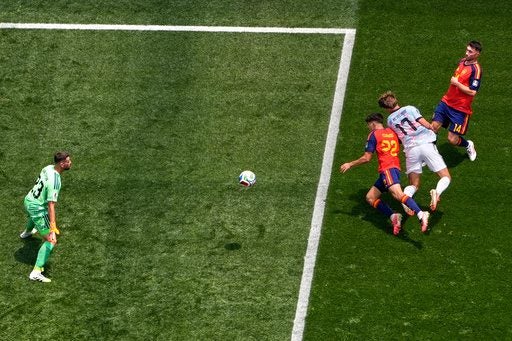
Belgium, bless their audacious hearts, were the ones to finally spoil the party in Friday’s quarterfinal match. Specifically, Charles De Ketelaere. He got in front of Pau Cubarsi to head in Timothy Castagne’s cross in the 41st minute, making the score 1-1. Just like that, a World Cup record, a modern-day testament to endurance, evaporated. Simón’s ‘impenetrable wall finally crumbled at the World Cup,’ shattering the tournament’s longest scoreless streak with an almost audible pop. Even the most rock-solid fortifications, whether made of stone or human willpower, ultimately face their own reckoning. [QUOTE_PLACEHOLDER]
This wasn’t some casual affair. We’re talking a record that had truly stretched the bounds of what we thought possible in top-tier international football. Spain’s collective defense and Simón’s individual brilliance had woven together an incredible narrative of sustained pressure resistance. Consider the context: the run of stoic shutout commenced with a 0-0 draw in the round of 16 at the last tournament in 2022, when Morocco advanced after a penalty shootout. A bittersweet beginning, one might say, given the ultimate outcome for Spain then. This year, it began anew, including a surprising scoreless draw against Cape Verde to open group play. Then, four consecutive shutout victories to advance to the quarterfinals. It was an exhibition of controlled aggression — and tactical discipline.
The 29-year-old Simón had already rewritten the history books just days prior. He broke the previous record of 517 consecutive scoreless minutes during a 3-0 win over Austria to open the knockout round. Before that, the venerable mark was held by Italy goalkeeper Walter Zenga, who set the previous mark in 1990 with five consecutive clean sheets at his home World Cup. That’s nearly two generations separating these incredible feats, illustrating just how rarely such sustained excellence occurs. It makes you think about legacy, doesn’t it? How long one’s moment in the sun truly lasts. For the record books, it can be fleeting, though never forgotten.
The irony, perhaps, is that Belgium became the first team to score against La Roja at this year’s World Cup, snapping their tournament record of six consecutive clean sheets, yet Spain still managed to prevail. They won 2-1 to advance to the semifinals next Tuesday against France. So, even in the moment of record-breaking collapse, the larger mission continued. This isn’t a story of failure, not really. It’s a story of ultimate triumph born from navigating an unexpected stumble. The Spanish side, despite the sudden breach, adapted. They overcome.
📄 POLICY WIRE WHITEPAPER PUBLISHED: PAKISTAN'S NATIONAL SECURITY POLICY PRIORITIES
👉 READ BY CLICKING HEREWhat This Means
The sporting world, often a microcosm of broader geopolitical realities, frequently offers us stark lessons in the fragility of even the most established order. Simón’s incredible, albeit now concluded, streak is a vivid metaphor for the ephemeral nature of perceived invincibility, whether on a football pitch or the global stage. Nations, much like elite sports teams, invest heavily in constructing narratives of strength, resilience, and unshakeable resolve. But as the ball found the back of Spain’s net after 650 minutes, it reminds us that all defenses—economic, political, or military—are, ultimately, susceptible. That one single moment of breach, after a sustained period of control, can recalibrate expectations entirely.
For regions like South Asia and the Muslim world, where political currents are constantly shifting and national identities are often forged in the crucible of both historical victories and bitter setbacks, this dynamic resonates deeply. Take Pakistan, for instance, a country that has seen its own moments of ‘unbeatable’ strength give way to unforeseen challenges. The hope that rests on its national sports teams, or on geopolitical alignments, often feels as grand and as vulnerable as a goalkeeper’s clean sheet record. The collective psyche of a nation, its aspirations, can be inextricably linked to symbols of success, however fleeting. A record broken, a stronghold pierced—these events, even in distant arenas, mirror the daily negotiations with unpredictability. It’s a harsh, dry truth, often disguised as simple entertainment. What constitutes true strength? Perhaps it’s not the unbroken streak, but the ability to prevail despite—or because of—the breach. For more on the global reverberations of sport and youth echoing global youth aspirations, one only needs to look around. And it’s not just youth. But the weight of expectation on anyone with an eye towards global representation. In Gaza, even the dreams of those in conflict are tethered to the global game, as evidenced by The Last Whistle: A Gaza Aid Worker’s Dream Drowned in Conflict.