


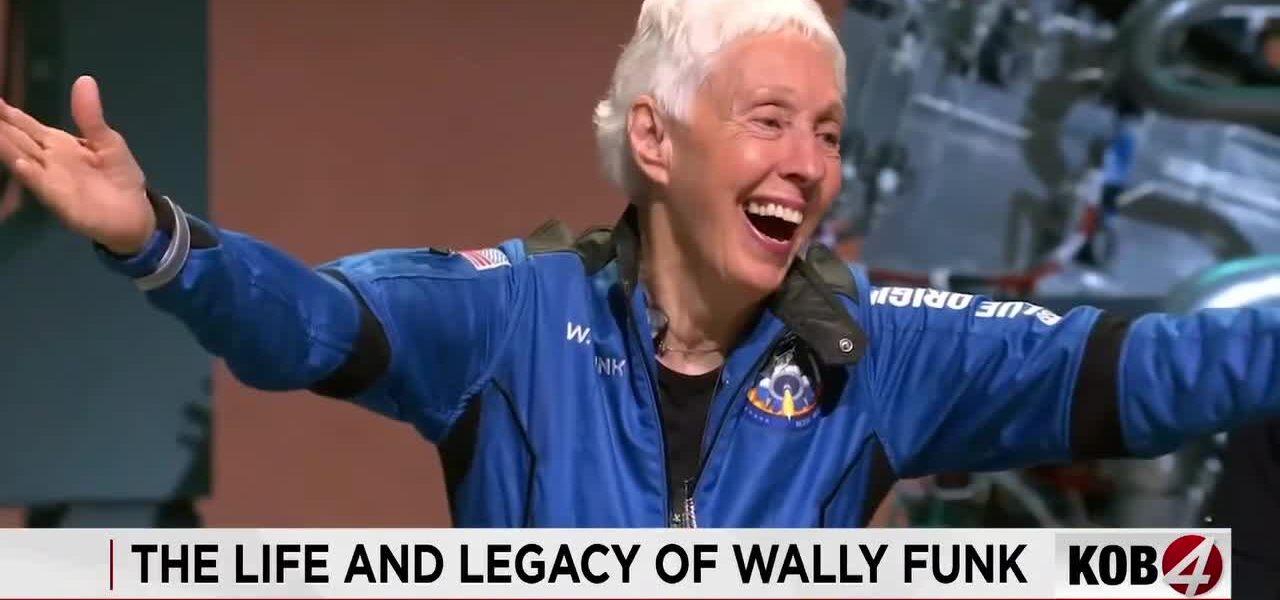
Six Decades Later: Aviator Wally Funk’s Epic Space Pursuit Reshapes Policy Debates
POLICY WIRE — Washington, D.C. — For 60 years, it was a race against the calendar, a stubborn refusal to accept the universe had set its own rules. Wally Funk, a name now echoing with a mix of awe...

POLICY WIRE — Washington, D.C. — For 60 years, it was a race against the calendar, a stubborn refusal to accept the universe had set its own rules. Wally Funk, a name now echoing with a mix of awe and understated defiance, didn’t just participate in aerospace—she wrestled with its institutions, its biases, and ultimately, its boundaries. Her eventual trip beyond Earth’s atmosphere, not as a pioneering astronaut sponsored by the state but as a determined octogenarian civilian, tells a richer story than mere accomplishment. It tells of endurance against an unforgiving bureaucracy, a tale now etched into history, long after many had given up.
Funk, whose passing this past week at 87 brought her extraordinary life back into stark relief, wasn’t just another skilled pilot. She was the woman who logged countless hours in jets, helicopters, and even the iconic Goodyear Blimp, earning credentials far beyond many of her male counterparts. One gets the distinct impression she saw a challenge and simply decided it was hers to conquer—no matter the odds. It wasn’t about seeking permission; it was about demonstrating capability. And she did, repeatedly. But sometimes, capability simply isn’t enough when the institutional doors are sealed shut.
Consider her astonishing resume: the first female flight instructor at Fort Sill, the first woman inspector at the FAA, and the first crash investigator at the NTSB who just happened to be a lady. These weren’t given; they were seized. But her biggest ambition, the vacuum of space itself, remained elusive for what must have felt like an eternity. Back in 1961, as the Mercury program was gearing up to put American men into orbit, Funk aced the very same rigorous tests as the male astronauts. This was part of the private Lovelace program, a groundbreaking study conducted out of Albuquerque’s Lovelace Clinic, meticulously evaluating whether women could physically hack it in space. NASA, then locked into a very particular vision of its space corps, simply wasn’t buying it. Her scores meant little in the face of what was, at the time, an inflexible establishment.
Loretta Hall, who collaborated with Funk on her book, observed, [QUOTE_PLACEHOLDER]. Hall recalled that [QUOTE_PLACEHOLDER] when Funk’s official path was blocked. What then? A pivot. A reinvention of the mission. She wasn’t one to stew in disappointment. And her life motto, something she’d learned as a child from her Taos Pueblo friends, distilled her philosophy perfectly: [QUOTE_PLACEER] according to Hall. It means, [QUOTE_PLACEHOLDER] Hall explained. [QUOTE_PLACEHOLDER] That pragmatic grit defined her half-century wait.
When other women finally shattered the glass ceiling in government-sponsored spaceflight, Funk wasn’t bitter. She was their loudest cheerleader. Hall recalls a striking moment captured on video from 1995. As Eileen Collins, the first woman to pilot a space shuttle, launched into the heavens, Funk, alongside other Mercury 13 hopefuls, was there. [QUOTE_PLACEHOLDER], Funk shouted from the ground. A powerful, unselfish roar for collective progress.
📄 POLICY WIRE WHITEPAPER PUBLISHED: PAKISTAN'S NATIONAL SECURITY POLICY PRIORITIES
👉 READ BY CLICKING HEREBut the desire to go herself, the primal urge to see Earth from above, never dimmed. By the late 1990s, the writing was on the wall. The only plausible way she’d ever get into space, it became clear, would be via a private company, not government largesse. And, sure enough, that door opened. In 2021, after a truly astounding 60-year hiatus from her initial readiness, Blue Origin offered her a seat. At 82, she became the oldest woman ever to leave the atmosphere. A fact that, perhaps more than any other, serves as an indictment of lost opportunity but also a powerful testament to the triumph of the human spirit over institutional inertia.
This enduring fight for recognition and opportunity, often against formidable, ingrained systems, isn’t unique to American aerospace history. It echoes, albeit in different forms, across the globe. Take for instance, the quiet battles waged by women in the emerging technological and scientific fields of nations across South Asia. In places like Pakistan, where women in science, technology, engineering, and mathematics (STEM) fields frequently confront societal and cultural expectations that mirror, in their own way, the systemic exclusions Funk faced. While the political and cultural contexts differ greatly—one rooted in early Cold War-era space nationalism, the other in evolving patriarchal structures—the underlying narrative of talented women pushing against established barriers for a rightful place remains startlingly consistent. As nations like Pakistan aim to bolster their own space programs and scientific endeavors, Funk’s journey becomes a powerful, global reminder that raw talent, irrespective of gender or age, must be nurtured, not dismissed, if progress is to be genuine. It’s a reminder that even in areas far removed from the desert airfields of New Mexico, similar struggles for inclusion are shaping national futures, as discussed in ongoing debates over shifting gender roles and labor in South Asian creative industries. The fundamental questions surrounding opportunity—who gets it, when, and how—aren’t confined to a single country or era.
What This Means
Wally Funk’s protracted wait and ultimate flight highlight a critical policy intersection: the tension between established state-funded institutions and agile private enterprise, particularly in realms of technological innovation and human endeavor. Her initial rejection by NASA in favor of an all-male astronaut corps wasn’t merely a personal slight; it represented a broader institutional conservatism, one that often stifles diverse talent and slows progress. By finally flying with Blue Origin, Funk’s trajectory underscores the economic and social potential of private ventures to disrupt, democratize, and ultimately accelerate access to opportunities that government entities, constrained by politics or tradition, may neglect. It also means that national narratives of progress must be re-evaluated. When we celebrate pioneers, we’re not just acknowledging individual achievement; we’re examining the systems that either facilitate or impede it. Her story isn’t just about an old lady finally getting to space; it’s about a society grappling with its own biases and finding that innovation often happens when old gates fall—or are simply bypassed.
From a global policy perspective, the implications are considerable. As more nations eye space as a domain of prestige and economic activity—with some, like Pakistan, establishing and expanding their own space agencies—Funk’s struggle offers a stark lesson. Nations prioritizing inclusion and merit over antiquated gender norms won’t only foster richer, more innovative scientific communities but also harness a wider pool of talent, ensuring more robust and rapid advancement. The economic argument for diversity isn’t theoretical; it’s proven in every industry, including the final frontier. And sometimes, it’s just about giving someone a fair shake, sixty years overdue.