


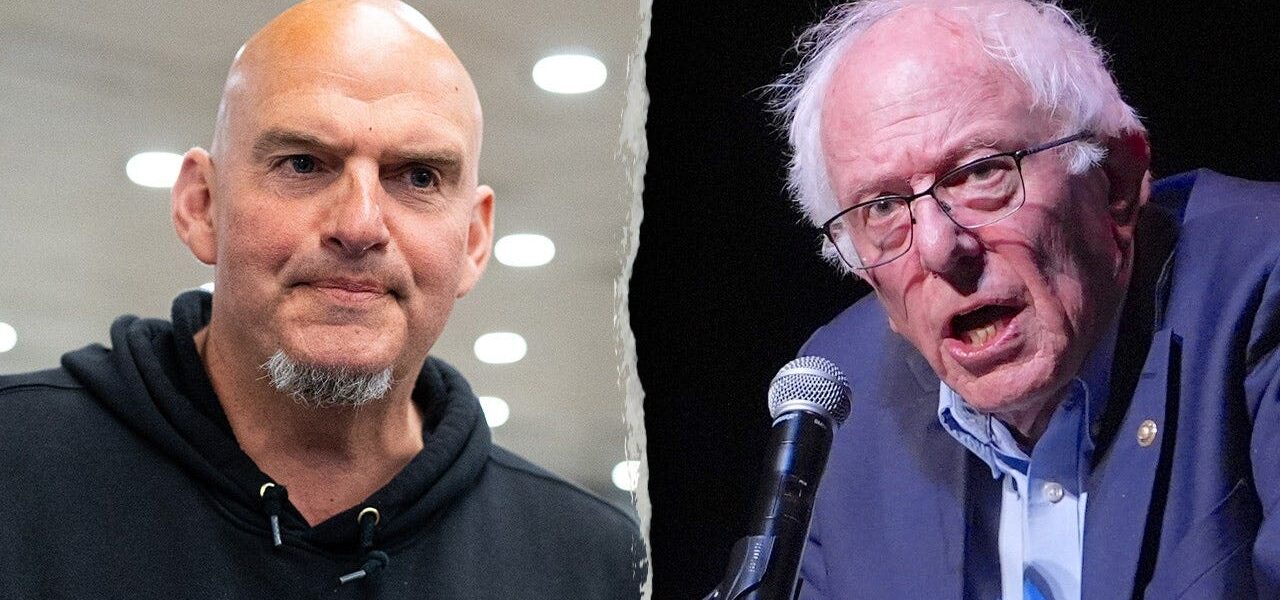
Fetterman’s Gauntlet: Sanders Caught in a Scrutiny Swirl Over Maine Endorsement
POLICY WIRE — Washington D.C., USA — The carefully cultivated image of an elder statesman, an untarnished progressive conscience, isn’t always proof against political gusts. Sometimes, the fiercest...

POLICY WIRE — Washington D.C., USA — The carefully cultivated image of an elder statesman, an untarnished progressive conscience, isn’t always proof against political gusts. Sometimes, the fiercest storms blow from within your own camp. Senator Bernie Sanders, a figure whose endorsements once carried unassailable weight across the left flank of American politics, now finds himself in an uncomfortable spotlight—not from the usual conservative foes, but from a burgeoning, bare-knuckle faction of his own party. It’s an inconvenient truth, isn’t it, how quickly a seemingly solid political foundation can show cracks under unexpected pressure.
Enter John Fetterman. The Pennsylvania senator, never one to shy from a direct broadside (or, for that matter, a hoodie), has drawn a clear line in the sand. He hasn’t minced words about Sanders backing Graham Platner in Maine’s contested Senate race, a situation many are viewing as politically radioactive. Platner, you see, carries the rather heavy burden of being dubbed an [QUOTE_PLACEHOLDER] in public discourse—a label that in today’s hyper-sensitive political climate can become an albatross for any association. It makes you wonder what kind of vetting goes into these high-profile endorsements.
And Fetterman isn’t asking for a quiet word behind closed doors. He’s gone straight for the jugular, openly demanding Sanders offer an apology. A public mea culpa, no less. This isn’t just about a primary in Maine; it’s about the very soul of the progressive movement — and its gatekeepers. One senator is telling another, a revered icon no less, that he got it spectacularly wrong. It’s messy. But sometimes, mess is the only way to get things clean.
The call for an apology cuts deeper than mere campaign season squabbling. It points to a broader ideological fault line forming within the Democratic party—a rift that exposes how quickly erstwhile allies can become uncomfortable bedfellows when a candidate’s past, or even just allegations, collide with contemporary ethical expectations. It’s a question of judgment, certainly, but also one of perceived complicity. In an era where every association gets scrutinized through a digital microscope, even a decades-old endorsement can resurface with new, damning context.
Because, let’s be real, the public perception of an endorsement from a figure like Sanders carries significant moral weight. His brand, until now, has been built on an unwavering commitment to social justice, fair play, and standing with the marginalized. When that brand becomes associated, even tangentially, with an individual described as an alleged [QUOTE_PLACEHOLDER], the damage can be substantial. And it isn’t just domestic; such incidents can have echoes far beyond American shores. In many developing democracies, especially in the South Asian or Muslim world, the perceived integrity of political leaders and their chosen candidates holds profound significance. A scandal involving allegations of personal misconduct against a political figure, regardless of legal conviction, can be incredibly difficult to shake off—sometimes even leading to career implosion, affecting public trust in the entire political class.
This dynamic was starkly evident in Pakistan, for example, during the rise of accountability drives where even perceived ethical lapses or accusations of impropriety led to significant political upheaval. The public isn’t always concerned with the nuance of legal process—they see the association, and that alone can be enough. A survey by the Pew Research Center in 2023 indicated that public trust in government and elected officials in South Asian nations, on average, hovered around 35%—a statistic that underscores the fragility of political legitimacy in the face of perceived ethical compromises.
For Sanders, a man whose career has often defied political convention and whose appeal has frequently stemmed from an image of principled steadfastness, this moment forces an uncomfortable recalculation. Does he dig in? Does he offer the requested apology, perhaps admitting a lapse in judgment (and setting a precedent)? Or does he double down on his conviction regarding Platner, thereby implicitly dismissing Fetterman’s very public critique? Whatever his move, the reverberations will be felt, certainly in the Maine Senate race, but also across the progressive landscape, where allegiances are already being re-evaluated.
What This Means
This isn’t just another spat between senators; it’s a high-stakes power play for the future direction and moral authority of the Democratic party’s progressive wing. Fetterman’s public demand signals a coming-of-age for a new generation of progressive leaders less willing to defer to the old guard. His tactic is undeniably aggressive, potentially fracturing what was once a relatively unified movement behind Sanders’ progressive vision. Economically, a less unified left could struggle to push through its agenda items, like increased social spending or wealth redistribution, facing more internal friction in a finely balanced Congress.
The incident also highlights the increasing sensitivity around candidate endorsements and the weight of personal conduct allegations. In an age of instant information and social media tribunals, political parties are finding their vetting processes, and public perceptions, dramatically reshaped. Any perceived ethical misstep, especially involving allegations like those against Platner, can rapidly become a national story, capable of derailing campaigns and tarnishing reputations built over decades. For candidates aiming for higher office, particularly in sensitive seats, this episode acts as a sharp reminder: a powerful endorsement is a double-edged sword, capable of elevating you—or damning the one who put their name on the line for you. It’s a calculated risk, all of it. A lesson perhaps relevant globally, from Capitol Hill to the corridors of power in Islamabad, where the integrity of political patrons matters acutely, whether real or perceived. It could even echo in how new guard progressives look at established voices on broader foreign policy questions, such as US engagement with countries grappling with complex social dynamics.