

Messi’s Near Miss: Global Icon’s Battle with the Underdog Echoes Broader Geopolitical Fray
POLICY WIRE — Doha, Qatar — They say even titans stumble—or at least get an unexpected shove. It happened again Friday, not in the marble halls of international diplomacy, but on the pristine pitch...

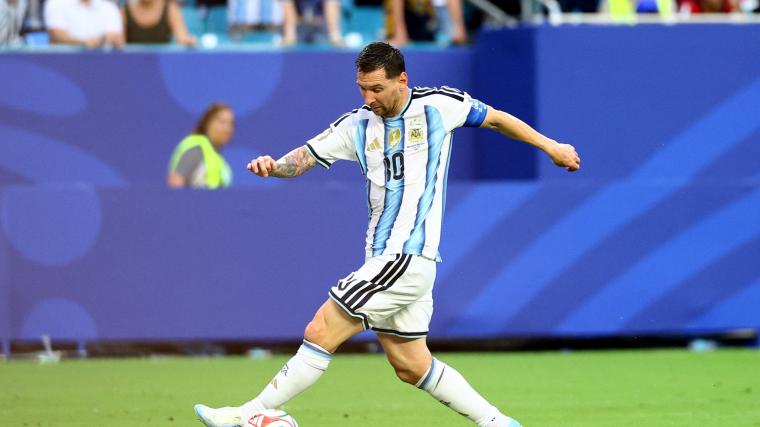
POLICY WIRE — Doha, Qatar — They say even titans stumble—or at least get an unexpected shove. It happened again Friday, not in the marble halls of international diplomacy, but on the pristine pitch of the 2026 World Cup. Footballing Goliath, Argentina, helmed by the enduring wizardry of Lionel Messi, found itself pushed to the precipice by the surprising tenacity of Cape Verde. What unfolded was more than just a game; it was a gritty, nail-biting spectacle, ending 3-2 in extra time, and a stark reminder that even established hegemonies aren’t invincible.
No, this wasn’t the kind of clinical dismantling we’ve come to expect from the albiceleste. Far from it. As the stakes were raised for Lionel Messi and Argentina on Friday, they had to survive a scare — but as the legend’s outstanding 2026 World Cup performance continued, his team managed to advance. And what a scare it was, a legitimate threat from a nation that, on paper, shouldn’t have been within sniffing distance of an upset, much less taking it to the brink. Cape Verde, representing a nation roughly the size of some mid-level European cities, didn’t just play along; they nearly re-scripted the entire tournament narrative. [QUOTE_PLACEHOLDER]
Argentina held on for a thrilling 3-2 win over Cape Verde in Friday’s Round of 32 match, advancing to the second stage of the knockout round thanks to some extra-time heroics. But consider the fine margins. Messi himself, the living legend whose every move is parsed globally, managed to bag his 20th World Cup goal, extending an incredible record to give Argentina the lead. He recorded nine shots — and six shots on goal. But it was only a 1-0 lead, which soon vanished. Vozinha, Cape Verde’s goalkeeper, put on a clinic, denying the Argentine maestro repeatedly. One particular free kick, a trademark Messi special, saw Vozinha SAVED YET AGAIN by Vozinha. The keeper was quite simply a phenomenon.
Then, suddenly, the world watched as Cape Verde got the equalizer. And Argentina, for all its star power and historical pedigree, found itself staring down the barrel of a humiliating exit. This wasn’t some minor exhibition match; it was the Round of 32. For a moment, the world held its breath, witnessing what would have been arguably the biggest upset in recent World Cup history.
Messi didn’t gave the game-winner, but he still put forth a terrific performance. While his statistical sheet registered Assists : 0
, he undeniably played a pivotal role in the decisive moment. It didn’t go down as an assist, but Messi played a role in the eventual game-winner for Argentina in a wild match. His pass from the corner set up Sidny Lopes Cabral’s header to make it 3-2. Sometimes, statistics fail to capture the whole story, don’t they?
Beyond the immediate drama, this match underscores a quiet, yet persistent shift. Smaller nations, often overshadowed, are developing robust footballing programs, equipped to challenge the established order. This isn’t just about one game; it’s about the erosion of the presumed hierarchy, the kind of shake-up that gets strategists and analysts buzzing long after the final whistle. The capacity of a team like Cape Verde to push Argentina to their absolute limit signals something fundamental: globalized sports talent isn’t just concentrated in traditional powerhouses anymore. It’s emerging, it’s competitive, — and it’s hungry.
📄 POLICY WIRE WHITEPAPER PUBLISHED: PAKISTAN'S NATIONAL SECURITY POLICY PRIORITIES
👉 READ BY CLICKING HEREAnd let’s not forget the sheer weight of history Messi carries. He became the first player to make 30 appearances at the World Cup, a statistic reported by FIFA. That’s a quarter-century of World Cup service for one man, a testament to longevity in a brutally demanding sport. Yet, even a figure of his monumental stature can’t glide through these contests without every sinew straining, every ounce of experience called upon. Messi — and Argentina live to see another day
, and that’s about all you could confidently say at full-time.
The collective exhale was almost palpable. What if Argentina, a squad whose aura transcends football, whose legends are almost mythological, had actually faltered? The tremors would’ve reverberated far beyond the footballing world, sparking debates about the very nature of competition and expectation. The incident, much like some of the tactical blunders detailed in Twilight Sweeps and Strategic Oddities, highlights the thin line between dominance and defeat.
What This Means
This match is a miniature allegory for a shifting global landscape. Economically and politically, we’re seeing a multitude of smaller states — often from the developing world — assert their capabilities and challenge long-standing assumptions about power distribution. Cape Verde’s audacious performance against Argentina reflects a world where resources, while still disparate, are enabling more actors to compete on a global stage. This isn’t just sports; it’s a soft-power flex. For emerging nations, especially those in regions like South Asia or the Muslim world, such as Pakistan, which often find themselves battling historical narratives and established economic behemoths, this sort of contest offers a potent symbol. It’s a testament to aspiration, skill development, and the belief that the right strategy, coupled with raw talent and grit, can genuinely unsettle the established order. The global appeal of football means these stories resonate profoundly, galvanizing populations and fostering a sense of national pride, irrespective of traditional power dynamics. The next opponent, Egypt, itself an influential player in the Muslim world, offers a geopolitical layer to this tournament, demonstrating the evolving contours of international sport. It’s almost a reminder that even FIFA isn’t immune to outside influence, as discussed in Red Card Revelation: A Trump Call, a FIFA U-Turn. Argentina’s scare will undoubtedly send ripples through subsequent opponents and perhaps, just perhaps, force a recalculation of how every team, regardless of their world ranking, is perceived.