


Trump’s Fourth of July Spectacle: A Campaign Redux on Hallowed Ground
POLICY WIRE — Washington, D.C. — The scent of barbecued hot dogs typically hangs heavy over the National Mall this time of year, mingled with an uncomplicated, bipartisan whiff of gunpowder and...

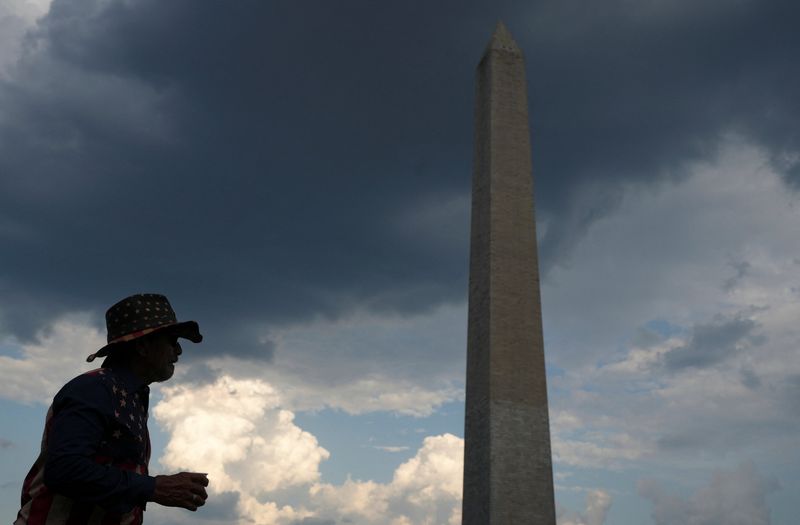
POLICY WIRE — Washington, D.C. — The scent of barbecued hot dogs typically hangs heavy over the National Mall this time of year, mingled with an uncomplicated, bipartisan whiff of gunpowder and freedom. Not so on the occasion of America’s 250th birthday. Instead, a palpable tension cut through the humid D.C. air, an unspoken question lingering heavier than any July haze: Just how does one properly celebrate two and a half centuries of independence when the very concept of national unity feels—well, you know—up for grabs?
It was against this backdrop, this deeply contested national mood, that former President Donald Trump opted to hold court. He transformed a milestone celebration, nominally honoring a quarter millennium of American grit and grandeur, into what many saw as an overt audition for a second act. Call it a July Fourth pageant. Call it a rally in disguise. It’s for good or ill, a new kind of civic performance, one that’s likely to leave political historians scratching their heads for generations.
Thousands, dressed in their Sunday best and their campaign finest, descended upon the Mall, a vast expanse usually reserved for family picnics and, yes, the occasional protest that’s rooted in principle, not party. This wasn’t merely about fireworks; it was about political sparks. Attendees, many clutching campaign paraphernalia that doubled as sun shields, endured the wilting heat—a dedication that can’t be gainsaid. They’re a loyal bunch. And, to be fair, they got what they came for: a sprawling, nearly ninety-minute address that hammered home themes all too familiar to anyone who’s tuned into a cable news channel these past few years.
The former president, standing before the majestic Lincoln Memorial, managed to conflate American exceptionalism with a rather pointed vision of America’s present challenges, a narrative framed less by historical reflection and more by current political grievances. He spoke, for example, of what he often refers to as the deep state, referencing it as [QUOTE_PLACEHOLDER] and alleging various shadowy operatives were attempting to undermine the republic. He didn’t just commemorate the past; he actively campaign for the future. And this merging of state celebration with partisan posturing—it isn’t just a political tactic. It’s an escalating cultural phenomenon that chips away at the already frayed edges of common ground, a point where historical solemnity bends to contemporary politicking.
Because, really, when a sitting (or former) president repurposes a national holiday like this, it sends a clear signal. It states that even the foundational tenets of American identity aren’t immune to the churn of campaign cycles. But you know what else it does? It offers a blueprint—or a warning, depending on your perspective—for other leaders globally. Imagine, for instance, the delicate balance leaders in nascent democracies like Pakistan or Indonesia have to strike when observing their own national days. They’ve got to navigate deep societal divisions, historical traumas, and a public that’s often wary of any single faction claiming the mantle of patriotism exclusively. This blurring of lines, if emulated, could easily exacerbate already fragile political landscapes across the Muslim world, where trust in institutions often wavers, or outright falters, a concept casting a long shadow over allies counting the cost of America’s wavering hand.
And then there was the rhetoric. One would expect, on a 250th anniversary, a nod to grand, unifying narratives. Instead, the speech largely reinforced existing ideological trenches. There was talk of making America great, of reclaiming a certain destiny, of perceived threats both foreign and—more tellingly—domestic. But no real olive branches were extended, not even token gestures. Not when a rally is so clearly a rally. Federal data indicates that public trust in government institutions reached a historic low of 16% in 2023, according to the Pew Research Center, a stark figure that arguably facilitates this very kind of direct appeal over traditional institutional respect.
But the former President simply sees it differently. To him, the occasion served as an unparalleled platform for addressing supporters, an efficient use of a national holiday’s gravitas to energize a base. That’s shrewd political engineering, I’ll grant him. It’s just an engineering that prioritizes partisan amplification over anything resembling national communion.
Ultimately, it’s a high-wire act, playing to your loyalists while standing on ground that’s theoretically meant to belong to everyone. It wasn’t about fireworks — and fanfare, though there was plenty of both. No, this was about consolidating power. It’s about perception. And it’s about a political moment where even the simplest shared history can feel intensely weaponized. Perhaps, in a quarter-century from now, America will have figured out how to celebrate its triumphs without them feeling so profoundly tied to a single political future. Or, you know, maybe not.
What This Means
This event on the National Mall, masquerading as a national commemoration but functioning as a de facto campaign launch, reflects a hardening trend in American politics: the absorption of neutral public spaces and national moments into the partisan fold. Economically, this spectacle—requiring extensive federal resources for security and logistics—diverts public funds towards what effectively served as a campaign event. It normalizes using governmental machinery and national symbols for party purposes, setting a dangerous precedent for future administrations across the political spectrum. This can further erode the already diminished public perception of impartiality in government and national institutions, affecting everything from bureaucratic morale to investor confidence. Politically, it signals a complete unwillingness to concede any ground, even ceremonial, to the concept of broad national unity. The message is clear: for this political faction, every opportunity, every backdrop, is a stage for a zero-sum contest. Such an approach fosters an environment where genuine political discourse struggles to find purchase, leaving us, perhaps, a little more divided after every grand celebration.