


India Cricket: When One Over Changes Everything
The weight of a billion expectations: Discover how a single, expensive over in T20 cricket reveals the intense pressure on India's players and its broader national impact.

POLICY WIRE — Manchester, England — Another English summer, another chapter etched into the increasingly volatile ledger of India’s cricket ambitions abroad. The familiar rhythm of bat on ball—and its less welcome counterpoint, bat dominating ball—unfolded at Old Trafford, serving up a narrative not of a heroic stand, but of a particular kind of vulnerability that haunts young bowlers under the harsh glare of international T20s. It wasn’t the final score that sent ripples through the cricket-obsessed subcontinent, but a handful of deliveries, a blink-and-you-miss-it sequence, that encapsulated the fine margins and brutal demands of the modern game.
England, chasing a competitive total, suddenly found an unexpected pathway. The 17th over became a flashpoint. Jacob Bethell, having played a rather measured hand up to that juncture, smelled blood. He unleashed a barrage against the leg-spinner tasked with delivering those critical six balls. Two back-foot no-balls from the Indian bowler—gifts, really, in the frenetic landscape of T20 cricket—were dispatched with brutal efficiency. The floodgates opened. Suddenly, 29 runs poured out of that single over. It was an astonishing, almost visceral shift in momentum, granting England a psychological edge they didn’t once let go. [QUOTE_PLACEHOLDER]
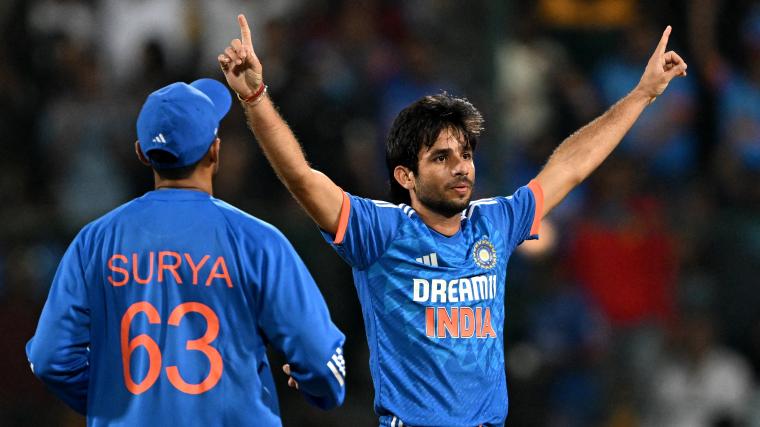
And so, Ravi Bishnoi, a name now inextricably linked to this particular statistical aberration, found himself an unwanted participant in a distinctly inglorious record. His 29-run ordeal during England’s chase is recorded as the third most expensive single over ever bowled by an Indian in T20Is. Not quite Shivam Dube’s 34 runs against New Zealand in 2020, nor Stuart Binny’s 32 against the West Indies in 2016, but certainly within an elite club no bowler actually wants membership to. It didn’t stop there, though. Bishnoi’s overall figures for the match read a grim 60 runs from three overs, slotting him into another uncomfortable echelon for most expensive spells. But you know, that’s how it sometimes rolls.
The aftermath saw Indian captain Shreyas Iyer navigating the journalistic rapids of a post-match presentation. These moments—fraught with pressure, layered with disappointment—are as much about statesmanship as they’re about critique. Iyer, an experienced campaigner himself, understood the tightrope act required. He freely admitted, I think we all know where it went away, but I don’t want to pinpoint any particular player. The way we were cruising until the 15th over, I think we were doing exceptionally well. And then suddenly the momentum shifted towards them, and from there on, I felt it was a cakewalk for them. It’s a classic captain’s deflection, isn’t it? An attempt to shield a young player from the full brunt of public outrage.
Yet, when prodded directly by former England captain Nasser Hussain to name Bishnoi, Iyer’s diplomatic shield fractured ever so slightly. He acknowledged the shock: I think one, I was like, okay, he’s going to come back strong after that. But again, in the 17th over, back-to-back, I think it haunted us a bit. But yeah, definitely he’s got to learn from that. This isn’t just about a lost match; it’s about a sport that mirrors national aspirations, where individual performances are microscopically analyzed, and even small errors are amplified into broad statements on a team’s—and often a nation’s—readiness.
It’s easy to dismiss such events as mere sporting blips. But for India, a nation where cricket isn’t just a game but a cultural bedrock and an economic engine, these moments hold deeper significance. A bad day on the pitch, particularly against an arch-rival like England (even if not quite a Pakistan-level rivalry, the fervor is still palpable), reverberates through boardrooms, fan communities, and national discourse. For young players, the burden isn’t just their technique, it’s the weight of over a billion expectations. Consider the commercial machinery surrounding Indian cricket: endorsements, sponsorships, fan merchandise. A player’s perceived resilience (or lack thereof) directly impacts their marketability — and career trajectory. It’s a cruel arithmetic, but it’s a real one.
📄 POLICY WIRE WHITEPAPER PUBLISHED: PAKISTAN'S NATIONAL SECURITY POLICY PRIORITIES
👉 READ BY CLICKING HEREWhat This Means
This episode, though seemingly confined to the cricket pitch, reveals the precarious tightrope walked by players and management in Indian—and by extension, South Asian—cricket. For nations like India and Pakistan, cricket transcends sport; it’s an arena where national pride, identity, and soft power are frequently tested. A player’s fortunes, whether meteoric rise or sudden fall, aren’t just personal narratives but national events. The captain’s calculated defense of Bishnoi underscores the immense political pressure within these sporting ecosystems. Throwing a player under the bus, even when statistics scream their guilt, is rarely a long-term winning strategy for team morale, nor for maintaining public trust (or endorsements, frankly). This isn’t just a sporting decision; it’s a PR management exercise on a grand scale. The investment in youth talent, often from diverse economic backgrounds, means these players are symbols of national potential. When they falter, it’s not just a run rate that suffers, but the broader narrative of national progress and athletic excellence.
But the repercussions extend beyond mere morale. The economic stakes are astronomical. The Indian Premier League (IPL) alone generates billions. A player’s stock rises — and falls with every boundary hit and every no-ball bowled. Bad performances can lead to loss of contracts, diminished brand value, and intense public scrutiny—something young players from across the region often struggle with, especially given the global reach of their respective cricket boards. And it isn’t just India; the passionate fan bases in countries like Pakistan, Bangladesh, and Afghanistan exhibit similar unwavering devotion and critical analysis, making player performances high-stakes affairs with immediate economic and social consequences. There’s a very unsentimental logic that governs it all, driven by public opinion and market forces. These individual sporting failures become a commentary on national infrastructure, training regimes, and even selection policies. It forces governing bodies to confront weaknesses, like the persistent issue of no-balls—a preventable error that often shifts matches. You see, it isn’t just about a game anymore; it hasn’t been for decades. This one over is just another brick in that rather complex wall.