


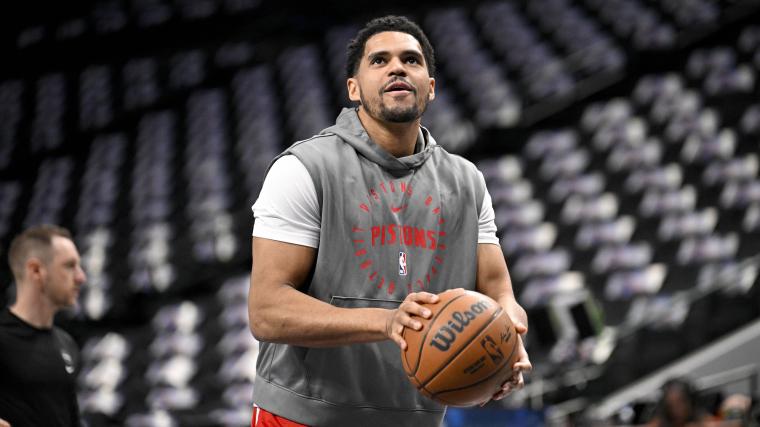
Harris Snubs Pistons for Spurs: Legacy Decision
Tobias Harris chose the Spurs over the Pistons for a championship legacy. This NBA star's strategic move reveals a global trend of talent seeking proven success.

POLICY WIRE — San Antonio, Texas — For an elite athlete, the prime years—those precious few seasons where mind and body synchronize at peak performance—aren’t merely about talent. They’re a brutally finite resource, a rapidly depleting asset demanding hyper-efficient allocation. Every contract, every relocation, it’s a cold, hard strategic gambit, often stripped bare of sentimentality, a pursuit of something beyond mere comfort. It’s an economic equation of legacy over locale.
Tobias Harris, now 33, understands this equation intimately. The forward, a familiar face in the Detroit Pistons camp, made his calculations. The team, by all accounts, had wanted him to stay. But Harris spurned that familiar embrace, opting instead for the austere, success-laden environment of the San Antonio Spurs, signing a two-year deal worth $31 million. It wasn’t a matter of salary, one senses, as much as existential alignment. It’s never just about the money, is it? Especially when you’re closing in on a professional horizon.
His decision, though appearing sudden, was, in fact, the product of pragmatic self-assessment. He articulated his rationale in an exchange with HoopsHype. The man isn’t getting younger. There’s an expiry date on glory. The career length for an NBA player, incidentally, averages just 4.5 years, according to the NBA Players Association, a stark reality often overlooked amidst the multi-million-dollar contracts. It’s a quick clock for immortality.
And what did he say about this pivotal pivot? [QUOTE_PLACEHOLDER] It wasn’t exactly an eloquent manifesto, but it was direct. He craved the ultimate prize. Harris sought an institution—not just a team—that mirrored his personal quest for the highest honor in the sport. The Pistons, bless their heart, aren’t exactly known for annual deep playoff runs these days. But San Antonio, a perennial contender, a franchise synonymous with meticulous strategy and sustained excellence, presented a clear path. Harris articulated it clearly: The urgency to win a championship. He also added, in simple terms, It felt like both our goals aligned. No flowery prose, just objective truth.
This calculated movement of a seasoned player—one choosing established, high-performing structures over sentimental attachments—isn’t unique to American sports. Across the Muslim world, from the burgeoning football leagues in Saudi Arabia and Qatar drawing top European talent, to highly skilled tech workers leaving Pakistan’s Lahore for Silicon Valley’s established giants, we see a similar dynamic. Young, ambitious professionals, and those nearing the twilight of their prime, are often forced to choose between building within a developing ecosystem and transplanting themselves to an environment with proven infrastructure and a higher probability of tangible success, be it in championships or groundbreaking innovation. It’s a quiet migration of excellence, always seeking the fertile ground where ambitions aren’t merely encouraged, but expected. And sometimes, this means abandoning the comfort of the known for the promise of the triumphant. Harris’s decision isn’t just basketball news; it’s a microcosm of global talent flow, where expertise, ambition, and the pursuit of validation converge into strategic personal economics.
📄 POLICY WIRE WHITEPAPER PUBLISHED: PAKISTAN'S NATIONAL SECURITY POLICY PRIORITIES
👉 READ BY CLICKING HEREOne also has to appreciate the cold irony in this; a franchise built on sustained greatness often becomes a magnet for those craving a piece of that very success, often at the expense of developing markets. It’s how the powerful grow more powerful, aggregating the most potent assets—human capital—to further their own strategic aims. This isn’t just about an NBA forward; it’s about the stark, unwavering demand for efficiency in modern globalized competitive landscapes.
What This Means
Harris’s choice to join the Spurs reflects a broader economic and political calculus often seen in established global ecosystems. The veteran athlete, like a seasoned diplomat, assesses the geopolitical landscape of his profession. He prioritizes stability, a proven track record, and a clear path to desired outcomes (a championship) over loyalty to a developing market (Detroit). This isn’t necessarily a knock on Detroit’s intent to retain him; it’s an indictment of its perceived institutional readiness to deliver on the ultimate promise. From a political economy perspective, this resembles nations (or corporations) losing valuable talent to more robust, better-governed entities. There’s a brain drain occurring—not just in science or tech—but even within sports leagues. Less successful teams become de facto feeder systems, while powerhouse franchises aggregate talent, creating a virtuous cycle for themselves and a vicious one for others. It impacts team identity, fan loyalty, and, ultimately, local economic multipliers linked to successful sports franchises.
This particular episode in the ongoing saga of player movement provides a neat illustration of ambition meeting opportunity, filtered through the uncompromising lens of a ticking clock. The veteran, it seems, has little time for developing a new ecosystem when there’s a championship, (however elusive) on the table. He’s made his bid. The table’s set, the stakes are high, — and Tobias Harris, it would appear, isn’t here for rebuilding seasons. He’s there to win.