


MLB Cavalli’s Slur: Social Media’s Public Judgment
Cade Cavalli's racially charged remark sparked an MLB firestorm. Explore how social media's instant judgment now defines public figures' reputations in a hyper-sensitive, interconnected world.

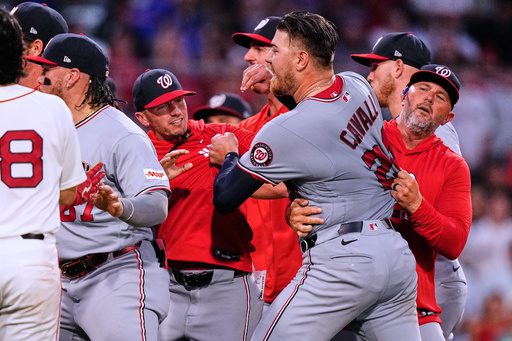
POLICY WIRE — BOSTON, United States — For Washington Nationals pitcher Cade Cavalli, the aftermath wasn’t just about striking out a rival batter; it was a digital tsunami crashing down on a sleepy Wednesday night. A day removed from igniting a benches-clearing incident with a seemingly innocuous, if poorly chosen, phrase directed at Boston Red Sox first baseman Willson Contreras, Cavalli found himself adrift in an ocean of online condemnation.
It wasn’t the pitch that stunned the 27-year-old right-hander; it was the ferocious, instant public backlash. He’d learned the hard way that a few spoken words can become a career-defining soundbite—a global judgment. Cavalli recounted, “I looked at my phone, and I saw what people were saying about me. Saw how torn up my wife was. It hurt my heart,” adding later, “I couldn’t believe it. I really couldn’t. Because I know that people know me, and they know my character, and that’s not me. So, it was hard. I truly didn’t sleep last night.” The agony of immediate online reputation demolition—it’s something many public figures, whether they’re sports stars or politicians, grapple with in this interconnected age.
The core of the brouhaha? After fanning Contreras with a full-count pitch during an 8-1 Nationals victory, Cavalli yelled “sit down, boy!” at the Venezuelan first baseman. Contreras, an athlete whose composure rarely cracks, wasn’t having it. He snapped back, “Are you talking to me?” before charging the mound, sparking the classic on-field fracas that resulted in multiple ejections. Among them were Contreras, Boston interim manager Chad Tracy, Red Sox outfielder Nate Eaton, and Washington pitcher Miles Mikolas. It was quite a spectacle for such a simple exchange.
Now, the word “boy” holds a particularly sharp edge in American English. The term “boy” has a racist history in the United States, often employed historically as a demeaning epithet against Black men. Cavalli, after his belated social media awakening, quickly cottoned on to this grim reality. “There’s a history behind that word, and that’s just something that as a competitor, like in football or basketball, playing wiffle ball with my brother, you don’t understand it,” he acknowledged. But that’s exactly the thing, isn’t it? Language evolves, — and contexts change, especially when dealing with such potent historical baggage.
And for a fleeting moment, a player’s thoughtless outburst became a national discussion on racial sensitivity. He expressed genuine anguish over how his words might have affected his young Black fans, confessing, “I couldn’t sleep because of it. It hurt my heart, knowing that, if there’s a 13-year-old Black kid in D.C. that sees that — that looked up to me and thinks that he perceived it in a way that wasn’t intended the way that it came out, and then he’s not looking up to me anymore — that hurts my heart.” That’s a tough realization to swallow, that your own slip could fracture a young fan’s admiration.
Contreras himself chose discretion over confrontation, not directly alleging racism when questioned. Perhaps he recognized the power of such an accusation, opting to let Cavalli wrestle with his conscience publicly. “I’m extremely torn up about the way that things were perceived,” Cavalli stated, quickly adding, “Obviously, there was no ill intention behind that.” Whether intentions truly matter when the impact is so broad is often a rhetorical tightrope walkers like Cavalli must traverse. He still hasn’t directly connected with Contreras to offer a private mea culpa, though he says he hopes his public statements convey his remorse. “I know that we’re both competitors, I hope that he hears this and he understands that was not what was intended at all,” Cavalli said.
But the damage is done—at least online. This incident is just another data point in the relentless surge of online judgment. For example, a 2023 survey by Statista indicated that 48% of American adults have witnessed hate speech or offensive content online. That’s nearly half the population seeing precisely the kind of rapid-fire condemnation that hit Cavalli, whether deserved or not. Social media, a megaphone in one moment, becomes an executioner’s block the next. This rapid-response court of public opinion doesn’t always differentiate between intent and impact; it rarely offers nuance.
What This Means
This particular fracas, unfolding on an American baseball diamond, offers a stark mirror to broader global dynamics—how easily language, perceived disrespect, and cultural insensitivity can escalate into major flashpoints. It isn’t merely about an ill-chosen word from a pitcher. It speaks to a modern-day policy challenge: how institutions—be they sports leagues, corporations, or even governments—manage reputations and perceived slights in a hyper-connected, easily offended world. When a politician or public figure from Pakistan, for instance, makes a comment interpreted as disparaging a minority group or another nation, the backlash can ignite cross-border diplomatic tensions faster than a news cycle used to allow. We’ve seen similar sensitivities erupt into major crises, for instance, debates around free speech versus religious offense that regularly stir outrage across the Muslim world. The concept of izzat, or honor, for instance, deeply ingrained in South Asian cultures, can mean even an unintentional insult can spiral into far-reaching consequences—much like a single phrase sent a bench-clearing melee into motion and now threatens to stain a player’s image.
It demonstrates that public perception, molded by instant reactions on platforms like X (formerly Twitter) or Instagram, now dictates accountability, often overriding official processes. Organizations like Major League Baseball—or even nation-states dealing with a diplomatic crisis—have to perform a delicate dance. They must acknowledge the historical baggage of certain words while simultaneously understanding the subjective nature of human error, all while the digital masses bay for immediate retribution. This quick-trigger environment suggests a pressing need for better communication strategies, more proactive cultural sensitivity training, and a global re-evaluation of how intent versus impact is weighed in the unforgiving glare of the public eye. And what Cavalli’s apology really represents is the unavoidable, brutal education delivered by modern media to anyone in the public sphere.