
Glide Bombs: Redefining Warfare & Global Security
Unpack the silent revolution of glide bombs. See how these cost-effective, high-volume weapons are devastating Ukraine and reshaping global military strategy.

POLICY WIRE — Washington D.C., USA — The hum of engines on a stealth fighter or the distant thud of artillery — that’s not what rattles generals in war rooms anymore. Not entirely, anyway. It’s the eerie quiet that precedes a devastating blow, the almost invisible descent of a weapon unleashed from miles beyond the front lines, leaving defenders with scant seconds to react. This isn’t science fiction; it’s the uncomfortable reality of the Russia-Ukraine conflict’s next brutal phase, shaped less by infantry pushes and more by the burgeoning prevalence of sophisticated, air-launched glide bombs. But their impact — — and lessons — echo far beyond Eastern Europe’s shattered landscapes.
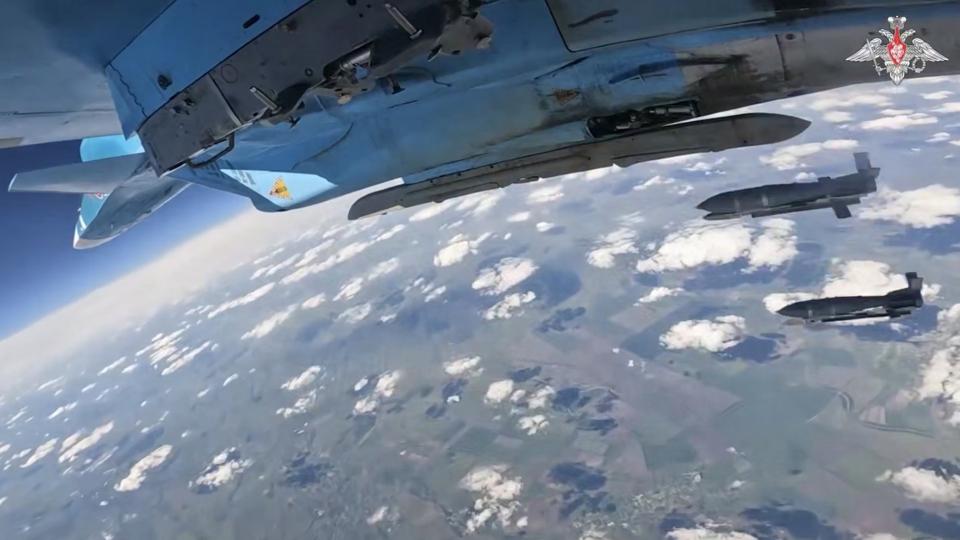
Russia has dramatically escalated its use of these converted, Soviet-era munitions, strapping guidance kits onto old FAB-series bombs. Think of it: they’re not sleek, purpose-built marvels, but repurposed bulk, now suddenly cunning — and lethal. These aren’t your grandfather’s gravity bombs. These are smart. They become formidable, unpowered glide vehicles — an almost low-cost precision strike capability — capable of turning static defensive lines into rubble. They fly extended ranges, typically 40 to 60 kilometers, released from planes operating safely out of immediate Ukrainian air defense reach. But here’s the kicker: they’re relatively cheap compared to the purpose-built cruise missiles and guided munitions of Western arsenals. This allows for volume. Lots of volume. It’s a strategic calculus, stark and chilling, where quantity meets sufficient quality to inflict widespread damage and psychological dread. [QUOTE_PLACEHOLDER]
The implications are stark. Ukraine’s air defenses, already stretched thin against an onslaught of drones and ballistic missiles, now contend with an escalating barrage of these glide weapons. And because they’re essentially unpowered after launch, their flight path can be trickier to predict and counter with traditional interceptors, designed for ballistic arcs or cruise missile signatures. Ukraine faces a grim choice: allocate increasingly scarce, expensive air defense assets to counter these cheap, numerous threats, or watch as front-line fortifications simply disappear. It’s a game of asymmetrical cost, — and right now, Kyiv is losing that specific exchange. Western allies, grappling with their own stockpiles and production limitations, can’t just magically conjure up Patriot batteries by the dozens.
This evolving tactical landscape isn’t just a concern for Kyiv. Geopolitical observers and military planners across the globe — especially in regions with contested borders or burgeoning security challenges — are watching closely. The sheer destructive power of these munitions, coupled with their cost-effectiveness and standoff delivery, offers an unsettling blueprint for future conflicts. Take the broader Muslim world, from the Middle East to South Asia. Countries there often operate with complex threat matrices, from state-sponsored aggression to asymmetric insurgency. A recent report by the Institute for Strategic Defense Studies (ISDS) indicated that defense expenditure in the broader South Asian region alone saw a 12% increase in the last fiscal year, a significant portion earmarked for air defense and precision strike capabilities. But are they adapting fast enough to this kind of innovative, budget-conscious destruction? What if adversaries adopt similar low-cost, high-impact strategies? This innovation could easily migrate to other flashpoints, altering regional power balances and demanding rapid, often expensive, counter-adaptation. Fake Tremors and real ones, both can destabilize.
It’s not just about what hits. It’s also about what can’t be hit back easily. These bombs represent an evolution where conventional air superiority — the idea of flying fighter jets unchallenged — morphs into a more complex contest for control over vast swaths of airspace, including the ‘safe’ zones behind enemy lines. Russia, leveraging its numerical advantage in aviation and a willingness to accept high losses in its older airframes, has turned its older iron bombs into a strategic asset. It’s an inconvenient truth: the era of expensive, single-shot missile dominance might be giving way to a period where ‘good enough’ precision at high volume rules the skies, reshaping tactical doctrine and defense procurement strategies for decades.
What This Means
The ascent of glide bombs points to several uncomfortable realities for global policy makers. Politically, we’re likely to see heightened pressure on Western nations to not only provide advanced air defense systems to Ukraine but also to significantly ramp up production. This isn’t just about charity; it’s about safeguarding allies and understanding the shifting nature of geopolitical competition. The perceived effectiveness of these relatively simple weapons could incentivize other nation-states — or even non-state actors, eventually — to develop or acquire similar capabilities, further destabilizing regions already prone to conflict. It implies a darker horizon for civilian populations, as these high-volume, albeit imprecise (when compared to stealth cruise missiles), weapons aren’t meant for surgical strikes on specific targets but for area denial and overwhelming enemy positions, which often happen to be near towns and cities.
Economically, this signals a fresh boom for the defense industry, particularly in sectors focused on air defense innovation and, ironically, counter-measures against these very glide munitions. Nations across Asia, already engaged in a steady arms race, will scrutinize their procurement budgets, potentially re-evaluating priorities to incorporate robust anti-glide bomb capabilities. For economies recovering from recent shocks, or indeed those perpetually struggling, redirecting funds from public services to enhanced air defenses presents an excruciating dilemma. Because who pays when an entire town gets flattened from 40 kilometers away? The cost of defense just ratcheted up — a lot.