


Celestial Passages and Earthly Priorities: When Near-Misses Distract From Real Perils
POLICY WIRE — New York, USA — We worry about quite a bit down here, don’t we? From inflation — and geopolitical chess to what’s for dinner, our terrestrial concerns feel all-consuming....

POLICY WIRE — New York, USA — We worry about quite a bit down here, don’t we? From inflation — and geopolitical chess to what’s for dinner, our terrestrial concerns feel all-consuming. But every now and then, the cosmos throws a curveball — or, in this instance, a gigantic hunk of rock that’s roughly the size of two to four Empire State Buildings — just to remind us there’s a whole lot of nothing out there and sometimes, it gets pretty close. This weekend, it’s doing precisely that.
No, this isn’t some Hollywood blockbuster premise, but a perfectly benign, if a little eerie, celestial flyby. And that’s really the point, isn’t it? A colossal asteroid named 1997 NC1 will just sorta cruise by, a silent, stony behemoth, at a distance most folks can barely fathom. Yet, for a brief, fleeting moment, it steals headlines and occupies a tiny corner of our collective consciousness, a harmless specter in an often too-threatening world. [QUOTE_PLACEHOLDER]
Discovered nearly three decades ago by an asteroid-tracking system in Hawaii, this space pilgrim’s dimensions are genuinely mind-boggling. We’re talking between 2,461 feet (0.75 kilometer) to 5,413 feet (1.65 kilometers) wide. Think about that for a second. An object this vast, silent — and cold, is merely a speck in the cosmic grand scheme. It makes its closest approach Saturday morning, coming within 1.6 million miles (2.6 million kilometers), according to the European Space Agency.
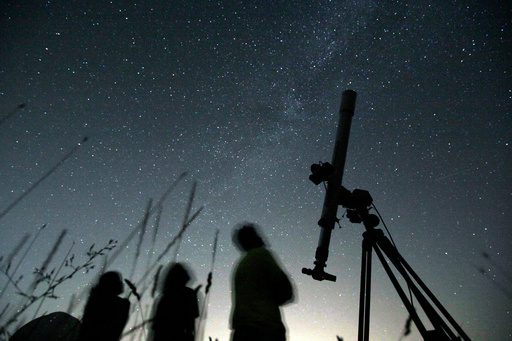
It’s close enough, apparently, for diligent skygazers with binoculars — and small telescopes to perhaps catch a glimpse. You might even spot the asteroid as a small point of light passing harmlessly through the sky. A pretty neat thought, honestly, seeing a cosmic voyager from your backyard. But it’s also a stark reminder of the sophisticated orbital mechanics and painstaking vigilance required to keep tabs on such objects.
For those living in countries like Pakistan, where astronomical observation infrastructure isn’t quite the priority compared to, say, managing persistent energy crises or tackling climate-induced flood recovery, such cosmic occurrences remain largely abstract. Folks there are busy trying to secure their next meal, or maybe just keep the lights on. It’s hard to drum up public interest in a harmless, distant rock when day-to-day existence is already an existential struggle. The policy frameworks for space defense, or even just observational science, simply don’t stack up against more pressing, immediate needs.
But let’s be real, humanity’s fixation with impending doom is hardly a novel concept. We’re wired for it. A massive, harmless asteroid does get our attention, doesn’t it? Though, crucially, ‘harmless’ is the operative word here.
The space rock — 1997 NC1 — makes its closest approach Saturday morning, coming within 1.6 million miles (2.6 million kilometers), according to the European Space Agency. This sort of thing puts life on our little blue marble into a stark, humbling perspective, if you really stop and let it.
And it won’t greet Earth from such a distance again until 2133, according to NASA. So you’ve got nearly a century-and-a-half to plan your next viewing party, I guess. The last time an asteroid similar in size passed safely by Earth from an even closer distance was in 2022, when a space rock called 1994 PC1 made its approach. You know, these things happen. It isn’t new. NASA, ESA and other space agencies track the paths of asteroids and other space junk so they can keep Earth safe from any possible collisions.
Last year, for instance, astronomers tracked a smaller asteroid resembling a spinning hockey puck and said there’s no chance of it hitting Earth or the moon. They’re good at this stuff, these folks. But they’re also human, — and budgets are always a thing. So, for now, we simply watch, knowing we’re utterly dependent on the calculations of a few sharp minds and a bit of cosmic good fortune. It’s a reminder of a grander dance, — and our comparatively minute position within it. Yet, here we’re, caught up in the details.
📄 POLICY WIRE WHITEPAPER PUBLISHED: PAKISTAN'S NATIONAL SECURITY POLICY PRIORITIES
👉 READ BY CLICKING HEREWhat This Means
This weekend’s asteroid flyby, while explicitly posing no danger, subtly highlights the fascinating dichotomy in global priorities and public perception. On one hand, you’ve got advanced space agencies like NASA and the European Space Agency meticulously tracking these objects, dedicating significant resources to planetary defense — a long-term, low-probability, high-impact threat. The reassurance that A large asteroid will zip past Earth this weekend, but don’t worry: It poses no danger offers a measure of cosmic security, a collective sigh of relief that allows us to focus on the more immediate, man-made problems.
But the political — and economic implications are much more nuanced. Consider how these narratives—of external, impersonal threats—sometimes eclipse the policy debates over more controllable, immediate perils like economic instability, healthcare access, or environmental degradation. Does the attention given to a distant asteroid, however fleeting, detract from critical policy discussions happening in Washington or Islamabad? Possibly. Resource allocation is always a zero-sum game, after all. Money spent on ever-improving orbital telescopes is money not spent on, say, strengthening national healthcare systems or investing in climate resilience, which can feel incredibly abstract to those without direct astronomical expertise.
From a global policy perspective, the international cooperation between space agencies on asteroid tracking is actually a success story. It’s a template for what humanity can achieve when faced with a universal threat, albeit one often more perceived than actual. Yet, this shared purpose rarely translates to other pressing international challenges, like coordinated responses to pandemics or poverty. We see organizations wrestling with geopolitical currents all the time, but the unity shown in tracking a distant rock seems, ironically, harder to replicate when dealing with more immediate, messy human problems.
In developing nations, the perception of ‘threats’ is fundamentally different. An asteroid, even if dangerous, often ranks lower than localized conflicts, food shortages, or government corruption. Therefore, the narrative spun by developed nations around planetary defense can seem out of touch or even privileged. It reflects divergent priorities — and varying levels of existential comfort. This flyby, despite its benign nature, thus serves as a tiny, shiny indicator of where global priorities really lie and, perhaps, where they differ. And sometimes, these differences are as vast — and empty as the space between Earth and that rock.