


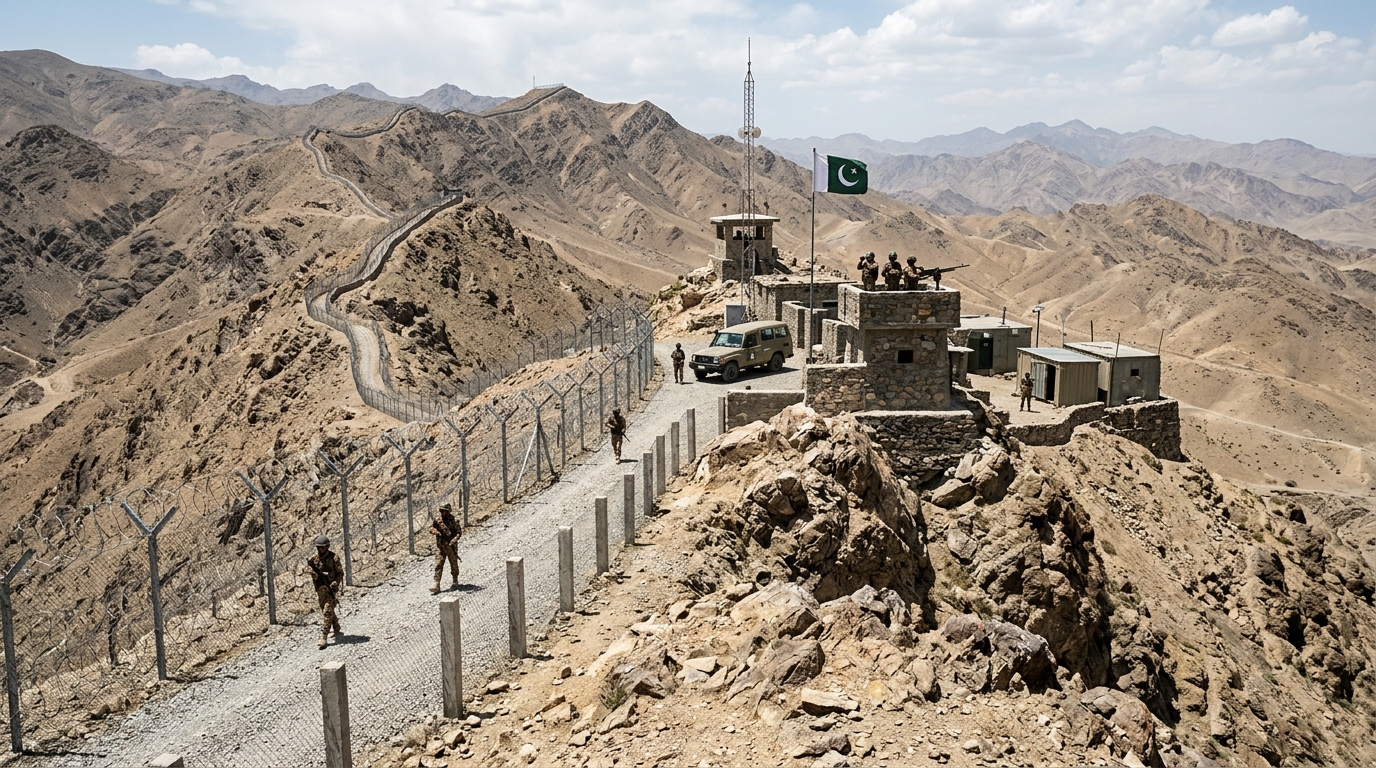

In international relations, there is a well-known idea called “proxy warfare,” where a stronger or hostile state avoids direct confrontation and instead supports armed groups to fight its rival on its behalf. Scholars who study terrorism also describe how ungoverned or loosely controlled border regions often become safe havens for terrorist groups, allowing them to plan, train, and launch attacks across international boundaries while the host state denies responsibility. This theoretical pattern, of using non-state actors as a buffer to strike a neighbour while avoiding open war, is exactly what now lies at the centre of a fresh and serious dispute between Pakistan and Afghanistan.
Pakistan’s Foreign Office has lodged a strong protest with Afghanistan after a terrorist attack on a Pakistan Rangers (Sindh) camp in Karachi left three security personnel dead and four others wounded. The attack, which took place on the night of June 27, 2026, in the Gulistan-e-Jauhar area of the city, has once again raised tensions between the two neighbouring countries over cross-border militancy.
According to the Inter-Services Public Relations (ISPR), the media wing of the Pakistan Army, a group of terrorists attacked the Rangers camp by first setting off an explosion at the main gate. They then tried to force their way inside, but Rangers troops fought back quickly and stopped the attackers from breaching the camp. Three terrorists were killed in the exchange of fire, and a fourth attacker, who was injured, was captured alive. The captured man was identified as an Afghan national.
The attack was first reported near Gulistan-e-Jauhar Block 6, where heavy gunfire and an explosion caused panic in the area. Roads connecting Mosmiyat Chowrangi, Kamran Chowrangi, and Chaman Iqbal Colony were closed to traffic as police and other law enforcement agencies rushed to the scene. A sanitisation operation was carried out afterward to make sure no other terrorists were hiding nearby.
The ISPR blamed the attack on a group called Jamaat-ul-Ahrar (JuA), which Pakistani officials describe as a proxy of India. Jamaat-ul-Ahrar was formed in 2014 after splitting away from the banned Tehreek-e-Taliban Pakistan (TTP), though the two groups reunited in 2024. Pakistan refers to such terrorist groups collectively as “Fitna al-Khawarij.” According to information from the United Nations Security Council, JuA has been operating out of Afghanistan’s Nangarhar province.
Because of the Afghan nationality of the captured attacker, the Pakistani Foreign Office summoned Afghanistan’s Charge d’Affaires in Islamabad and issued what it called a strong demarche, a formal diplomatic protest. Foreign Office spokesperson Tahir Andrabi said the Afghan envoy was called in late on the night of the attack. At the same time, Pakistan’s Ambassador to Kabul, Ubaid-ur-Rehman Nizamani, delivered a similar protest directly to the Afghan Ministry of Foreign Affairs. Andrabi said the involvement of Afghan nationals in the attack proved once again that Afghan soil continues to be used to plan and carry out terrorist attacks inside Pakistan.
In the days following the attack, more details emerged about the captured terrorist. Security sources said he identified himself as Usman Ali, a resident of Jalalabad in Afghanistan’s Nangarhar province, and admitted to being a member of Jamaat-ul-Ahrar. During questioning, he reportedly said that four attackers had taken part in the assault and named his accomplices as Abdul Hadi, Janan, and Umar Farooq. He claimed the group had entered Pakistan about a week before the attack and had stayed in an under-construction building with Hadi, who was from Bajaur. He also said the weapons used in the attack were brought from Waziristan, and that the attackers, including himself, had received training inside Afghanistan, including instructions on making suicide jackets, from a trainer named Umar Qari.
Pakistan’s military responded to the attack with renewed cross-border action. Information Minister Attaullah Tarar said security forces carried out a ground operation in Bajaur district, killing four terrorists, including a commander identified as Khan Farosh. This was followed by what Pakistan called precision airstrikes on terrorist camps in Afghanistan’s Paktia, Paktika, and Kunar provinces under an ongoing campaign known as Operation Ghazab Lil Haq. Afghan officials, however, said the strikes killed dozens of civilians, including women and children, and condemned them as an act of aggression, with one Afghan official warning of retaliation.
This latest exchange adds to a long-running and increasingly tense dispute between the two countries. Pakistan has repeatedly accused the Afghan Taliban government of allowing terrorist groups to use Afghan territory as a safe haven, a claim Kabul has consistently denied, arguing instead that the militancy is Pakistan’s own internal problem. Fighting between the two sides has continued on and off since border clashes broke out in October 2025. Earlier this year, Pakistan presented Afghan authorities with three key demands during talks held in Urumqi, China, asking Kabul to formally declare the TTP a terrorist group, dismantle its infrastructure inside Afghanistan, and provide verifiable proof that action had been taken.
As both governments continue to trade accusations, the Karachi attack has become the latest flashpoint in a relationship marked by deep mistrust, with neither side showing signs of backing down.
Author