


Carla Leite’s WNBA Masterpiece Ignites Debate on Global Talent Flows and Economic Futures
POLICY WIRE — Washington, D.C. — Sundays in professional sports aren’t always about clean narratives and predictable outcomes. Sometimes, they’re about sheer, grinding attrition—a testament to...

POLICY WIRE — Washington, D.C. — Sundays in professional sports aren’t always about clean narratives and predictable outcomes. Sometimes, they’re about sheer, grinding attrition—a testament to human will that spills beyond regulation, into realms of physical and emotional exhaustion. Like when the Washington Mystics faced the Portland Fire recently, a skirmish that stubbornly stretched through four overtime periods, pushing athletes to the brink of what seems tolerable.
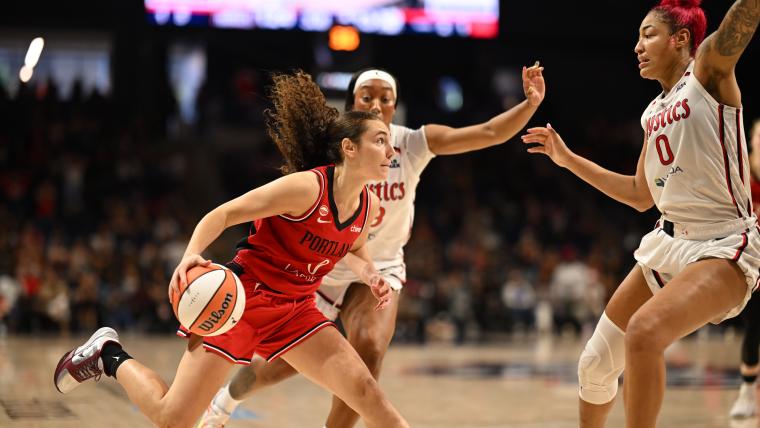
It was in this prolonged, breathless contest, a battle waged far beyond the typical professional basketball encounter, that something truly remarkable unfurled. Not the final score itself (though it was close, agonizingly so for one side), but a single, fleeting sequence—a momentary revolution orchestrated by one player, Carla Leite, that spoke volumes not just about her skill, but about the rapidly evolving global landscape of women’s sports. She made one dribble move late in the game while defended by Shakira Austin, leaving onlookers (and Austin) utterly bewildered. [QUOTE_PLACEHOLDER]
Leite, a French import, found herself with the imposing Mystics big, Austin, switched onto her. And then, she went to work. A drive to her left, then an abrupt stop, reversing course as if aiming to loop back outside. But when Austin eased up, just a fraction, anticipating that perimeter shift, Leite didn’t hesitate. She reversed again, instantaneously, surging by the Mystics defender — and slicing straight to the hoop to score. It wasn’t just effective; it was artistry. Social media erupted. One widely shared post simply stated, That’s so filthy.
And it was. But there’s a particular sting in delivering such a moment of brilliance in a losing effort. The Fire, an expansion franchise, came up one shot short in the fourth OT. They lost, despite Leite’s astonishing stat line. According to WNBA official records, she finished that epic contest with 32 points, 6 rebounds — and 9 assists. Austin, playing an incredible 47 minutes, recorded 9 points, 13 rebounds — and 6 assists. Leite, for her part, was on the court for a near-unbelievable 48 minutes, essentially the entire game plus overtimes. This wasn’t just a highlight reel play; it was a snapshot of a talent that feels rare, one now gracing American courts.
The story here isn’t just a loss or a single, incredible dribble. It’s about a French guard, a revelatory force for an expansion Fire team, becoming an immediate star on the American sporting stage. It’s a trend, actually. The world’s best aren’t just flocking here for fame. They’re coming for opportunity, for a professional structure, and for the recognition that a rapidly growing league can provide.
It’s fascinating, watching these young phenoms from places like France, Australia, and now, potentially, even less traditional basketball nations, ascend in the American system. The WNBA, once a niche market, is increasingly becoming a global magnet, drawing in skill sets that offer an immediate competitive advantage. That pulls in new fans, yes, but also investor interest, creating an ever-expanding feedback loop of talent and capital.
We’ve seen similar dynamics in other spheres of international competition, how a nation’s athletic output or its ability to host major events can become a quiet flex of soft power—the kind that extends influence far beyond traditional military or economic might. America’s soft power often shines through its cultural exports, particularly in sports, and the WNBA is increasingly becoming a part of that narrative.
What This Means
This episode, an intense basketball game defined by individual brilliance and collective endurance, signals something deeper than just a sporting spectacle. For one, it highlights the surging global appeal — and economic viability of the WNBA. The league’s success in attracting elite international talent like Carla Leite (from France) is no accident; it reflects a structured environment that nurtures athletic growth and offers substantial professional opportunity.
The economic implications are straightforward: such talent bolsters viewership, merchandise sales, and crucially, sponsorship deals—fueling further investment into the league and its players. This, in turn, creates a compelling case study for other nations aiming to cultivate their own professional sports ecosystems. Consider, for a moment, how these trends could resonate in regions like South Asia. Nations such as Pakistan, long steeped in cricket, are experiencing demographic shifts and growing youth populations increasingly exposed to diverse global sports through digital platforms. Imagine the ripples of inspiration that could spread if players from similar, less dominant basketball markets could envision such a trajectory for themselves.
The WNBA, by showcasing global stars, indirectly champions a meritocratic athletic capitalism. It implicitly challenges notions of national sports insularity, advocating for a borderless marketplace for top-tier athletic skill. And when an expansion franchise, the Portland Fire, can immediately field a talent of Leite’s caliber, it’s a testament to the league’s robust player development pipelines and scouting networks, which scan the world for the next big thing. But it’s not just about player acquisition. It’s about how this global infusion of talent redefines competitive balances and elevates the overall quality of play, creating a more dynamic and engaging product for audiences worldwide. This subtle, sporting form of economic globalization has far-reaching cultural implications, subtly shaping aspirations and leisure spending habits in burgeoning economies. It also serves as a sharp observation on how athletic migration, much like other forms of skilled labor movement, increasingly favors well-established, well-resourced markets.