


Maple Leaf Moment: Canada’s Shock Win Stirs a Nation Beyond the Ice Rinks
POLICY WIRE — INGLEWOOD, Calif. — The collective roar that tore through SoFi Stadium wasn’t for an Oscar winner, nor a pop idol, but for a different kind of sudden, dizzying spectacle. It erupted not...

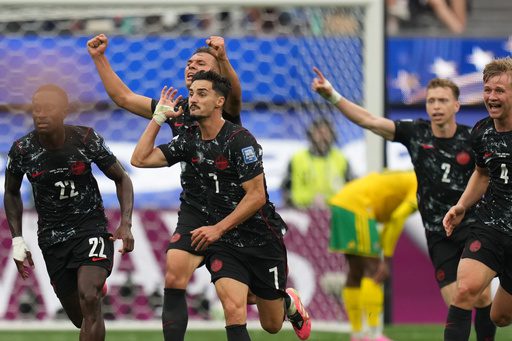
POLICY WIRE — INGLEWOOD, Calif. — The collective roar that tore through SoFi Stadium wasn’t for an Oscar winner, nor a pop idol, but for a different kind of sudden, dizzying spectacle. It erupted not at kickoff, but well after the 90th minute had melted away, when a ball hit the back of the net, ripping through years of expectation—or, more accurately, the distinct lack thereof—for Canadian soccer. Stephen Eustáquio’s late strike wasn’t just a goal; it was a sudden, seismic event that reverberated from the sun-drenched turf of Southern California all the way to frosty Canadian living rooms, an emotional shockwave. And, let’s be honest, few saw it coming.
For a country famously devoted to ice hockey and the calculated savagery of winter sports, football has often felt like an afterthought. An endearing curiosity, perhaps, but certainly not a national obsession capable of sparking mass hysteria. Yet, coach Jesse Marsch knew the weight of the moment, the sheer, intoxicating audacity of it all. After the 1-0 conquest of a resilient South African squad—a team known affectionately as Bafana Bafana, playing with their own fierce, historic pride—Marsch huddled his lads on the pitch, raw emotion crackling in his voice. He shouted: “You guys are Canadian heroes today!” He kept going, you know? “Canadian heroes for the future children of this country who play this sport. The sport has a big future because of you guys. You should be so proud of who you are. You should be so proud of this game. You never lost belief. You went after it, point after point, moment after moment. You are Canadian heroes!” It was pure, unfiltered sentiment, a performance worthy of an entire Hollywood production, minus the staged drama.
This wasn’t just about advancing to the round of 16 for the first time in Canada’s three World Cup appearances. Oh no. Marsch, ever the showman, clearly understood that this single, dramatic victory had the potential to do something far grander: to etch itself into the collective consciousness, to perhaps, just perhaps, forge an entirely new national narrative. He mused, after all the breathless shouting, “But obviously the timing of the goal means that the win is incredibly dramatic, and I think the effect that it will have in Canada, and the inspiring of people, will be immense.” A pretty astute observation, wouldn’t you say? Especially when you consider the stakes for a nation typically more accustomed to winning on frozen ponds than on manicured green fields.
The match itself was a grind, a frustrating testament to South Africa’s cagey defense. Ninety-plus minutes of huffing — and puffing yielded nothing. Until, that’s, Alistair Johnston threaded a long pass into the box, a Hail Mary of sorts, which then ricocheted off a South African defender directly into Eustáquio’s path. The midfielder, who plays his club ball locally for LAFC—how’s that for serendipity?—didn’t waste a nanosecond. He chested it down like it was the easiest thing in the world, then, off the bounce, hammered it into the bottom corner of Ronwen Williams’ net. Bedlam. Utter, joyous pandemonium erupted, Canada’s bench emptying as Eustáquio sprinted into the arms of his teammates, a moment of unadulterated triumph in the second minute of second-half stoppage time. Talk about timing.
“We worked for it,” Eustáquio reflected post-match, clearly still riding the high. “We have a special group. We feel like we are brothers. When we fight for each other, when we play for each other, special things like this can happen. I am over the moon, but at the same time I don’t want to say that the job is finished.” You gotta appreciate that humility. This unexpected progression also saw a brief, welcome return for star defender Alphonso Davies in the 75th minute, his first World Cup action after recovering from a hamstring injury. He immediately dished out the best pass of the day, setting up Promise David for a golden chance that sadly went wide. But it mattered little in the end.
South Africa’s coach Hugo Broos, a figure of dignified resignation, tried to put a brave face on things. “We lost the game because there was a lack of power and speed in our team when I compare that with our opponent,” he observed. His squad, ranked 61st by FIFA before the tournament, gave it their all, certainly. But they managed only one shot on goal throughout the entire game. And Eustáquio? [QUOTE_PLACEHOLDER] Marsch later praised.
What This Means
This seemingly isolated sporting victory isn’t just about athletic prowess; it’s a potent shot in the arm for national identity, especially for a country that often struggles with its own self-image on the global stage. Consider Pakistan, for instance, a nation where cricket isn’t just a sport but a unifying creed. When the national team excels, it creates a palpable sense of shared destiny, overriding linguistic and ethnic divisions. Canada’s hockey dominance provides a similar, if more predictable, touchstone. This football victory, however, punches above its weight because it’s unexpected; it hints at a broader, more diverse athletic capability than previously acknowledged. It allows for a new kind of national pride to coalesce around a global phenomenon, bringing Canada closer to the world’s shared passions—the very passions that resonate across vast stretches of Asia and the Muslim world, where football, or soccer, commands an almost spiritual devotion.
The economic ripple effect, though difficult to quantify immediately, shouldn’t be dismissed either. Increased viewership means more advertising revenue, more merchandise sales, and potentially a spike in youth participation, which then translates into longer-term talent development and even healthier populations. Plus, it serves as a powerful PR moment on an international stage, showcasing Canadian talent and grit, an attractive notion for foreign investment and tourism alike. But let’s not pretend it’s all sunshine — and roses. Canada now faces a formidable challenge against either the Netherlands or Morocco in Houston. Still, the emotional currency generated from this single, improbable win is a powerful, perhaps even enduring, legacy. It demonstrates how political fictions shape perception. It’s what we often see played out in Washington to Karachi, but this time on a very different kind of global stage.