


Beyond the Tape: Arizona’s Track Gods and the Enduring Echoes of Greatness
POLICY WIRE — Phoenix, Arizona — Arizona, it turns out, has a funny way of making history. It isn’t just about canyons or saguaros, not always. Sometimes, it’s the roar of a crowd, the...

POLICY WIRE — Phoenix, Arizona — Arizona, it turns out, has a funny way of making history. It isn’t just about canyons or saguaros, not always. Sometimes, it’s the roar of a crowd, the perfect snap of a stopwatch, and the blur of a young man defying gravity or lung capacity on a dusty track. This whole exercise of listing ‘greats’ feels a bit like trying to categorize thunder—you can measure its decibels, but you’ll never quite capture the sheer awe it commands.
But that’s precisely what a new USA TODAY Network initiative sets out to do: chronicle the roots of America’s sports culture. They’re peeling back layers to spotlight the high school titans who shaped communities and carved indelible marks into their state’s very essence. You see, these aren’t just names; they’re the architects of aspiration, the guys who made everyone else believe it was possible. They made Arizona, a state often synonymous with desert heat and political skirmishes, synonymous with sheer, unadulterated athletic firepower.
We’re talking about a lineup of track — and field phenoms so potent, it’d make an Olympic selection committee blush. It’s easy to look back at the glory. It’s harder to grasp the grind, the early mornings, the solitary focus needed to do something nobody else ever did. And yet, they did it. People forget that these local stories—these individual struggles and triumphs—often carry a weight far beyond the medals and personal bests, stitching communities together, fueling civic pride. “These young athletes weren’t just running for themselves; they were running for an entire state’s self-perception,” observed State Representative Michelle Lujan (D-Phoenix), reflecting on the initiative. “Their success echoed in school halls and living rooms across Arizona, building a collective identity rooted in excellence.”
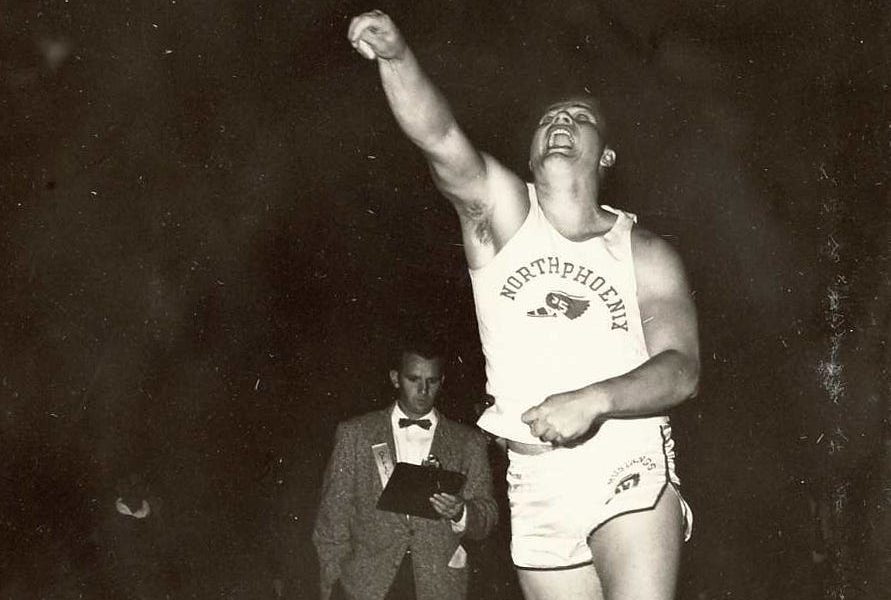
Take Dallas Long, for instance. From Phoenix North, he threw things further than anyone could have imagined. Back in 1958, Long hurled a shot put an astounding 69 feet, 3 inches—a United States high school national record at the time, a statistic pulled directly from the Arizona Interscholastic Association archives that simply beggars belief even now. At 17, he was already world-class, claiming the #2 global ranking. Then he scooped up an Olympic gold — and a bronze. You just don’t see that kind of raw dominance come along every day. His story isn’t just a win; it’s a statement, a defiance of conventional wisdom about what a kid from Arizona could achieve.
But the list goes on, a litany of breathtaking performances. Dwayne Evans, Phoenix South Mountain’s sprinting wizard, grabbed an Olympic bronze at the tender age of 17 in Montreal ’76. Nobody from Arizona had ever done that as a prep. And there’s Nick Hysong, from Tolleson, who pole vaulted higher than anyone before him from the Grand Canyon State, eventually clinching gold at the Sydney Olympics in 2000. These aren’t just athletic achievements; they’re moments that imprinted themselves on the psyche of a state, proving that local talent could compete, and often dominate, on the global stage.
📄 POLICY WIRE WHITEPAPER PUBLISHED: PAKISTAN'S NATIONAL SECURITY POLICY PRIORITIES
👉 READ BY CLICKING HERESometimes, though, global events—the geopolitical tremors that ripple across borders—have their own cruel way of intervening. Consider LaNorris “Cricket” Marshall, Dysart’s speed demon, whose 100-meter dash time from nearly 50 years ago remains an Arizona state record. He was all set for the 1980 Moscow Olympics. But then came the US boycott, a cold, hard dose of political reality that snatched his chance at the ultimate sporting platform. His story isn’t unique; it’s a stark reminder that even the purest athletic dreams can be shattered by decisions far removed from the track itself. But his legend endures, his time unbroken, a testament to what might’ve been.
This interweaving of sports — and global dynamics isn’t just a relic of the Cold War. Today, nations like Pakistan, navigating a complex geopolitical landscape, understand implicitly how sports can project national soft power and unity—whether it’s excelling in cricket or developing other athletic endeavors. They’re investing in youth programs, aiming for global recognition, recognizing that national pride isn’t solely built on military might or economic prowess; it’s also built on shared triumphs and the heroic efforts of individuals who represent their flag. And when global powers clash, as they often do, sports sometimes offer the purest, most relatable common ground. It’s a subtle parallel, certainly, but one that highlights the universal human pursuit of excellence through competition. Geopolitical maneuverings, like acquiring a stealth submarine, grab headlines, but the aspirations of athletes trying to represent their country? Those are stories that echo globally.
What This Means
This deep dive into Arizona’s athletic lineage isn’t merely a nostalgic trip. It’s an investment in local pride — and future talent. But it’s also, fundamentally, about how states—and, by extension, nations—construct identity. The sustained excellence from places like Phoenix North or South Mountain sends a clear message: that raw talent, nurtured correctly, can transcend modest beginnings. And because success breeds success, it incentivizes investment in school sports programs and youth development, a tangible economic and social good. The political implications are clear, if subtle: these are stories that unify, providing non-partisan points of pride in often fractious communities. the enduring tales of athletes like Marshall remind us that even as national and global politics often shape individual fates, the intrinsic human desire for excellence and recognition—be it in Arizona or Lahore—persists, an unyielding constant against the ever-shifting currents of the world. State athletic associations recognize this impact, you bet they do. “You can’t put a price tag on the inspiration these athletes provide,” remarked Dr. Sarah Chen, Director of the Arizona Interscholastic Association. “They prove that greatness isn’t just for big cities; it lives in every community, fueling dreams that ripple through generations.” It just does.