


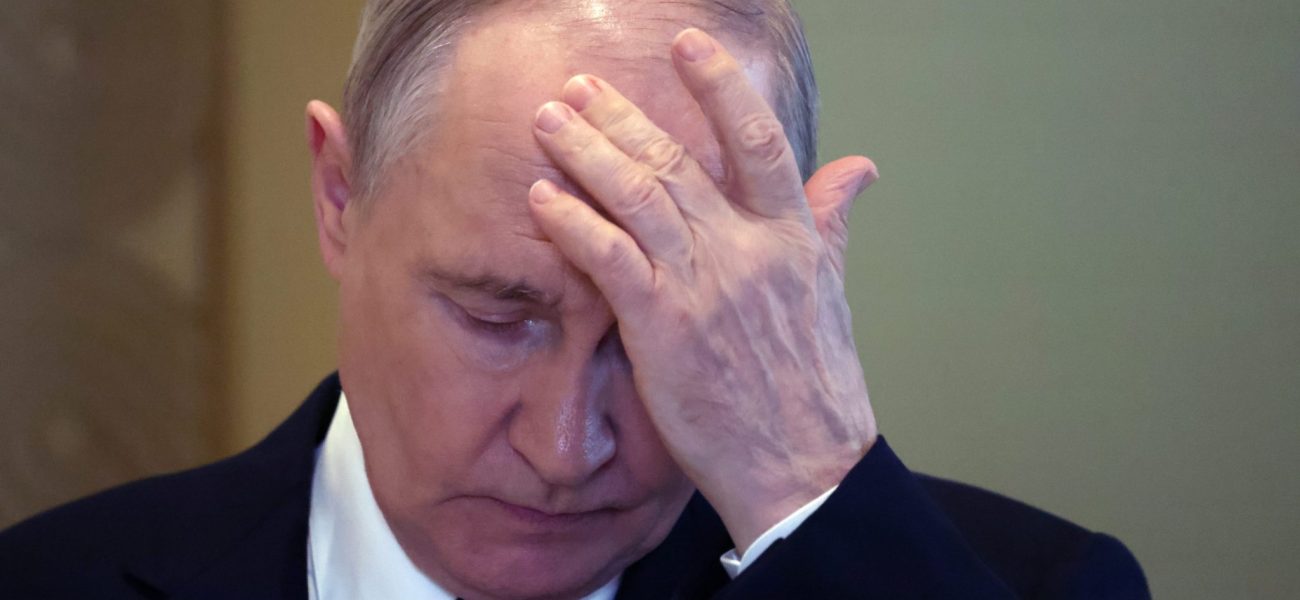
Rubles, Rumors, and Russian Ruin: Putin’s War Economy Faces Reckoning Amid Domestic Decay
POLICY WIRE — Moscow, Russia — Forget the grand strategy; the cracks might just be appearing in Russia’s budget sheets and gas queues. While the world’s gaze fixates on battlefield...

POLICY WIRE — Moscow, Russia — Forget the grand strategy; the cracks might just be appearing in Russia’s budget sheets and gas queues. While the world’s gaze fixates on battlefield maneuvers, a far more mundane, yet potentially devastating, enemy closes in on the Kremlin: fiscal instability. It isn’t some clandestine intelligence operation threatening Vladimir Putin’s long grip, it’s the cold, hard cash – or lack thereof – fueling his ambitions.
It’s the kind of grinding reality that often escapes headlines but shapes history. A former advisor to Russia’s central bank—someone who’s seen the system’s inner workings—has bluntly pointed to the nation’s colossal war expenditure as the Achilles’ heel. His assessment paints a grim picture: a financial hemorrhage spiraling into disarray, prompting both military grumbling and street-level desperation.
The regime, which once boasted of sanction-proofing its economy, now grapples with the everyday ugliness of resource scarcity. Reports—though hard to verify conclusively—have surfaced detailing public squabbles and outright brawls at gas stations, a clear signal that the basic machinery of a modern state is stuttering. Fuel, the lifeblood of transport and industry, appears to be an increasingly contested commodity, its distribution systems frayed by wartime demands and patchy infrastructure. And this isn’t just about domestic consumers; it crimps the nation’s ability to move its troops and matériel efficiently. It’s an inconvenient truth for a Kremlin obsessed with projecting strength.
A recent deep dive by the Congressional Research Service noted that Russia’s military spending saw a stunning 108% increase between 2021 and 2023, reaching an estimated $109 billion last year. This relentless drain isn’t merely siphoning off resources; it’s actively distorting the entire economic landscape. We’re talking about inflation, about industries repurposed for war, and a skilled workforce either conscripted or fleeing the country. This former advisor has stated that the financial stress will lead to significant social upheaval, even to the point where [QUOTE_PLACEHOLDER]. It’s a stark forecast.
There’s a subtle irony, too, in the fact that while Russia claims to be ‘de-Nazifying’ a neighboring country, it’s struggling with the kind of resource management that’s usually the hallmark of less developed nations. But then, autocracies often sacrifice long-term stability for short-term political gains, don’t they?
The murmurs of dissent extend beyond economists’ forecasts. Whispers of military unrest have grown louder, not necessarily due to ideology, but out of frustration with poor logistics, inadequate equipment, and — let’s be honest — the grinding futility of prolonged conflict. History tells us that a dissatisfied military, especially one feeling neglected by the home front, poses a significant threat to any government’s stability. Remember the fate of several Roman emperors, whose power ultimately depended on the legions’ loyalty?
📄 POLICY WIRE WHITEPAPER PUBLISHED: PAKISTAN'S NATIONAL SECURITY POLICY PRIORITIES
👉 READ BY CLICKING HEREAnd when those whispers meet a collapsing domestic economy, a combustible mixture forms. It isn’t about grand ideological shifts; it’s about soldiers not getting paid on time, or their families struggling to put food on the table because the price of basic goods has shot through the roof. It’s gritty, street-level anger that could spark much larger issues. That’s how real revolutions happen, not in think tanks, but in bakeries — and barracks.
The Kremlin’s desperate search for alternative financial arteries stretches beyond its immediate neighbors, reaching far into markets like those in South Asia. Countries like Pakistan, for instance, despite their own complex internal politics and balancing acts between global powers, become potential partners for Russian energy and goods as Moscow navigates Western sanctions. But these new pathways are often inefficient, costly, and inherently precarious, vulnerable to geopolitical whims and sudden shifts in alliance. Moscow is paying a premium, often in concessions or steeply discounted resources, for its pariah status. And this impacts revenue for future economic resilience, or lack thereof. Pakistan, with its own energy needs and fiscal pressures, may find some short-term relief, but it’s a Faustian bargain on both sides, tied to an increasingly unpredictable patron.
What This Means
This escalating economic instability in Russia signals more than just domestic turbulence; it carries significant geopolitical ripple effects. Should the regime truly begin to buckle under fiscal pressure, the global energy markets will undoubtedly feel a tremor, potentially opening new avenues for Western allies while creating fresh challenges for nations like China and India, who have leveraged discounted Russian resources. It’s a re-balancing act no one precisely foresaw.
For regions like South Asia, and particularly Pakistan, the continued dependency on an unstable Russian market—whether for oil, military hardware, or diplomatic maneuvering space—introduces a fresh layer of fragility. Pakistan’s strategic choices, always delicate given its position, become even more fraught as a key partner faces existential economic questions. The risk of being yoked to a faltering power is clear, especially when global financial mechanisms are increasingly scrutinizing secondary sanction compliance. And it suggests that while great power politics usually plays out with grand gestures, it can be undone by simple accounting errors, or, you know, just running out of gas. A shake-up in Moscow, therefore, isn’t just Russia’s problem; it’s a global flashpoint in the making. For another take on geopolitical friction in unexpected places, check out our piece on Tehran’s Edge. And for domestic political fault lines, consider Fissures Deepen.