

The Right-Back Reckoning: England’s Fragile Blueprint Hits Global Stage Crisis
POLICY WIRE — New York, USA — When you talk about the sprawling, meticulously planned machinery of a national football squad — particularly one consistently tipped for glory like England — you...

POLICY WIRE — New York, USA — When you talk about the sprawling, meticulously planned machinery of a national football squad — particularly one consistently tipped for glory like England — you don’t expect the edifice to crumble due to, of all things, a right-back problem. Yet, here we’re. Thomas Tuchel, the man tasked with guiding the Three Lions deep into this World Cup, finds himself grappling with what’s becoming less a tactical niggle and more a full-blown existential threat, all stemming from that often-unheralded position on the pitch.
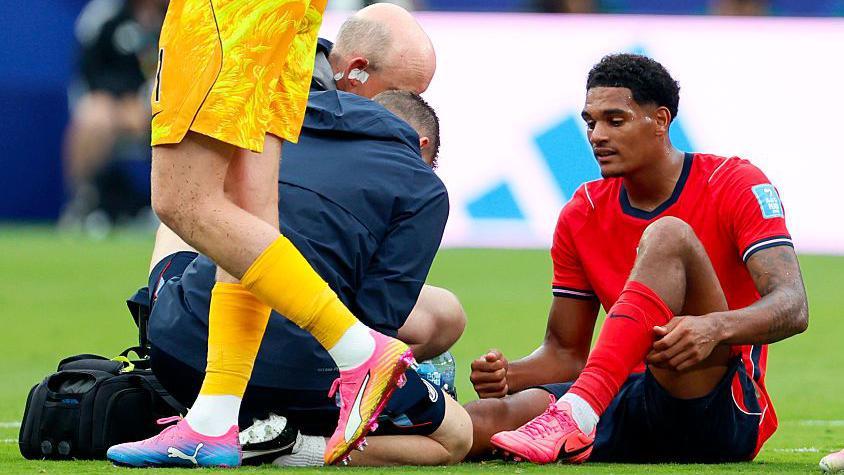
It’s a peculiar twist, really. One minute, you’ve got Reece James, a world-class talent, an engine room all by himself. The next, he’s a question mark. And Tino Livramento? Poof, gone from the squad entirely with a calf issue. This kind of misfortune feels almost conspiratorial, but that’s just the nature of top-tier football—brutal, unpredictable. Now, after Jarell Quansah limped off against Panama—an incident less of an ‘if’ and more of a ‘when’ in this cursed narrative—the depth chart looks less like a pyramid and more like a diving board over an empty pool.
Tuchel, typically measured, couldn’t mask the underlying dread. “A classic ankle twist and he’s in pain,” the coach conceded, his words thinly veiling a headache the size of Atlanta, where their next knockout tie awaits. “He said he had it before and it’s a matter of days.” But, my friend, days are a luxury this side of the World Cup Last-32. “Naturally of course [I am worried about the right-back situation] – we have another injury in the position. It will be a tight race for Reece James and a tight race for Jarell Quansah but it’s our job to find solutions and we will do.” Noble words, sure. But solutions often run out faster than good intentions.
The curious decision, early on, to opt for center-back Trevoh Chalobah over a dedicated right-back alternative like Trent Alexander-Arnold (a name that sparks more debate than a parliamentary budget debate in Westminster) feels particularly prescient now, doesn’t it? Because sometimes, playing it safe—or perhaps, just sticking to a predetermined plan—backfires with spectacular public ignominy. It’s like bringing a knife to a gunfight, then realizing you only packed a butter knife. The world is watching, after all. For instance, World Cup 2022 boasted over 5 billion viewers worldwide, with a significant chunk—over 1.5 billion—tuning in from Asian markets alone, FIFA reports, making every England stumble a universally scrutinized event, from London pubs to Karachi coffee houses.
This isn’t just about a couple of bruised ankles, you know. It’s about a team’s psyche. It’s about a manager’s strategic integrity under pressure. And, frankly, it’s about a global superpower of football – England, with all its deep resources – looking surprisingly brittle when the stakes are at their highest. Who’s left? Djed Spence, Ezri Konsa – a natural centre-back pressed into service. It’s not exactly the dream scenario you draw up on the whiteboards.
But the questions persist: Is this poor judgment in squad selection, a series of unlucky breaks, or the inevitable wear and tear of a grueling season catching up? It’s likely a messy cocktail of all three, served up with a dash of pure, unadulterated bad timing. You’ve gotta wonder, how many late-night sessions is Tuchel pulling, sifting through fringe players, contemplating wild card formations? My guess: plenty. This isn’t just football; it’s a high-stakes, public examination of crisis management.
📄 POLICY WIRE WHITEPAPER PUBLISHED: PAKISTAN'S NATIONAL SECURITY POLICY PRIORITIES
👉 READ BY CLICKING HERE“This isn’t just about right-backs,” opines Gary Lineker, former England international and incisive analyst, in a recent interview. “It’s about the gamble you take with squad construction, believing your initial blueprint can withstand any unforeseen fracture. It seldom does, not at this level, — and definitely not on the World Cup stage. You simply cannot afford this kind of tactical oversight when facing the best.” And he’s not wrong, you can’t.
What This Means
This escalating injury drama transcends the pitch. Economically, any falter in England’s World Cup run has ripple effects: advertising revenue, merchandise sales, even the ephemeral boost to national morale that can fuel consumer spending. A longer run means more primetime viewership across diverse markets—from Jakarta to Lahore, where millions don’t just follow English football, they practically live it. A sudden exit? A damp squib, particularly for global sponsors who bet big on England’s deep run.
Politically, the narrative plays into a broader sense of a nation’s ability to execute complex plans under pressure. Football, for many countries, functions as a proxy for national capability — and pride. England’s handling of this specific crisis reflects on the country’s meticulous planning—or lack thereof—in the eyes of its populace and the wider world. It exposes the fragility inherent in even the most robust systems when unforeseen events strike, a lesson not lost on policy makers grappling with more geopolitical storms. The initial, confident blueprint is dissolving, forcing improvisation at a moment when certainty is demanded. It’s a messy reminder that even well-oiled machines sometimes run out of essential parts, and how quickly those parts disappear when the world is watching, waiting for the stumble.