


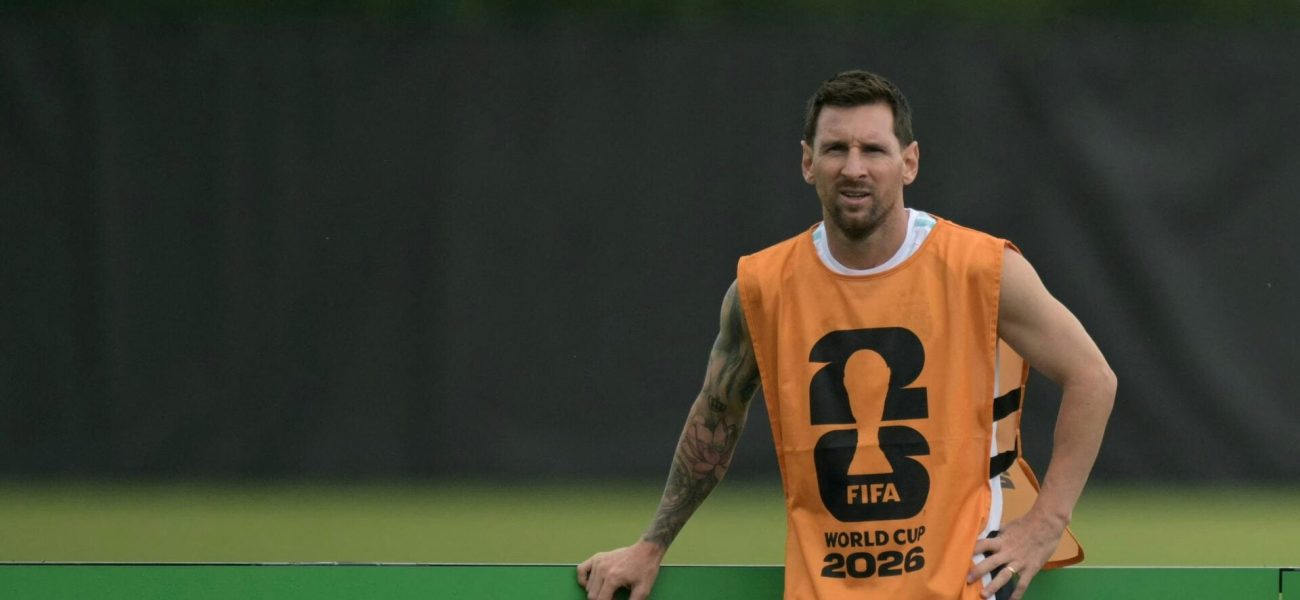
Messi’s Bench Warm-Up: A Geopolitical Touchstone in Qatar’s Global Canvas
POLICY WIRE — Doha, Qatar — Even in the seemingly apolitical realm of athletic contest, decisions reverberate with an uncommon weight. For Argentina’s talisman, Lionel Messi, a seemingly minor...

POLICY WIRE — Doha, Qatar — Even in the seemingly apolitical realm of athletic contest, decisions reverberate with an uncommon weight. For Argentina’s talisman, Lionel Messi, a seemingly minor coaching call—to begin the next World Cup fixture on the sidelines—doesn’t just concern his Golden Boot tally; it paints a fascinating tableau of strategic asset management, global brand valuation, and the often-unseen currents of fan diplomacy.
It’s no small thing to hold back perhaps the sport’s most recognized figure. But as the quadrennial spectacle of global football plays out, managing superstars like Messi is less about simple rotation and more about calculated risk, a delicate dance between preserving physical prime and satiating insatiable global demand. Argentina, you see, has already clinched a spot in the Round of 32, securing its berth early in what’s proven to be a barnstorming campaign so far. They’ve done it, in no small part, on the back of their venerable captain.
The murmurs turned to outright declaration from Argentina’s camp: Lionel Messi won’t start in Argentina’s game against Jordan. And, as Fabrizio Romano relayed, it’s not just talk. [QUOTE_PLACEHOLDER] Leo Messi will be on the bench for Argentina vs Jordan. This isn’t a whimsical choice; it’s rooted firmly in logic. The clash with Jordan, a game with zero bearing on Argentina’s progress to the knockout stages, provides a pristine opportunity to shield their 39-year-old maestro from unnecessary fatigue or, worse, a pre-knockout injury. Because sometimes, even national heroes need a breather.
But the ramifications ripple far beyond the dressing room. For those devoted legions who track every dribble, every shot, this decision, while pragmatic, alters their viewing calculus. Take Pakistan, for instance, a nation where cricket might reign supreme, but football’s reach—particularly during the World Cup—is immense. Or throughout the broader South Asian and Muslim world, where Messi’s iconic status transcends mere sporting fandom, becoming almost a cultural phenomenon. Millions would have meticulously planned their schedules around the precise kickoff, hoping to catch their hero, especially given the convenient time zones relative to the Middle East. They’ve paid their subscriptions, they’ve fueled the networks, they’ve bought the jerseys. And now, the main attraction’s opening act will be a bit muted.
Don’t misunderstand, the stakes are still very real for Messi himself. The 8x Ballon D’Or winner is currently leading the Golden Boot race with five goals to his name. All the next best scorers sit with four goals. While not a personal vanity project, maintaining that edge has real implications for his brand, for sponsorships, and for his enduring legacy. One can almost picture the spreadsheets in his agents’ offices, tallying up the potential financial upside of another goal, another personal accolade. Coach Lionel Scaloni did offer a slight concession to this ambition, affirming that Messi would get some gametime in the second half. [QUOTE_PLACEHOLDER] Leo Messi will be on the bench against Jordan. He will have minutes in the second half. This balance—resting him while giving him a shot at personal glory—shows a savvy understanding of the modern sports ecosystem. It’s good for Messi, for Argentina’s momentum, and, frankly, for keeping fan interest high. Think of the late-game drama potential!
📄 POLICY WIRE WHITEPAPER PUBLISHED: PAKISTAN'S NATIONAL SECURITY POLICY PRIORITIES
👉 READ BY CLICKING HERESuch decisions, even if framed around player welfare and tactical advantage, inherently intersect with the massive economic engine of global football. FIFA, for example, could smash $3bn World Cup target, partly thanks to the incredible drawing power of figures like Messi. When a player with that kind of magnetic pull is on the pitch, ticket prices soar, viewership records tumble, and merchandise flies off shelves. His absence from the starting lineup, even for a single, admittedly ‘meaningless’ group game, isn’t just about a lineup sheet. It’s a calculation, finely tuned to extract maximum value from a rare commodity, while trying not to completely disenfranchise a massive global audience, from Buenos Aires to Lahore.
What This Means
The decision to bench Lionel Messi against Jordan, far from being a simple tactical move, lays bare the intricate political economy of modern football. It demonstrates how national teams, particularly those with a globally recognized superstar, function not merely as sporting entities but as brand managers of immense national assets. The act of benching Messi, though logical for player preservation, carries subtle but significant economic ripples. It can dampen live attendance for this specific group game, affecting ancillary revenue streams in a host nation like Qatar. More profoundly, it plays into the psychology of fan bases across vast geographies, including economically crucial emerging markets in South Asia.
From an economic standpoint, the Golden Boot chase isn’t just about prestige; it translates directly into future endorsement deals and legacy value, something carefully guarded by a player’s management team. Scaloni’s compromise—starting Messi on the bench but promising second-half minutes—is a deft diplomatic maneuver. It signals a respect for Messi’s personal ambition and brand, acknowledges the financial weight of his celebrity, and prevents a complete fan backlash in distant markets that tune in primarily to witness his genius. This careful curation of Messi’s minutes is a masterclass in maximizing returns on human capital within a fiercely competitive global spectacle, illustrating the nuanced interplay between on-field strategy and off-field economics that governs elite-level sport.