

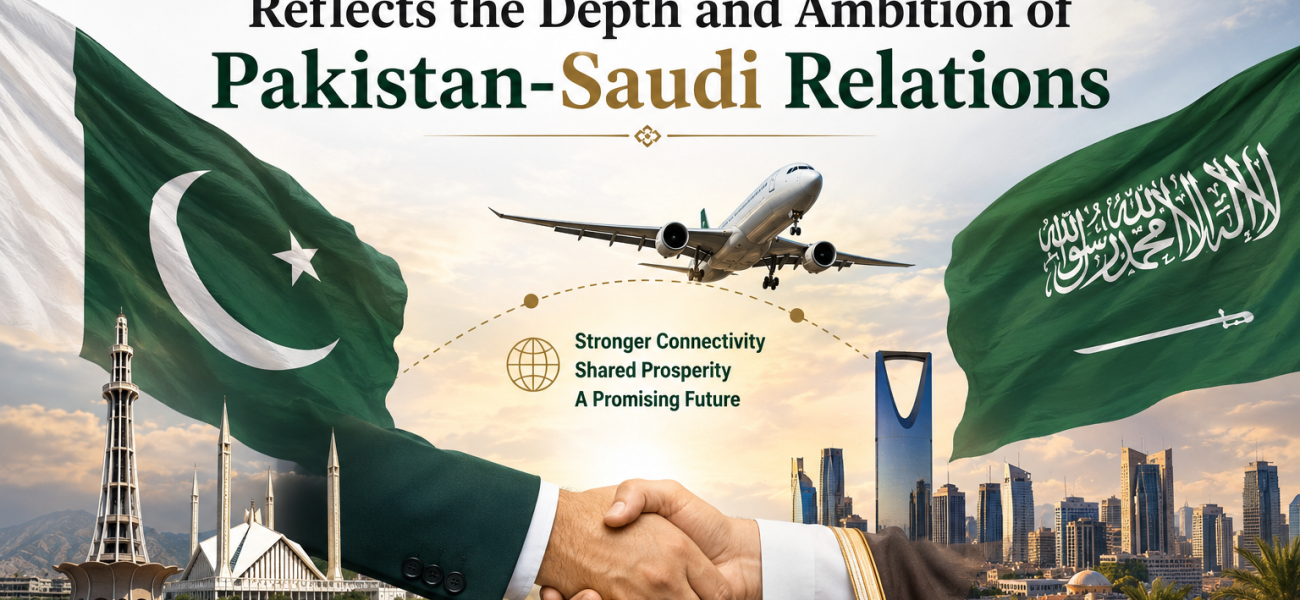
A New Air Accord Reflects the Depth and Ambition of Pakistan-Saudi Relations
An Agreement That Deserves Greater Attention When the Saudi cabinet convened in Jeddah under the presidency of His Majesty King Salman bin Abdulaziz Al Saud and approved a new Air Transport Services...

An Agreement That Deserves Greater Attention
When the Saudi cabinet convened in Jeddah under the presidency of His Majesty King Salman bin Abdulaziz Al Saud and approved a new Air Transport Services Agreement with Pakistan, the announcement was carried through official channels with the measured composure that characterises mature bilateral diplomacy. Published by the Saudi Press Agency following a formal cabinet session, the accord builds upon the aviation framework established between the two countries in August 2023 and represents the latest milestone in one of Pakistan’s most enduring and consequential international partnerships.
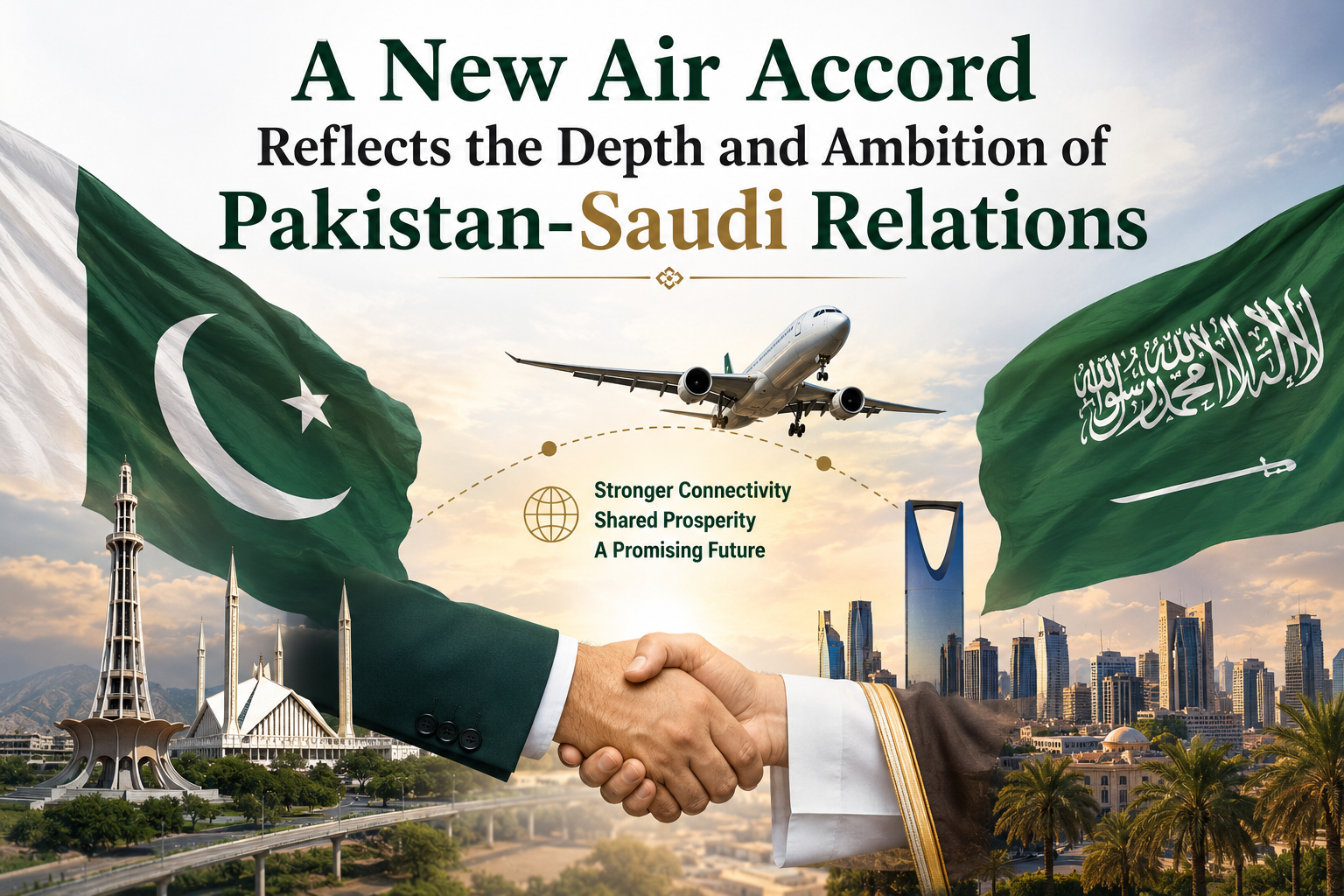
For the millions of Pakistani citizens whose lives are directly connected to the Kingdom of Saudi Arabia, as pilgrims, as workers, as members of families separated by distance, this agreement carries a significance that extends well beyond its technical provisions. It is both a practical instrument of connectivity and a formal reaffirmation of a strategic relationship that has been built over more than six decades of shared history and mutual commitment.
The Human Dimension of Air Connectivity
The relationship between Pakistan and Saudi Arabia is one that operates at a deeply personal level for millions of citizens on both sides. Each year, approximately 180,000 Pakistani pilgrims travel to the holy cities of Makkah and Madinah to perform Hajj, one of the five pillars of Islam and among the most profound obligations a Muslim undertakes in a lifetime. Millions more make the journey annually for Umrah. For these individuals, many of whom have dedicated years of saving and preparation to this singular purpose, the accessibility and affordability of air travel is a matter of the utmost personal and spiritual importance.
Equally important is the large number of Pakistani workers who have found employment in Saudi Arabia. Several hundred thousand Pakistani workers are engaged in various sectors of the Saudi economy like construction, health care, and hospitality, thus making a valuable contribution to the Saudi economy while earning money which serves as an important source of foreign currency for Pakistan. The income that they earn is very crucial for Pakistan and is spent by their family members in all the provinces of the country. Any policy that increases air connectivity between the two countries thus has direct economic implications on the lives of Pakistani citizens.
A Partnership Grounded in Principle and Mutual Respect
An analysis of the historical interactions between the two countries shows that there is a much deeper relationship in existence, which is based on the common religion, strategy and a record of mutual help that has been repeatedly tested throughout many years.
Saudi Arabia has helped Pakistan economically when Pakistan needed money, especially by supplying oil under credit terms and budgetary help. Pakistan, in its turn, has always supported Saudi interests in multilateral negotiations and provided help in security issues since the beginning of their relations.
The new Air Transport Services Agreement is the most recent expression of this partnership, practical in its application, but symbolic in its affirmation of a relationship that continues to evolve and deepen.
Strategic Connectivity and Pakistan’s Broader National Ambitions
The new air accord must also be situated within the larger context of Pakistan’s national connectivity agenda. Pakistan’s geographic position, at the intersection of South Asia, Central Asia and the Middle East, affords it a distinctive strategic advantage as a potential hub for regional trade, investment and transit. Realising that potential demands sustained and deliberate investment in bilateral connectivity agreements with key partner nations.
Enhanced air services with Saudi Arabia serve this broader objective directly. They facilitate the expansion of bilateral trade, support growing flows of investment and tourism, and reinforce the economic rationale underpinning the China-Pakistan Economic Corridor. Each such agreement contributes to the connectivity architecture that Pakistan is progressively constructing across its region, and strengthens Islamabad’s positioning as a serious and capable regional partner rather than a peripheral actor.
Conclusion
Pakistan Saudi Air Transport Services Agreement is a major development in the relations between two strategically important nations. There are clear advantages that go beyond mere economics. The agreement would ensure easier transport services to those who make the holy pilgrimage, provide better access to job opportunities for people, help bring families together and strengthen the economic ties between the two nations.
More fundamentally, the agreement reflects the continued maturation of a partnership that has long served as one of the most stable and productive relationships in Pakistan’s foreign policy. Rooted in shared faith, sustained by decades of mutual support, and now expanding into new dimensions of economic and people-to-people connectivity, the Pakistan-Saudi relationship stands as a model of principled bilateral engagement, and the new air accord is a fitting testament to the ambition that continues to drive it forward.
Author