


Qatar’s Madibo Slapped with Five-Match Ban for World Cup Tackle
POLICY WIRE — New York, USA — The repercussions for a career-altering tackle echoed through international football circles this week as Qatar player Assim Madib...

POLICY WIRE — New York, USA — The repercussions for a career-altering tackle echoed through international football circles this week as Qatar player Assim Madibo received a five-match ban. The disciplinary action, announced Wednesday, addresses an incident during a World Cup match where Madibo’s challenge resulted in Canada midfielder Ismaël Koné suffering a broken leg. (Reporting based on wire reports)
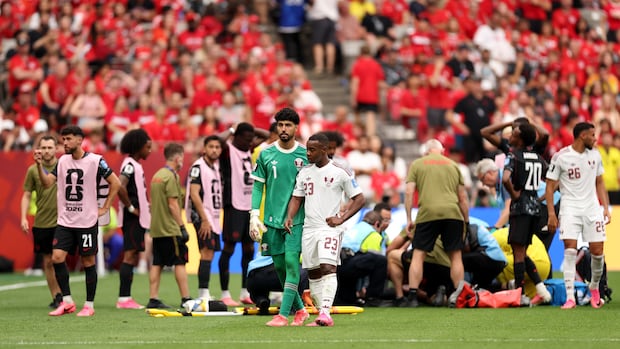
The critical foul, which occurred last Thursday during Canada’s commanding 6-0 victory over Qatar in Vancouver, saw Madibo immediately dismissed from the field. He was shown a straight red card at the time, indicating the severity and intent, or at least the recklessness, judged by the match officials.
Such suspensions are not handed out lightly in the highly competitive world of international football. A five-match ban points to the gravity of the injury sustained by Koné and the disciplinary body’s assessment of Madibo’s actions. It underscores the ongoing scrutiny surrounding player safety and the enforcement of rules designed to protect athletes on the pitch.
For Ismaël Koné, the impact is immediate — and deeply personal. A broken leg can sideline a player for many months, necessitating extensive recovery — and rehabilitation. This not only jeopardizes immediate tournament participation and club commitments but can also have long-term consequences for a player’s career trajectory. Football is a physically demanding sport, and while injuries are an unfortunate reality, severe incidents resulting from dangerous play often provoke calls for stricter penalties and enhanced player protection measures.
Madibo’s suspension will undoubtedly impact Qatar’s squad depth — and tactical options for upcoming fixtures. In tournaments like the World Cup, where every match is crucial, losing a key player to a ban of this magnitude can significantly disrupt team strategy and morale. Beyond the individual consequence for Madibo, this incident serves as a stark reminder to all players of the fine line between aggressive play and actions deemed dangerous by football’s governing bodies.
Disciplinary committees typically consider several factors when determining the length of a suspension, including the nature of the foul, the severity of the injury, and whether there was any prior disciplinary record. The direct red card issued on the field meant that officials deemed the foul to be serious, warranting an immediate ejection and triggering further review by the relevant football association. The subsequent five-match ban suggests the disciplinary panel concurred with, and further underscored, the on-field judgment regarding the severity of the tackle.
The context of a World Cup fixture, even if it was a preliminary or friendly match labeled as such in reports, adds another layer of significance. International competitions are high-stakes environments, where emotions run high and the pressure to perform is immense. However, this pressure is not, — and cannot be, an excuse for compromising player safety through reckless challenges.
What This Means
This substantial suspension for Assim Madibo sends a clear message within international football: dangerous play resulting in severe injury will be met with significant punitive action. Such decisions are crucial in maintaining the integrity of the game and protecting its most valuable assets – the players. For Koné, the immediate future involves a challenging rehabilitation journey, while Madibo will face a period of forced absence from the sport. This event also highlights the vigilance required by officials and disciplinary committees to ensure player welfare, continually balancing the physicality inherent in football with the need to prevent malicious or excessively reckless tackles. Whether such bans serve as sufficient deterrents for future incidents remains an ongoing debate among sports authorities and player unions, but for now, the consequences are stark for all involved.