


Double Quakes Rock Venezuela, Killing Dozens, Injuring Hundreds in Capital Region
POLICY WIRE — Caracas, Venezuela — A series of seismic shocks rocked Venezuela on Wednesday, exacting a grim human toll in and around the capital city of Caraca...

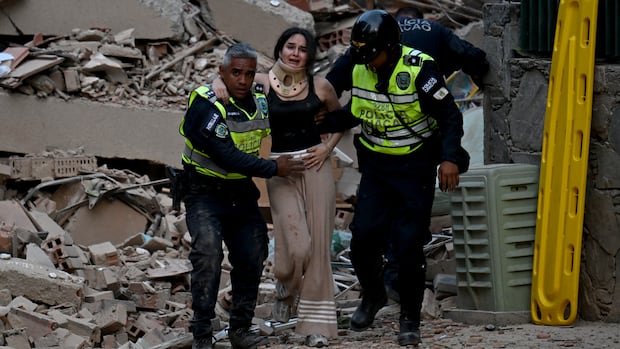
POLICY WIRE — Caracas, Venezuela — A series of seismic shocks rocked Venezuela on Wednesday, exacting a grim human toll in and around the capital city of Caracas. Two powerful earthquakes, striking in quick succession, claimed at least 32 lives and left a staggering 700 individuals injured, as reported by interim President Delcy Rodriguez. The immediate aftermath saw widespread damage, with buildings collapsing and communities grappling with the sudden devastation.
The tremor’s epicenter — and magnitude were not immediately detailed, but their destructive impact was clear. The significant number of casualties—dozens dead, hundreds wounded—highlights the severity of the events, prompting an urgent response across the affected regions. Caracas, a densely populated metropolitan area, experienced direct consequences of the quakes.
Interim President Delcy Rodriguez confirmed the preliminary figures, noting the tragic loss of life and the substantial count of those requiring medical attention. Her statement provided the initial assessment of the human impact as emergency services undoubtedly scrambled to navigate the chaos and begin search and rescue operations amidst the rubble of collapsed structures.
Geographically, Venezuela sits near the boundary of the Caribbean and South American tectonic plates, a region prone to seismic activity. (This geological context is general knowledge). While not historically as active as some of the Pacific Rim countries, the country does experience earthquakes periodically. Wednesday’s events serve as a stark reminder of these underlying geological forces and the vulnerability of urban infrastructure to their immense power.
The collapse of buildings, specifically noted in interim President Rodriguez’s remarks, points to either the intensity of the quakes, vulnerabilities in older construction, or a combination thereof. In densely built environments like Caracas, even moderate tremors can escalate into significant disasters if structures are not built to withstand the force. The sheer number of injured suggests not just direct impacts from collapsing structures, but also injuries from falling debris, panic-induced incidents, and the sheer force of the ground motion itself. Such large-scale injury counts inevitably strain local emergency medical services, requiring coordinated efforts to treat the wounded.
Recovery efforts in the wake of such a disaster are typically multifaceted, involving search and rescue teams, medical aid, temporary shelter for displaced populations, and eventual reconstruction. (This general process is general knowledge). The challenge is compounded in a country already navigating various economic — and social complexities. The loss of life is immediate and tragic; the long-term impact on the affected families and the broader community will extend far beyond the initial assessment. The suddenness of an earthquake often leaves communities little time to prepare, making rapid response crucial for mitigating further loss.
What This Means
The double earthquake event in Venezuela, with its confirmed toll of at least 32 fatalities and 700 injuries, underscores the ever-present threat of natural disasters in seismically active zones. For nations like Venezuela, nestled within a tectonic plate boundary, robust disaster preparedness and resilient urban planning are not merely recommendations, but existential necessities. The reported collapse of buildings highlights the critical importance of modern, earthquake-resistant construction codes and the rigorous enforcement of these standards, particularly in high-density areas such as Caracas.
The substantial injury count will likely place immediate, severe pressure on Venezuela’s healthcare infrastructure, demanding swift allocation of resources for emergency medical care and long-term recovery. Beyond the immediate humanitarian crisis, such events inevitably prompt scrutiny of existing emergency response capabilities and communication networks. Looking forward, the true measure of resilience will lie in the efficiency of the humanitarian aid operations that follow and the strategic planning to mitigate risks from future seismic events, potentially involving reassessments of vulnerable infrastructure and public safety protocols. The economic ripple effects of infrastructure damage and disruption could also pose challenges for a nation already contending with economic headwinds.