
Starlight or Star Power? The Billion-Dollar Cosmos of Messi vs. Ronaldo
POLICY WIRE — GENEVA, SWITZERLAND — In an era often derided for its banality, when global figures rarely escape intense scrutiny, the enduring saga of Lionel Messi and Cristiano Ronaldo offers a...

POLICY WIRE — GENEVA, SWITZERLAND — In an era often derided for its banality, when global figures rarely escape intense scrutiny, the enduring saga of Lionel Messi and Cristiano Ronaldo offers a curious antidote: a myth-making apparatus so potent it distorts reality, elevates brand values into the stratosphere, and keeps billions glued to screens across continents. It isn’t merely football anymore. It’s a multi-billion-dollar enterprise, sustained by what some, perhaps whimsically, claim was a destiny written in the stars, a cosmic competition playing out for nearly two decades.
Because frankly, what else can explain such sustained, individual dominance in a team sport? You’d think the sheer numbers alone would satiate our collective appetite. Eight Ballon d’Ors for Messi, five for Ronaldo. Nine Champions League titles between them. Thirty-six head-to-head contests, with Messi’s teams prevailing in sixteen of them to Ronaldo’s eleven. These aren’t just statistics. They’re milestones in a global narrative, data points carefully curated to fuel an incessant, perhaps even manufactured, debate.
It’s this incessant framing—this demand for an ultimate victor in a rivalry where both men have fundamentally reshaped their sport—that policy analysts often miss. The financial implications alone are staggering. Ronaldo, for instance, boasts a net worth exceeding $1 billion, as reported by Forbes, primarily propelled by his on-field prowess but amplified by an unparalleled marketing machine. Messi, not far behind, sits around $850 million. These aren’t just footballers; they’re economic superpowers. They move markets. They influence consumer behavior on a scale few politicians could ever dream of.
And yes, the whispers about cosmic alignments? They aren’t confined to tabloid horoscopes. From sports psychologists to brand strategists, the allure of ‘fated rivalries’ is irresistible. It grants gravitas. It justifies the endless, fervent discussions from the bazaars of Karachi to the corporate boardrooms of London. The fervor these two players ignite in regions like South Asia is incredible; it transcends simple fandom. It often aligns with aspirations, with a desire to see global excellence, sometimes even as a proxy for regional pride,
observes Dr. Aisha Khan, Senior Fellow at the Lahore Institute of Global Affairs. It’s not just about who scores more; it’s about the entire cultural narrative they embody, making them more significant than just athletes.
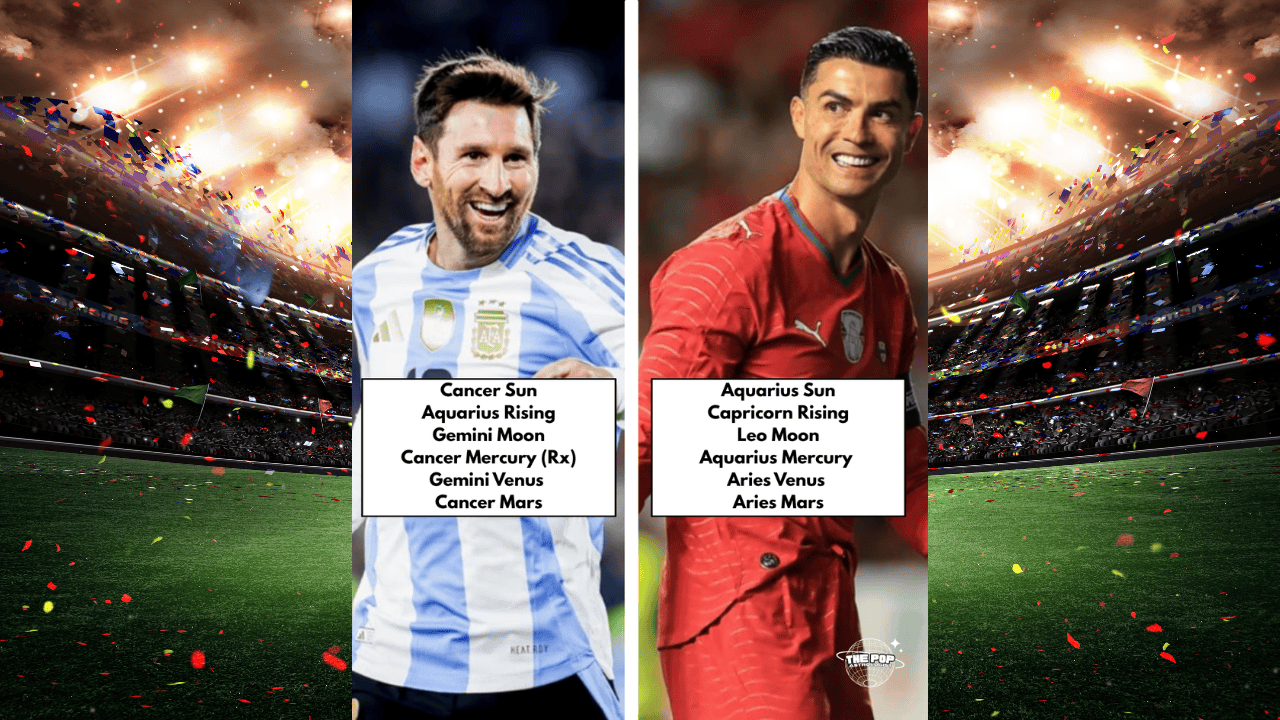
Their sustained presence, sometimes against all odds, certainly fuels the narrative of destiny. Messi, for his part, often projects a persona rooted in familial bonds. His Jupiter placement, the planet of abundance, literally sits at the bottom of his birth chart, on his Imum Coeli, representing roots. This, we’re told, connects directly to his father, a foundational figure in his life—a story arc neatly tying success to origins. Ronaldo, on the other hand, embodies raw ambition. His Venus-Mars conjunction in fiery Aries, seen as driving his competitive spirit, is reportedly housed in his chart’s fourth sector, speaking to a hunger forged early, an almost predestined push for individual excellence. One’s home. The other’s hunger. It’s a tale as old as, well, competitive sport.
But the true magic, some insist, lies in their synastry—how their charts overlay. Allegedly, each man occupies the other’s ‘rival zone,’ a perfectly convenient astrological explanation for their magnetic, ceaseless competition. It sounds almost too neat, doesn’t it? As if the universe itself storyboarded this epic duel. And why wouldn’t it? The spectacle drives billions in revenue for broadcast rights, endorsements, — and merchandising. FIFA, a body that understands global appeal better than most, certainly knows the value of a compelling narrative, especially one involving two living legends.
From a commercial perspective, their rivalry has been an unprecedented gift,
states Marcus Thorne, former Head of Commercial Operations at FIFA. They didn’t just play the game; they expanded its reach, brought in new demographics, and demonstrated the immense financial power of individual sporting brands on a truly global stage. Their perceived ‘destiny’ to compete, whether you believe it or not, was pure gold for the industry.
We’re witnessing, in other words, less a sporting rivalry and more an exercise in global brand management.
This 2026 World Cup provides a fascinating, perhaps final, chapter. With Messi already at five goals after two matches and Ronaldo navigating a tricky group stage, the Mercury retrograde in Cancer—for those who consult such things—stirs ‘nostalgia and unfinished business.’ It certainly makes for great punditry, even better advertising. And while new talents like Mbappé and Haaland are clearly emerging, the public’s gaze remains fixed on these two aging titans, desperately hoping for one last, glorious clash.
What This Means
This endless fascination isn’t just about football; it’s about control over narrative — and global influence. The Messi-Ronaldo dynamic is a masterclass in soft power, demonstrating how individual athletes can become cultural ambassadors far more effective than diplomats. For countries, their allegiances—or simply their viewership numbers—can quietly elevate their standing in the global sporting ecosystem, making them desirable hosts for future events, or lucrative markets for merchandise. the economic engine driving these mega-rivalries—billions in media rights, sponsorships, tourism—presents a stark picture of modern capitalism. It shows us how effectively a crafted ‘destiny’ can generate wealth and engagement, far beyond the confines of the pitch itself. It forces policymakers to recognize that ‘sport’ is often ‘industry,’ with geopolitical and economic ramifications that are rarely ‘casual.’
In the end, perhaps the astrology buffs got it half-right. Not that the stars pre-ordained their rivalry, but rather that human beings, driven by ambition and an innate desire for epic stories, effectively manifested it into a real, tangible phenomenon. It’s a testament not to cosmic alignment, but to humanity’s capacity for creating grand narratives and—crucially—spending billions to consume them. And so the games, both on and off the field, continue.