

Asphalt’s Ironic Twist: Albuquerque Traffic Headache Ends Early, Or Does It?
POLICY WIRE — Albuquerque, United States — For those gridlocked in the seemingly eternal asphalt labyrinth of Albuquerque’s busiest arteries, a flicker of improbable hope just arrived. A major choke...

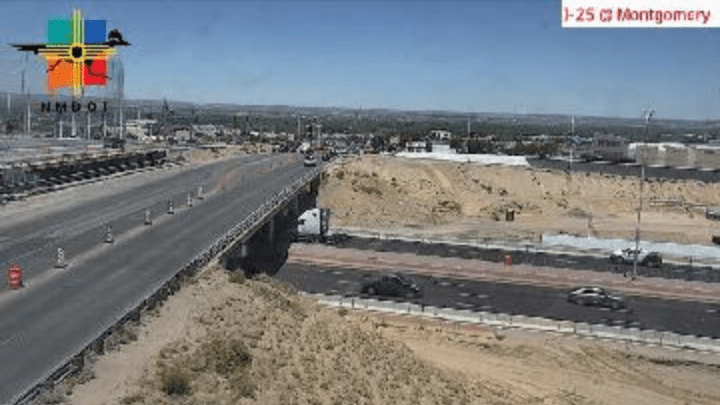
POLICY WIRE — Albuquerque, United States — For those gridlocked in the seemingly eternal asphalt labyrinth of Albuquerque’s busiest arteries, a flicker of improbable hope just arrived. A major choke point, an off-ramp — the southbound Interstate 25 off-ramp to Montgomery Boulevard in northeast Albuquerque — is slated to close. Sounds like more misery, doesn’t it?
But here’s the rub: this isn’t just another phase of soul-crushing congestion. Instead, the New Mexico Department of Transportation (NMDOT) has suggested this part of the ‘I-25 Improved’ saga, a project known for causing significant anguish (a euphemism for widespread road rage, really), might actually wrap up ahead of schedule. Consider it a minor miracle, or at least a public relations win, given how often these things drag on, stretching taxpayer patience thinner than an overheated tire on a long desert haul. (Awaiting official quote)
Beginning Wednesday night and set to stretch until early August, this specific closure kicks off a rapid construction push. Crews will construct the new off-ramp after the old one closes Wednesday at 10 p.m. It’s a short, sharp shock to the commuter system, disrupting thousands who navigate that segment daily. Traffic will be detoured around the clock to Comanche Road until the new off-ramp is ready to open in August. And just like that, the familiar flow is re-routed, testing the patience of everyone from harried parents on the school run to truckers hauling critical goods. This particular stretch isn’t just a local annoyance; it’s a critical vein in the region’s economic bloodstream, connecting residential areas to commercial hubs and the national interstate network.
And so, while local officials are probably doing high-fives over what KOB.com reported as the NMDOT’s claim it’s likely to finish ahead of schedule, one can’t help but notice the peculiar dynamics of modern infrastructure projects. Remember, this initiative, the larger ‘I-25 Improved’ project, has wreaked havoc on drivers since it began back in 2020. The official line implies an unexpected acceleration, but many commuters might be left wondering if ‘ahead of schedule’ simply means ‘less delayed than our worst fears.’ It’s a classic move in public works communications, managing expectations by overstating the challenge, then celebrating meeting or slightly beating an adjusted, conservative timeline. Call it the bureaucrat’s slight of hand—a perfectly respectable strategy for anyone trying to avoid pitchforks at town halls.
The state DOT, per a KOB report, wasn’t just bragging about finishing early; they’re also hinting at more projects coming. This suggests an ongoing, probably never-ending cycle of improvement, repair, and rerouting—a perpetual motion machine of orange cones and freshly poured asphalt. But at least here, in this specific instance, the New Mexico Department of Transportation told KOB this week it’s likely to finish ahead of schedule. It’s a rare pronouncement in the world of large-scale government contracts. But is it genuinely a triumph of efficiency or just a sigh of relief from beleaguered planners?
Consider the scale, for a moment. This particular segment of Interstate 25, while busy, pales in comparison to the urban infrastructure demands seen globally. Take, for instance, a metropolis like Karachi, Pakistan. Its populace grapples with traffic congestion costs estimated by some economic models to run into billions of dollars annually – far outpacing the localized (albeit intense) frustrations of Albuquerque residents. In many South Asian or Muslim-majority nations, the sheer volume of traffic and the inadequacy of existing infrastructure turn daily commutes into epic struggles, impacting economic productivity and public health. This single ramp closure in New Mexico, for all its inconvenience, occurs within a relatively robust framework of planning and public finance that often eludes its counterparts in regions contending with far more substantial, existential infrastructural deficits.
📄 POLICY WIRE WHITEPAPER PUBLISHED: PAKISTAN'S NATIONAL SECURITY POLICY PRIORITIES
👉 READ BY CLICKING HEREStill, disruptions, even small ones, aren’t trivial for the local economy. Businesses near the detour routes often see a temporary bump, while those on the now less-traveled main path might suffer. A single day of unexpected gridlock can cost local businesses tens of thousands in lost productivity and sales, according to a 2022 study by the American Transportation Research Institute which found that traffic congestion adds an average of 4.3 cents per mile to the operational costs of trucking. It’s a cascading effect, felt in reduced delivery efficiency — and ultimately, consumer prices. For residents, it’s personal: more gas, more time away from family, a little more rage on the morning drive.
This particular ramp, though, is scheduled for a short, sharp jolt—unlike those prolonged infrastructural agonies that plague other parts of the world, where grand projects seem to begin without a visible end in sight. Here, it’s a focused intervention, an amputation for the sake of the limb’s overall health. That’s the theory, anyway. We’ll all be watching to see if this particular piece of highway promises actually stick. Because when it comes to traffic, we’ve learned to be skeptical.
What This Means
The impending closure and expedited construction of the I-25 off-ramp aren’t just about asphalt and concrete; they reflect deeper dynamics in urban governance and economic flow. From a political standpoint, NMDOT’s early completion projection offers a welcome—if perhaps temporary—boost in public confidence, something increasingly rare for government-led projects. It’s an exercise in expectation management, minimizing the political fallout that invariably accompanies prolonged commuter disruption. A sense of governmental competence, even if it’s an illusion born from careful framing, is a commodity. It implies responsiveness, or at least the perception of it, crucial for public agencies often critiqued for sluggishness and overruns. But it doesn’t change the foundational headache: the relentless strain urban sprawl puts on outdated roadways. Cities are living organisms, and their circulatory systems—our roads—are constantly under stress. Upgrading them isn’t an option; it’s a desperate chase to keep pace with demand, a chase many cities, particularly those in the rapidly urbanizing parts of Asia like Lahore or Dhaka, are losing. Those cities don’t have the luxury of relatively clear-cut construction timelines, or the funding streams, often resorting to more fragmented, less comprehensive solutions.
Economically, any traffic diversion, no matter how brief, creates winners — and losers among local businesses. Smaller, independent ventures along detour routes may experience a fleeting boost, but the broader commercial impact tends towards a net negative due to reduced accessibility and increased logistical costs. For the Albuquerque metropolitan area, this project is part of a longer-term investment in regional efficiency. Completed upgrades, theoretically, reduce travel times, cut fuel consumption, and attract more businesses by signaling a well-maintained transport network. However, the recurring nature of these projects suggests a perpetual state of investment and disruption, where true efficiency gains are continually offset by the growing demands of population and commerce. It’s a treadmill, not a finish line. The underlying policy implication is clear: even well-managed urban centers are in a constant state of costly adaptation, a battle against obsolescence as old as the roads themselves. And they’re battles fought in ways both efficient and, frankly, incredibly messy, depending on where you are in the world. It’s rarely just about the concrete; it’s about the commerce, the commute, — and the public trust.