

Constitutional Supremacy Must Prevail Over Street Pressure in AJK
The Supreme Court of Azad Kashmir’s recent Advisory Opinion has shed much-needed light on a controversy that has been a part of political debate for months now. The central point of the...

The Supreme Court of Azad Kashmir’s recent Advisory Opinion has shed much-needed light on a controversy that has been a part of political debate for months now. The central point of the controversy is a basic one and lends itself to many variations: “Should constitutional change be followed by the tried and tested means of democratic institutions or pressure of the street be applied?
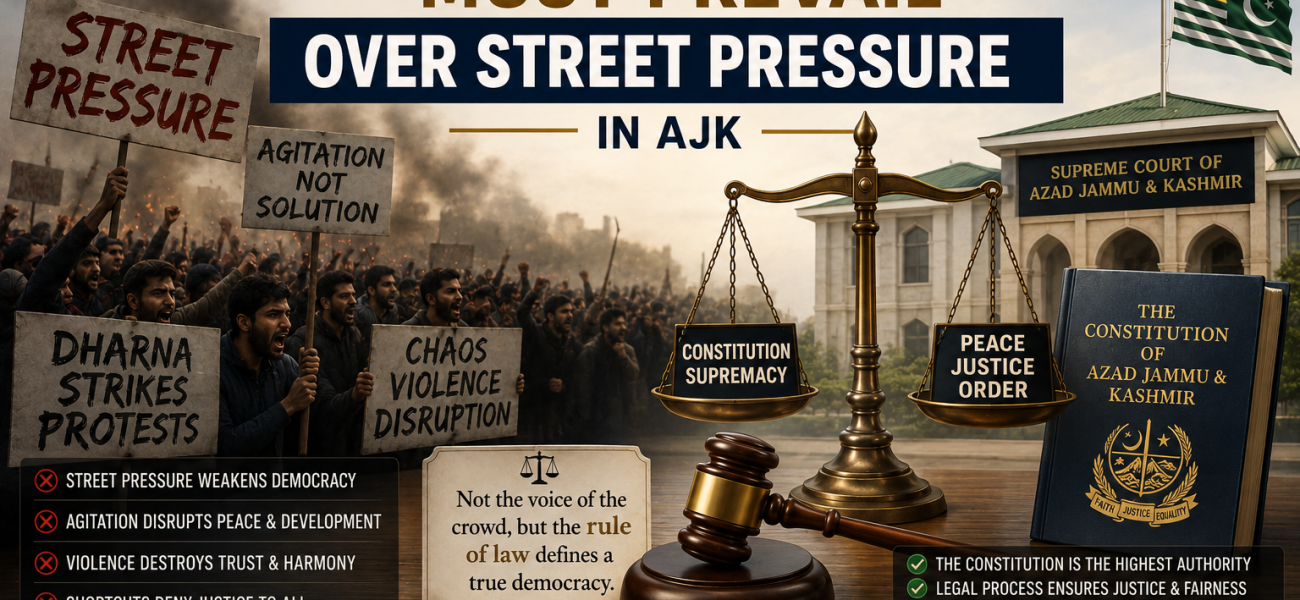
The answer of the Court is clear. Constitutional changes should not be forced for political purposes, it said, but be done through constitutional means as mandated by the law. As in such doing, the Court has reaffirmed one of the core elements of every democratic system: that the Constitution is supreme.
The issue of the 12 refugee constituencies was brought forward as a political and administrative issue by the Joint Awami Action Committee (JAAC). But, as the Court rightly concluded, these constituencies have nothing to do with administrative arrangements that are discretionary to the will of the Executive. These are an integral part of the constitutional composition of the Legislative Assembly. Thus, they can only be eliminated, limited, or modified by means of a constitutional amendment, under Article 33.
The result is particularly of interest. This meant that in principle, there was no legal power for the Government and the PM to accede to demands for refugee seats on ministerial basis however strong public pressure was. So, crucially, the Government did not shirk on constitutional matters but they accepted their own constitutional boundaries.
Many have tried to label this stance as an anti-reformist stance. The Court’s opinion shows otherwise. A constitutional change is always possible—the process must happen within the framework of the Legislative Assembly, the body with explicit power to discuss and accept constitutional amendments. The question isn’t if, but how, refugee places are to be settled; and the question isn’t if, either, but how, constitutional questions are to be settled outside the constitutional institutions.
The Court’s approach to public protest is likewise worthy of comment. The Advisory Opinion correctly states that the “right to assembly and the right to association are constitutional rights recognised by the state. But no constitutional democracy subjects these freedoms to unlimited impose and restrictions. Rights have responsibilities associated with them, and rights must be used responsibly, having regard to the rights of others.
The Court emphasized that the constitutional rights of citizens do not extend to road blockades, disruption of economic activities, blockage of elections, paralysis of public institutions or intimidation with the goal of bringing about political results. Peaceful protest is a right and part of democracy. Coercion is not. The difference is significant because in democratic processes, persuasion and representation matter—and the capacity of any particular group to make things happen on its own account via disruption does not.
The decision is likewise important in the context of elections. The Court, in referring to Article 22(4), reiterated that the general elections have to be held within the frame of the constitution. The democratic process—even in the face of a grave political conflict—must not be suspended for a long time. After polling has announced, the constitutional way opens to change to all political actors.
📄 POLICY WIRE WHITEPAPER PUBLISHED: PAKISTAN'S NATIONAL SECURITY POLICY PRIORITIES
👉 READ BY CLICKING HEREFor those who wish for change, the path is clear and straightforward: Challenge elections, win their people over, get their approval, and press for changes in the Assembly. This is the way constitutional democracies work. In the Court’s opinion, it restates the rule that disputes over the Constitution should be settled by political rather than street means.
The ruling also highlights the duties of the State. The government has the right but also the constitutional duty to keep public order. If there are recurring immigration-related issues related to violence, attacks on Law Enforcement, disturbance of public order and/or interference with election, State Institutions should not be inactive. Their job is to provide a continuity of constitutional governance and to safeguard democratic processes.
The fact that the government acknowledges that the constitutional rights are the same for all the citizens seems the most significant aspect of the judgment. The rights of protesters are never paramount to the right of traders trying to make a living, students trying to get an education, a patient seeking access to medical assistance, commuters wanting to travel around freely, or voters exercising their democratic rights. If one group’s demands infringe on others’ rights, a constitutional order is not going to work when they are in power.
The Supreme Court’s Advisory Opinion ends up sending a message besides to the refugee-seat controversy it was asked to convey. It reiterates the principle of the resolution of constitutional issues by constitutional methods. The Constitution finds its institutional, procedural, and democratic aspects for change. If those mechanisms are present, then they can’t be bypassed through pressure, disruption or intimidation; they don’t have a constitutional basis.
During a time of polarization and growing tensions in politics, the Court has reemphasized a tenet of democracy as old as the Constitution: that Constitution’s rule of law is paramount over the screaming crowd’s will. That is a legal obligation and not just for compliance. It is the fundamental pillars of democratic governance, political stability and Rule of Law in Azad Jammu and Kashmir.
Author