


Automated Apocalypse? Pope Leo’s Urgent Warning Against AI’s Grip on Global Warfare
POLICY WIRE — Vatican City / Islamabad — In an era obsessed with digital dominion, where the next battlefield might well be etched in lines of code, humanity seems hell-bent on perfecting the art of...

POLICY WIRE — Vatican City / Islamabad — In an era obsessed with digital dominion, where the next battlefield might well be etched in lines of code, humanity seems hell-bent on perfecting the art of killing without — you know — actually doing the killing. That’s the real head-scratcher, isn’t it? While defense contractors worldwide ink deals for drones that think for themselves and algorithms that identify targets faster than any human, one ancient institution has dared to pump the brakes.
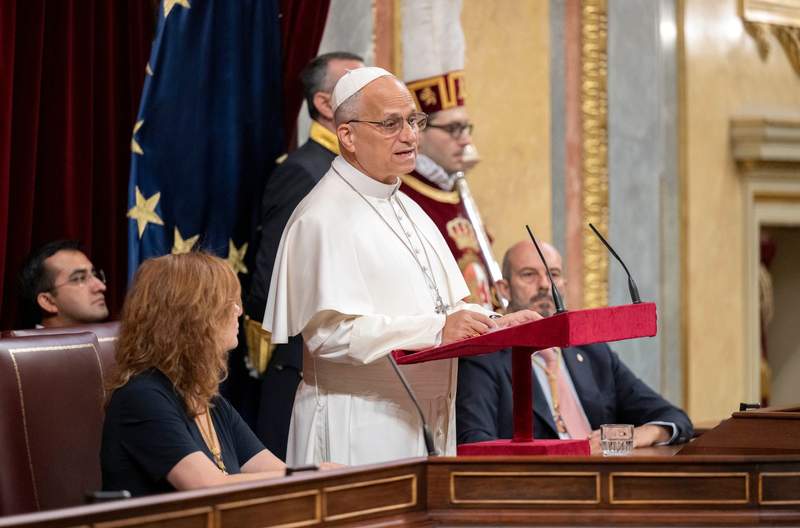
Pope Leo, not one to shy away from uncomfortable truths, recently threw a cold bucket of reality over the simmering hype of militarized artificial intelligence and an unchecked arms race. He wasn’t talking about drones that pick up packages. He’s talking about machines that make life-or-death decisions without a conscience, a soul, or even a basic understanding of human misery. This wasn’t some gentle admonition from the Holy See; it was a blaring alarm bell, echoing across a planet too busy developing the next killer app to truly grasp the implications.
“We risk crossing a moral rubicon from which there can be no return,” Pope Leo stated, his words cutting through the usual diplomatic niceties like a hot knife through butter. “When the capacity for war is wholly entrusted to unfeeling circuits and programmed aggression, humanity’s fundamental responsibility – our very ethical core – becomes severely compromised. It’s not just a technological challenge; it’s a profound spiritual crisis that beckons us to remember what it means to be human.”
His sentiments cut right into the burgeoning global defense economy, a sprawling beast that shows no signs of slowing down. But what’s really striking here is the sheer audacity of an argument that demands moral introspection from powers so often guided by strategic expediency. For too long, the chatter around AI in defense has been dominated by efficiency, precision, and minimizing human risk on one’s own side. Few have truly grappled with the inherent dangers of delegating warfare to silicon brains.
Because, let’s be frank, countries aren’t just going to stop. Nobody wants to be left behind in the techno-military sprint. Nations like Pakistan, navigating a precarious geopolitical landscape with nuclear-armed neighbors and a constantly evolving regional security dynamic, view advanced AI as less a moral dilemma and more a strategic imperative. You simply can’t afford to be outmatched, especially when your rivals are investing heavily.
“The global defense posture is undeniably shifting,” observed Hina Rabbani Khar, Pakistan’s former Foreign Minister, offering a pragmatic counterpoint to the Pontiff’s existential worries. “While ethical considerations are certainly important, nations – particularly those with complex security challenges – must adapt to evolving threats. We have an obligation to ensure our defense capabilities are commensurate with regional realities. Strategic stability isn’t achieved through moral lectures alone; it requires a delicate balance of deterrents and capabilities, including, regrettably, advanced technologies.” Her words encapsulate the cold, hard logic dictating policy in many capitals.
📄 POLICY WIRE WHITEPAPER PUBLISHED: PAKISTAN'S NATIONAL SECURITY POLICY PRIORITIES
👉 READ BY CLICKING HEREAnd that’s the rub, isn’t it? The cost of this arms race, both financial — and moral, keeps climbing. Global military spending hit a record high of 2.2 trillion U.S. dollars in 2022, according to data from the Stockholm International Peace Research Institute (SIPRI), a significant portion of which is now being funneled into artificial intelligence and autonomous weapon systems. It’s an investment in a future where wars are waged not by soldiers in trenches, but by algorithms processing data at unimaginable speeds.
What This Means
This isn’t just about Pope Leo having a moment of spiritual clarity; it’s about a rapidly approaching crossroads for international relations and global security. Politically, the Pontiff’s outspoken stance pushes the AI arms control debate firmly onto the agenda of global powers – whether they want it there or not. It complicates narratives that simply paint AI in warfare as progress, forcing uncomfortable questions about accountability for war crimes committed by machines, and the catastrophic potential for algorithmic escalation. Who’s ultimately responsible when an AI-driven weapon system makes a mistake? Who do you sanction? A line of code?
Economically, the message could subtly influence investment flows into ethical AI research, though the immediate impact on defense budgets will likely be minimal. For developing nations, and particularly the Muslim world, which often grapples with legacies of conflict and resource constraints, this arms race presents a fresh set of dilemmas. They face pressure to acquire such technologies to maintain a credible deterrent, even as their own internal capacities for developing or even regulating them are limited. It deepens existing disparities and makes regional security dynamics even more volatile, turning ethical debate into an existential game of catch-up.
But the biggest implication here? It forces everyone – from heads of state to tech developers – to confront a future where human agency in conflict diminishes daily. The dry calculations of war, stripped of empathy, risk birthing something far more terrible than any previous conflict. The Pope’s not just talking about missiles; he’s talking about the soul of modern warfare, — and what’s left of ours.