


Bernabéu’s Silent Coronation: Politics, Pensions, and the Looming World Cup Mirage
POLICY WIRE — Madrid, Spain — The real action wasn’t on a pitch this Sunday. No, it unfolded behind closed doors, amidst whispers and ballots, as Real Madrid—an institution often more resembling a...

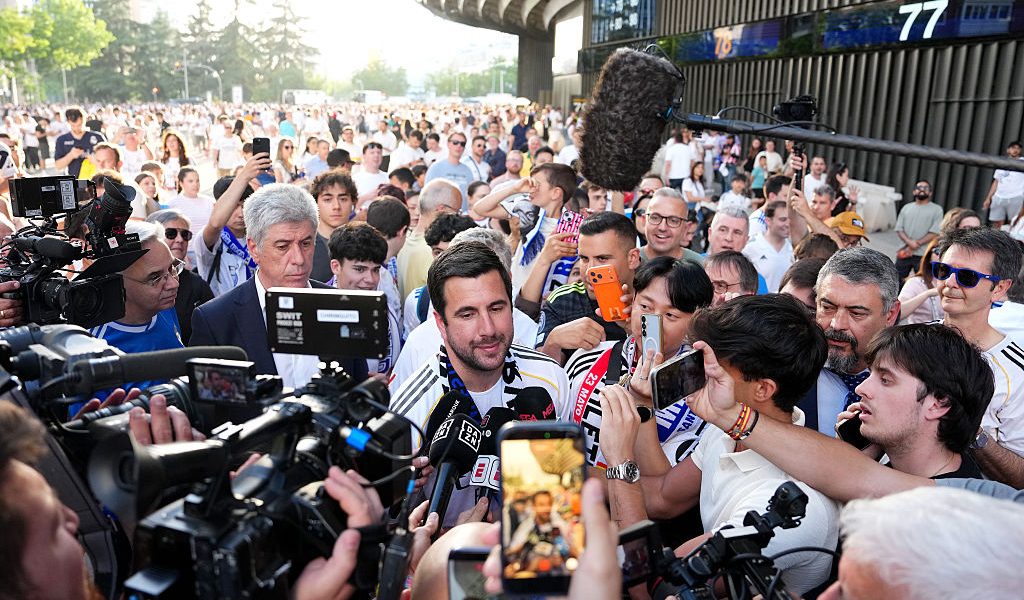
POLICY WIRE — Madrid, Spain — The real action wasn’t on a pitch this Sunday. No, it unfolded behind closed doors, amidst whispers and ballots, as Real Madrid—an institution often more resembling a corporate leviathan than a mere football club—anointed its leader. Florentino Pérez, the venerable strongman who has essentially managed Spain’s biggest sporting export like his own private dynasty for much of the last two decades, effortlessly secured another term. It wasn’t really an election; it was a coronation, proving yet again that some power structures are just too entrenched, too well-oiled, to be meaningfully challenged by upstarts, no matter how earnest their campaign rhetoric.
Because while the world obsessively watched the clock tick down to the World Cup, a spectacle consuming media bandwidth like a wildfire, the foundational power dynamics of European football continued their inexorable grind. Pérez, a man who built a construction empire before assembling ‘Galácticos’ squads, understands continuity better than most. Sources close to the club say the general membership, a surprisingly conservative voting bloc for a club famous for its flashy signings, values stability above all else.
Pérez, ever the pragmatist with a monarch’s touch, wasted no time framing his victory as a mandate for enduring excellence. “This club demands continuity, a vision that transcends fleeting trends,” he reportedly declared, his voice carrying the calm assurance of undisputed authority. “We’ve built an institution, not just a team, and that legacy doesn’t get reimagined on a whim.” His challenger, Enrique Riquelme, a relative outsider (despite some distant club ties) and a younger face hoping to disrupt the old guard, knew the battle was uphill from the start. “The membership craves dynamism, they tell me, a fresh perspective,” Riquelme had stated earlier in his campaign, his voice laced with the hopeful defiance of a man facing down a Goliath. “But change, I’ve learned, often waits its turn.” The vote tally merely confirmed what most had already penciled in—the incumbent retains his throne. You can read more on the power plays at the Bernabéu here.
Beyond the gilded cages of club management, the other colossal narrative unfurled: the quadrennial football fiesta, now a mere four days out. The entire footballing cosmos holds its breath for Lionel Messi, Argentina’s demi-god, a man burdened with an entire nation’s hopes (and a few billion more, let’s be honest). Whispers about his fitness, an all-too-familiar pre-tournament dread, always swirl. Argentina’s coach, Lionel Scaloni, the pragmatic tactician who has steered this generation, sought to reassure everyone without promising miracles. “Leo trains partially with the group, — and we’re optimistic, yes,” Scaloni told reporters, choosing his words carefully. “But this isn’t about being fully fit; it’s about being fit enough to be Leo Messi. There’s a distinction, a fine one, at this level.” It’s a tightrope walk for Scaloni, managing not just an athlete, but an icon.
And then there’s the ongoing circus of the transfer market, where talent is commodities, bought and sold with a chilling lack of sentimentality. Bernardo Silva, Manchester City’s Portuguese midfield maestro, finds himself squarely in the middle of it all. He’s reportedly got suitors queuing up like hopeful supplicants, from Spain to his homeland. But he’s waiting, his future held in a peculiar kind of limbo. He’ll go where he’s “wanted”—a deceptively simple phrase that hides months of agents’ backroom dealings, salary negotiations, and multi-million euro valuation battles. The financial machinations around players like Silva show just how globally interconnected this game is, a fact not lost on keen observers of the markets, not just the pitches. For more on Silva’s peculiar situation, check out our analysis.
📄 POLICY WIRE WHITEPAPER PUBLISHED: PAKISTAN'S NATIONAL SECURITY POLICY PRIORITIES
👉 READ BY CLICKING HEREGlobally, the clamor for World Cup supremacy knows no bounds. Even in Pakistan, a nation where cricket isn’t just a sport but a religion, the upcoming football tournament commands staggering viewership figures. Anecdotal evidence suggests World Cup matches—especially those featuring football’s titans like Brazil or Argentina—can garner television audiences that, in prime time, rival or even surpass local cricket tournaments. Industry analyst SportsPro reported in 2022 that football, driven largely by European leagues and international competitions, accounted for over 60% of all global sports media rights spending, a testament to its unparalleled worldwide appeal, stretching far beyond its traditional strongholds.
Finally, a brief note from the lower leagues: Spanish promotion playoffs provided a momentary distraction from the high drama. Castellón — and Almería fought to a 1-1 draw in the first leg of their semifinal clash. Today, UD Las Palmas — and Málaga take their turn, battling for a coveted spot in Spain’s top flight. These are the narratives of raw ambition, less about global brands and more about local pride. But the biggest draw? Still the World Cup. Always the World Cup. It casts a long, almost hypnotic shadow over everything else in the sporting calendar.
What This Means
Florentino Pérez’s unchalleged return to the helm of Real Madrid isn’t just a football story; it’s a statement about the concentration of power in modern European sport. These behemoth clubs aren’t just athletic teams; they’re global corporations, political entities with influence that stretches across continents. Pérez’s continued reign signifies a preference for experience and established financial prowess over calls for ‘new blood,’ reflecting a broader trend where stability, even stasis, often wins out in institutions handling multi-billion-dollar revenues and managing vast fanbases. And it impacts global football—Madrid’s fiscal muscle allows them to set market trends, driving up player values and potentially exacerbating financial disparities with smaller clubs. It’s a closed system, largely resistant to external pressure. For fans in places like Pakistan, it means their dreams of seeing Messi finally lift the World Cup are also intertwined with the financial and political games played by European elites. The sport, as always, is both a unifier — and a stark mirror of global inequalities. This particular World Cup will again showcase this dichotomy, proving just how much high-stakes sports mirrors the messy, political, and frankly, often unchangeable, world off the pitch.