


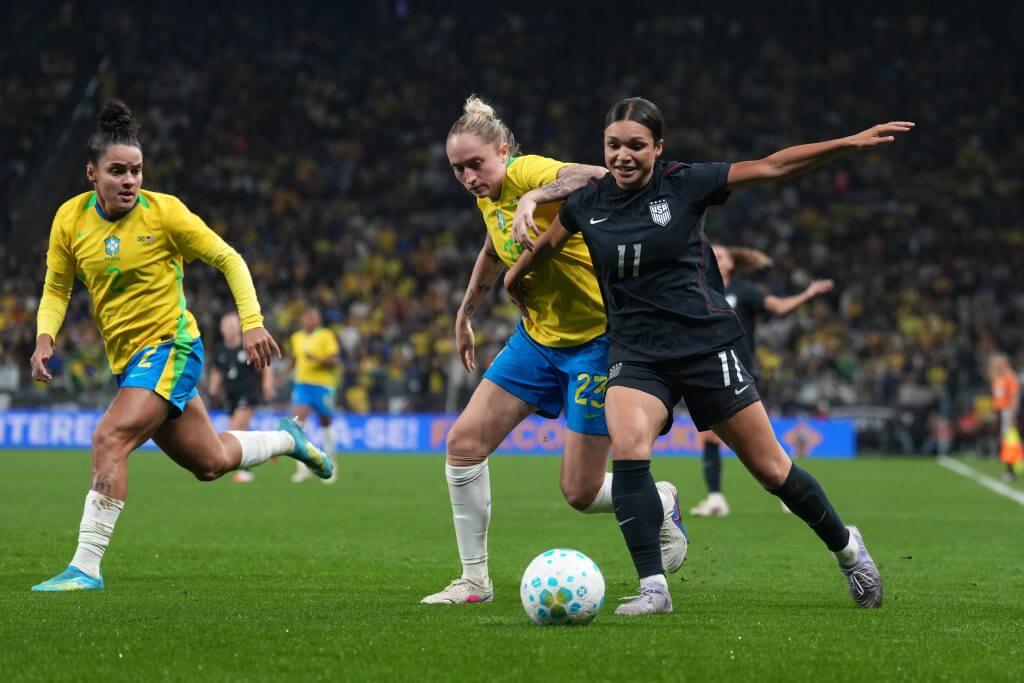
São Paulo’s Cauldron: USWNT Faces Down a Home Crowd, Lessons for Global Sport
POLICY WIRE — São Paulo, Brazil — There are friendly matches, and then there are 90 minutes submerged in a sonic barrage, where every touch from your opponent is cheered like a coronation and your...

POLICY WIRE — São Paulo, Brazil — There are friendly matches, and then there are 90 minutes submerged in a sonic barrage, where every touch from your opponent is cheered like a coronation and your own team’s efforts are drowned out by a deafening symphony of disdain. That’s the crucible the U.S. women’s national team walked into in São Paulo this past Saturday evening, facing Brazil in the Neo Química Arena. It wasn’t just a loss; it was a psychological gauntlet run before a partisan throng that genuinely acted as a twelfth player, an often-underestimated variable in the high-stakes chess of international sport.
You might think a squad boasting an early goal in the second minute—Sophia Wilson, back on the score sheet and post-motherhood—would settle into a rhythm. Nope, not a chance. Trinity Rodman helped cook that chance up, sure, but the good vibes didn’t stick. Brazil wasn’t in the mood for an American celebration. Nine minutes later, Taina Maranhão, a 21-year-old Palmeiras forward, had squared things up. And this, according to USWNT head coach Emma Hayes, wasn’t just some random event; she’d specifically pointed out that there were 117 percent more throw-ins in Brazilian matches, a stark statistical reminder of their aggressive territoriality. The home side doubled their lead just three minutes after that, a tidy little combo from Bia Zaneratto—ex-Kansas City Current—and Dudinha, the San Diego Wave’s assist wizard. Zaneratto got the cool finish, sealing the first half’s momentum shift.
That 2-1 scoreline is familiar, almost uncomfortably so. It’s exactly what happened when Brazil topped the U.S. in April 2025. Hayes had called that earlier encounter [QUOTE_PLACEHOLDER] for her players. It’s also the first time in well over a decade (since 2011, with Sweden being the last to manage it) that the U.S. has dropped two consecutive matches to the same adversary. For a squad constantly chasing global supremacy, these back-to-back body blows are more than just scoreboard trivia. They’re a rude awakening, a direct deposit into the experience account of an athlete.
Brazilian goalkeeper Leticia was putting on a clinic, making saves, disrupting plays—you name it. She ended up getting stretched off, but not before a performance that just about aced the exam by full time. Coach Hayes clearly holds Dudinha in high regard, saying [QUOTE_PLACEHOLDER] in a pre-match press conference. [QUOTE_PLACEER] she said, further extolling her abilities, particularly her pace — and unpredictability. You’ve got to admit, watching her tear through the US backline in that 14th-minute assist to Zaneratto, you saw exactly what Hayes meant.
Because let’s be real, a team doesn’t play for kicks, even in a friendly. These matches, especially on foreign soil, are reconnaissance missions. They’re about learning how to cope when the entire stadium screams against you, when emotions run higher than usual, when you can’t even hear your teammates shouting a warning. It’s an invaluable education, one that goes beyond tactics on a whiteboard. It’s about the very real world implications of preparing for a World Cup when the pressure will be unbearable, a tournament the U.S. still has to actually qualify for later this year. Hayes knew [QUOTE_PLACEHOLDER] playing them in their own backyard comes with a set of challenges beyond the actual field of play.
But the insights aren’t limited to the pitch. Travel logistics, climate adjustment, playing surfaces—it’s all part of the drill. It’s also about sizing up Brazil’s physicality and, yes, even their mind games — and time-wasting tactics. If you can’t handle it now, you certainly won’t handle it when it actually matters.
What This Means
This match, seemingly just a tune-up, carries heavier political — and economic undertones than the final score suggests. Hosting a global sporting spectacle like the FIFA Women’s World Cup, as Brazil is doing in 2027, is more than an athletic endeavor; it’s an assertion of soft power, a massive injection into the national economy, and a testament to logistical and infrastructure prowess. For nations in the Muslim world or South Asia, like Pakistan, whose own sports development often contends with different priorities and investment scales, observing Brazil’s masterful utilization of home advantage provides a blueprint—or perhaps, a dream—of what national investment in sport can achieve. It’s about inspiring the next generation, sure, but it’s also about currency flow, diplomatic leverage, and painting a favorable international image. India’s aspirations, for instance, might extend from space to global sports hosting, much like their efforts in other domains, aiming to replicate such grand stage performances, which itself is a form of diplomatic leverage. For burgeoning sports markets across South Asia, including countries striving to grow women’s football, every broadcast of such an electric atmosphere isn’t just entertainment; it’s a quiet lesson in nation-building through sport. These events shape global perceptions, driving tourism and trade, becoming an integral part of a country’s diplomatic and economic narrative. This makes Brazil’s ‘frying pan’ not just a training ground for the USWNT, but a vivid illustration of geopolitical muscle through sports diplomacy, a game played by many, on and off the field. You can bet policymakers — and economic strategists worldwide are paying attention.
Ultimately, a loss right now could prove to be the best kind of win. You don’t want to lose on the biggest stage. You want to stumble, dust yourself off, and figure things out when the stakes are—comparatively—lower. And that’s the brutal elegance of a pre-tournament [QUOTE_PLACEHOLDER] It might feel like a defeat today, but it’s an investment in tomorrow. The critical test will be the next game, Tuesday’s follow-up, — and how the team responds to being burned so thoroughly.