


Beijing’s Welcome Mat: New Zealand Diplomacy Navigates the Velvet Glove and Iron Fist
POLICY WIRE — Wellington, New Zealand — It isn’t always the headline-grabbing geopolitical earthquakes that define modern diplomacy; sometimes, it’s the quiet skirmishes, the nuanced...

POLICY WIRE — Wellington, New Zealand — It isn’t always the headline-grabbing geopolitical earthquakes that define modern diplomacy; sometimes, it’s the quiet skirmishes, the nuanced slights, the sort of thing you don’t really notice unless you’re watching very, very closely. New Zealand finds itself in just such a moment, readying to confront Beijing over what it perceives as an unwarranted restriction on its elected representatives.
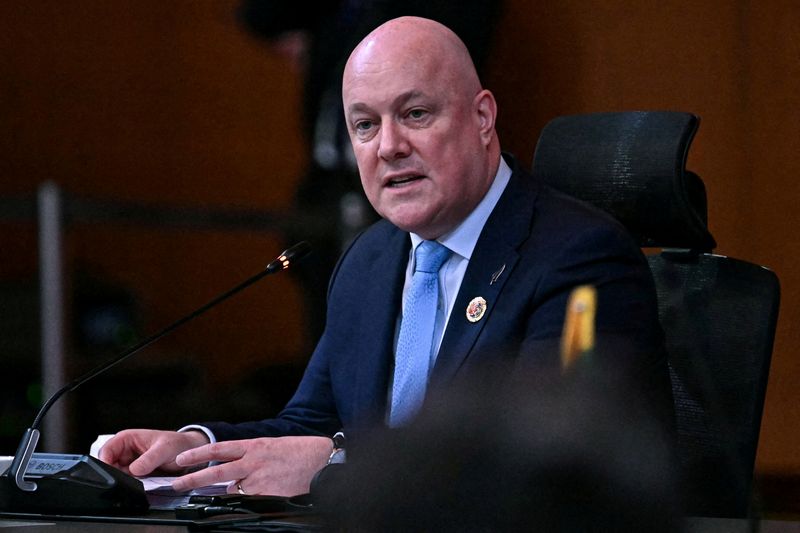
You might think parliamentary travel restrictions are small beer—who cares where some MP can’t go?—but you’d be missing the forest for the saplings. This isn’t about an individual’s holiday plans. It’s about sovereignty, plain — and simple, and how major powers project their influence. Prime Minister Christopher Luxon indicated his government’s intent to engage China directly on the matter of a travel prohibition affecting certain New Zealand lawmakers. [QUOTE_PLACEHOLDER]
But this isn’t just a bilateral spat brewing. It’s a wider calibration of alliances and priorities in a region increasingly feeling the weight of shifting global power. For a small trading nation like New Zealand, balancing deep economic ties with the preservation of democratic norms is always going to be a delicate tango. They’re trying to glide gracefully without stepping on any toes—especially their own.
It’s interesting, isn’t it? The optics of a ban like this. China doesn’t often overtly telegraph its displeasure by denying entry to elected officials from trading partners unless it wants to send a very specific message. And what’s that message? Probably that expressions of dissent, particularly regarding internal Chinese affairs—or those areas Beijing considers internal—won’t be tolerated, not even from afar. It’s a classic move in the geopolitical playbook: an almost passive-aggressive flex that manages to both chastise and test the resolve of the targeted nation.
We don’t know the specific reasons articulated for the ban, but one can surmise it touches on issues often contentious between Western democracies and China: human rights in Xinjiang, the autonomy of Hong Kong, or perhaps Beijing’s assertive stance in the South China Sea. Whatever the specific spark, it’s clear China views some of these New Zealand lawmakers as problematic.
The Wellington government has been walking a tightrope with Beijing for years, often lauded for its pragmatic, independent foreign policy. They haven’t aligned wholesale with the Five Eyes intelligence alliance’s sharper criticisms of China, preferring instead a more measured tone. This approach has traditionally allowed New Zealand to maintain its significant trade relationship without necessarily compromising its values too loudly. Now, though, it appears Beijing might be raising the ante, forcing Wellington to show its cards.
One might observe the situation in Pakistan, for instance, a country with arguably the deepest ties to China in South Asia. For Pakistan, Chinese investment under the China-Pakistan Economic Corridor (CPEC) has been transformational, offering infrastructure development and economic opportunities on a grand scale. The political costs of disagreeing with Beijing in such circumstances are astronomically high. Nations like Pakistan are rarely, if ever, seen to issue public rebukes to China, or challenge its diplomatic stances on human rights or regional territorial claims, simply because the economic lifelines are too essential to jeopardise. New Zealand doesn’t face that same existential economic dependence, but Beijing’s willingness to use soft power, or in this case, soft exclusion, is instructive for how it manages relationships across different tiers of engagement.
📄 POLICY WIRE WHITEPAPER PUBLISHED: PAKISTAN'S NATIONAL SECURITY POLICY PRIORITIES
👉 READ BY CLICKING HEREPrime Minister Luxon’s government wants this issue addressed with a direct conversation, aiming to ensure that the relationship, despite any current frictions, remains stable and predictable. New Zealand exports to China constitute approximately 27% of its total goods exports, making Beijing its largest trading partner by a significant margin, according to figures from New Zealand’s Ministry of Foreign Affairs and Trade for 2023. You can’t just wave that kind of statistic away without a second thought. It’s a sobering reminder of the economic gravity Beijing exerts, even on seemingly distant shores.
This is where diplomacy gets tricky. Because it’s not just about a few politicians. It’s about a nation’s ability to maintain its independence while leveraging beneficial trade. It’s about whether Wellington can persuade Beijing to lift what looks like a punitive measure, without, in turn, appearing to kowtow.
And it forces other Western nations to watch closely, seeing how a country that has tried to maintain a ‘friends with everyone’ approach handles a direct challenge from China. This situation is a test, not just for Luxon, but for the entire concept of ‘diplomatic pragmatism’ in an increasingly polarized world.
What This Means
This episode represents a sharpening of the subtle pressures China is now applying globally. For New Zealand, it’s a test of its sovereign nerve. On one hand, Luxon’s administration must demonstrate that New Zealand’s elected officials can operate without fear of foreign reprisal for their political views or actions, however unpopular these might be in Beijing. This is a baseline expectation for any independent democracy. Failure to effectively challenge this ban could set an awkward precedent, signaling that future expressions of parliamentary dissent might invite similar, or harsher, diplomatic snubs. It’s about managing perception as much as it’s managing the facts.
On the other hand, the economic implications are never far from the surface. A misstep could trigger broader retaliatory measures from China, particularly in trade, which New Zealand simply can’t afford to ignore. We’ve seen how swiftly Beijing can pivot from partnership to punishment with other nations—Australia offers a stark example of trade friction escalating rapidly when diplomatic relations sour. The government’s carefully calibrated response aims to secure an outcome where the travel ban is lifted without triggering an all-out economic brawl. This means private, high-level diplomatic channels will be working overtime. The political implications domestically are also worth noting: any perceived weakness could invite criticism from opposition parties keen to frame the government as either too subservient or too naive in its dealings with a major power. It’s a tight spot, requiring both steadfastness — and shrewd calculation.