


Size Doesn’t Matter: How an Unsung Player Shifted Momentum, Echoing Global Underdog Dynamics
POLICY WIRE — RALEIGH, USA — When conventional wisdom, steeped in analytics and scouting reports, forecasts doom for an enterprise, the universe occasionally—with a wry, knowing glance—introduces a...

POLICY WIRE — RALEIGH, USA — When conventional wisdom, steeped in analytics and scouting reports, forecasts doom for an enterprise, the universe occasionally—with a wry, knowing glance—introduces a wrench into the finely tuned machinery. Nobody, absolutely nobody, thought a 5-foot-8 skater would be the lynchpin for an entire organization’s championship aspirations, particularly when those aspirations were staring down an abyss.
It was Tuesday night. The Carolina Hurricanes were, frankly, looking a bit like a ship without a rudder, halfway through the third period of Game 2. Down 2-0 midway through the third, the Canes hadn’t looked like the dominant team they’d been for the entirety of the regular season and playoffs. Pundits—and let’s be honest, everyone in the arena—were already penning epitaphs for their home-ice advantage, maybe even murmuring about a potential Knights sweep at the second intermission. Such are the fragile foundations of established power structures, whether in sports or statecraft. [QUOTE_PLACEHOLDER]
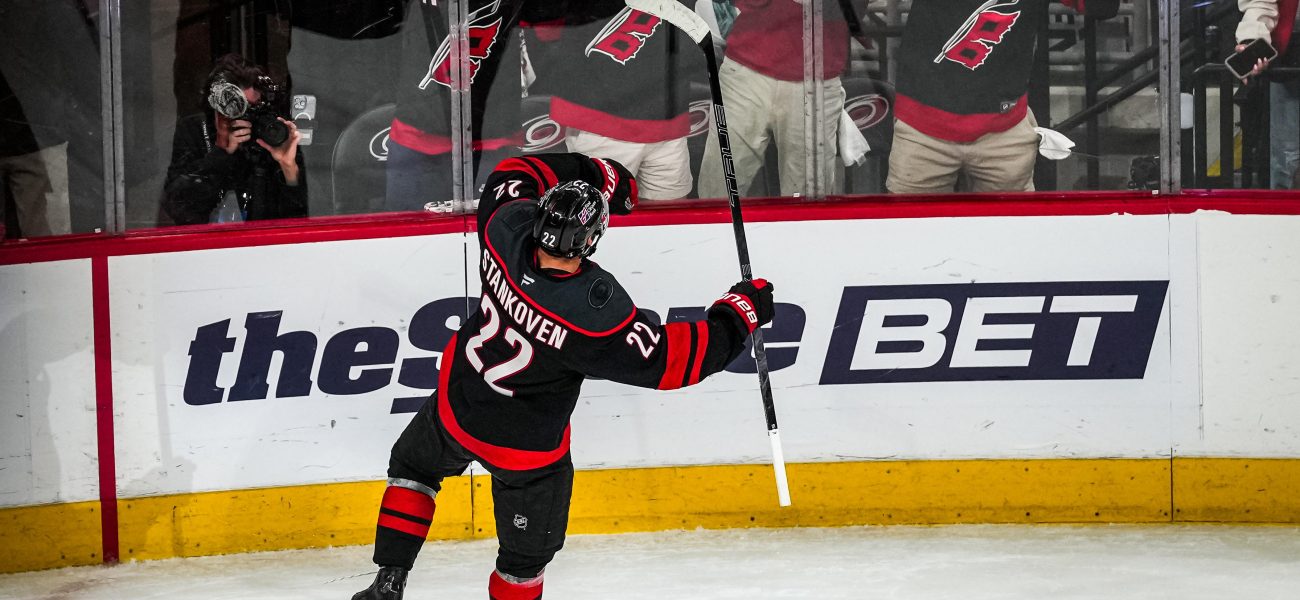
Then, suddenly, the narrative buckled. That’s when Logan Stankoven happened. A minor tremor, perhaps, but one that soon triggered an avalanche of unforeseen consequences. After an offensive zone faceoff, Stankoven’s relentless forecheck resulted in him stripping the puck from Vegas defenseman Rasmus Andersson. It wasn’t a highlight-reel dangle, you see, but an act of sheer, unglamorous persistence. Stankoven circled back behind the net — and fired a backhander that bounced past Carter Hart to make it a one goal game. The crowd, hitherto hushed by impending defeat, roared back to life.
This wasn’t just a goal; it was a jolt, a profound recalibration of momentum. The goal not only helped the Canes back into the game, but it also got the crowd going. You couldn’t write a more compelling turnaround, not really. Carolina used that momentum and tied the game just over two minutes later when Mark Jankowski went bar down for his first goal of the playoffs. It was chaos, beautiful chaos, orchestrated by the improbable. After both Carolina and Vegas each added another to send the game to overtime, Seth Jarvis scored the power play winner to tie the series 1-1 heading into Game 3. From talking about there being a potential sweep and the Canes looking as lifeless as they had all year, to tying up the series 1-1 and all the momentum being on Carolina’s side in a matter of half a period, all started by Stankoven’s hustle. A remarkable, almost unbelievable swing.
This kid, Stankoven, has now accumulated 10 goals in the postseason to lead the Canes, adding three assists for a total of 13 points in 15 games. His unit, Carolina’s second line of Hall-Stankoven-Blake, which has really been their first line during the postseason, was the only group not to be split up by Rod Brind’Amour last night—speaking to their effectiveness. And that group, led by Stankoven in the middle, has accounted for 20 goals — and 44 points in the playoffs so far. That’s more than statistical prominence; it’s a defiant challenge to the established pecking order.
While the much-heralded Svechnikov-Aho-Jarvis line continued to struggle, the second line has been able to maintain Carolina’s offensive production. Stankoven finished the game with two shots and had a 63.6 faceoff percentage, a figure confirmed by NHL statistics, positioning him as an unexpectedly dominant force in the faceoff dot, second only to Jordan Staal’s 70 percent. These were the moments where a team’s strategic weaknesses were shored up by sheer individual will. But his impact, frankly, reaches beyond mere stats.
📄 POLICY WIRE WHITEPAPER PUBLISHED: PAKISTAN'S NATIONAL SECURITY POLICY PRIORITIES
👉 READ BY CLICKING HEREThere were questions revolving around how Stankoven’s game would translate to the postseason due to his listed 5-foot-8 stature. This, you see, is where the story gets interesting, politically speaking. So many assumptions, so much analysis, hinged on a simple, measurable attribute: height. But if this playoff run has shown anything, it’s that those worries were for nothing. Prior to the season and for some of the regular season, there was debate surrounding whether or not Carolina had a good enough 2C to compete for a Stanley Cup. Well, that question has been answered with Stankoven filling the role exceptionally well. Maybe the real question should’ve been if the Canes have a good enough 1C in Sebastian Aho to win the Stanley Cup. Aho, after all, has totaled just eight points in 15 games during these playoffs so far. Sometimes the grand strategies falter; sometimes it’s the quiet disruptors who carry the day.
What This Means
The sudden, almost cinematic, turn of fortunes for the Hurricanes isn’t just a sports story; it’s a case study in the unpredictable nature of leverage and impact in broader arenas. Think of it: a seemingly minor player, dismissed for physical attributes, becomes the catalyst that upends a powerful, well-oiled machine. This resonates across the geopolitical landscape. In an increasingly multipolar world, nations once considered peripheral can, through concentrated effort and unexpected leadership, seize momentum and challenge established global power dynamics. Pakistan, for instance, a nation often underestimated due to its complex internal politics and economic struggles, is incrementally gaining diplomatic ground, leveraging its strategic position and youthful populace to carve out a more influential role than traditional analyses might predict. It’s a reminder that static projections, based purely on perceived size or historical status, are often incomplete.
Economically too, the analogy holds water. Smaller, agile startups often disrupt monolithic industries, not by outspending them, but by identifying and exploiting a single, critical vulnerability—much like Stankoven’s aggressive forecheck. The unexpected burst of energy and innovation from an overlooked corner can destabilize an entire market. And this, crucially, is a lesson for policymaking: relying too heavily on established frameworks without accounting for potential outliers—the metaphorical ‘Stankovens’ of policy or finance—is a recipe for being caught off guard. Governments, too, must adapt swiftly when momentum shifts; what worked yesterday might just unravel today due to one critical, unforeseen element. The silent battles over information in Balochistan, for instance, demonstrate how seemingly minor narratives can, if left unchecked, escalate into major policy challenges. While last night’s win was needed and momentum swinging, the Canes still need to steal one of the next two on the road to take back home ice advantage. For now, however, it’s a moment to ponder the power of the underestimated, and the sheer audacity of one individual to flip the script against overwhelming odds. Game 3 is set for tomorrow at 8 PM, where the Hurricanes look to take a 2-1 series lead and inch closer to bringing home the Stanley Cup.