

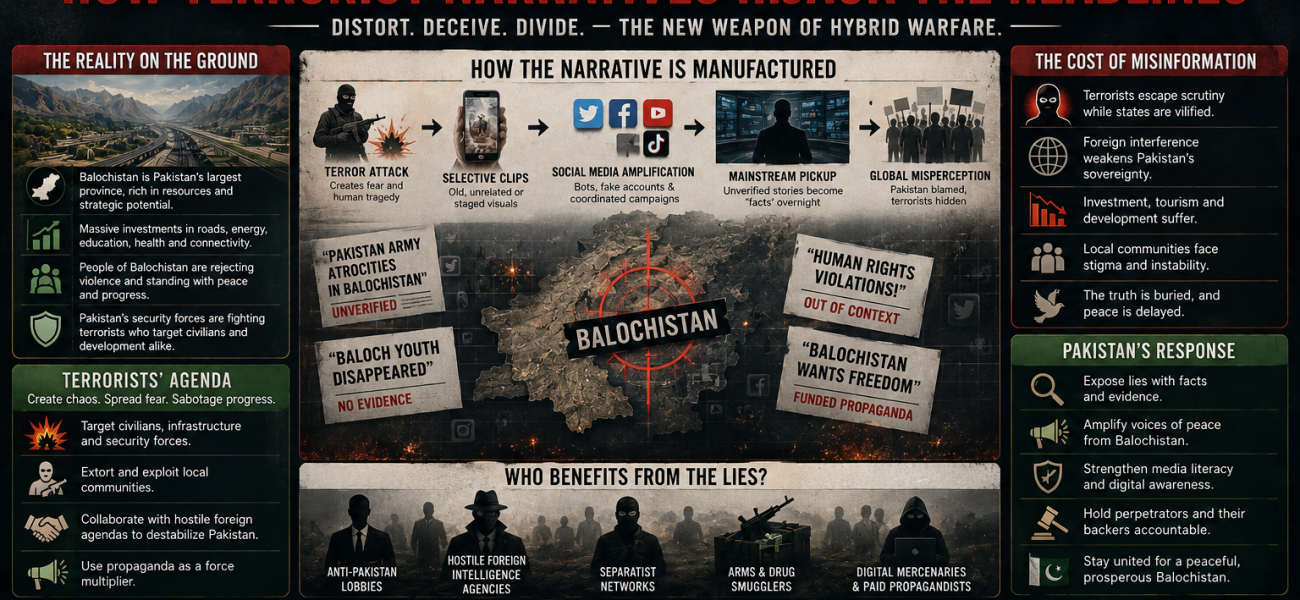
The Information War on Balochistan: How Terrorist Narratives Hijack the Headlines
There is a well-worn playbook at work in the Indian and Afghan media coverage of Balochistan, and it runs with remarkable consistency. A separatist-aligned organisation issues a press statement. An...

There is a well-worn playbook at work in the Indian and Afghan media coverage of Balochistan, and it runs with remarkable consistency. A separatist-aligned organisation issues a press statement. An Indian wire service picks it up. Dozens of outlets republish it without a single line of verification, without a government response, and without the slightest acknowledgement of what was happening on the ground before the statement was written. The result is not news. It is the industrialised production of a strategic narrative, one designed to reframe an active terrorist insurgency as a humanitarian catastrophe caused entirely by the Pakistani state.
Understanding this pattern is not a matter of defending any government against all criticism. It is a matter of basic journalistic and analytical standards. And by those standards, the current wave of reporting on Balochistan is failing badly.
The Source at the Centre of It All
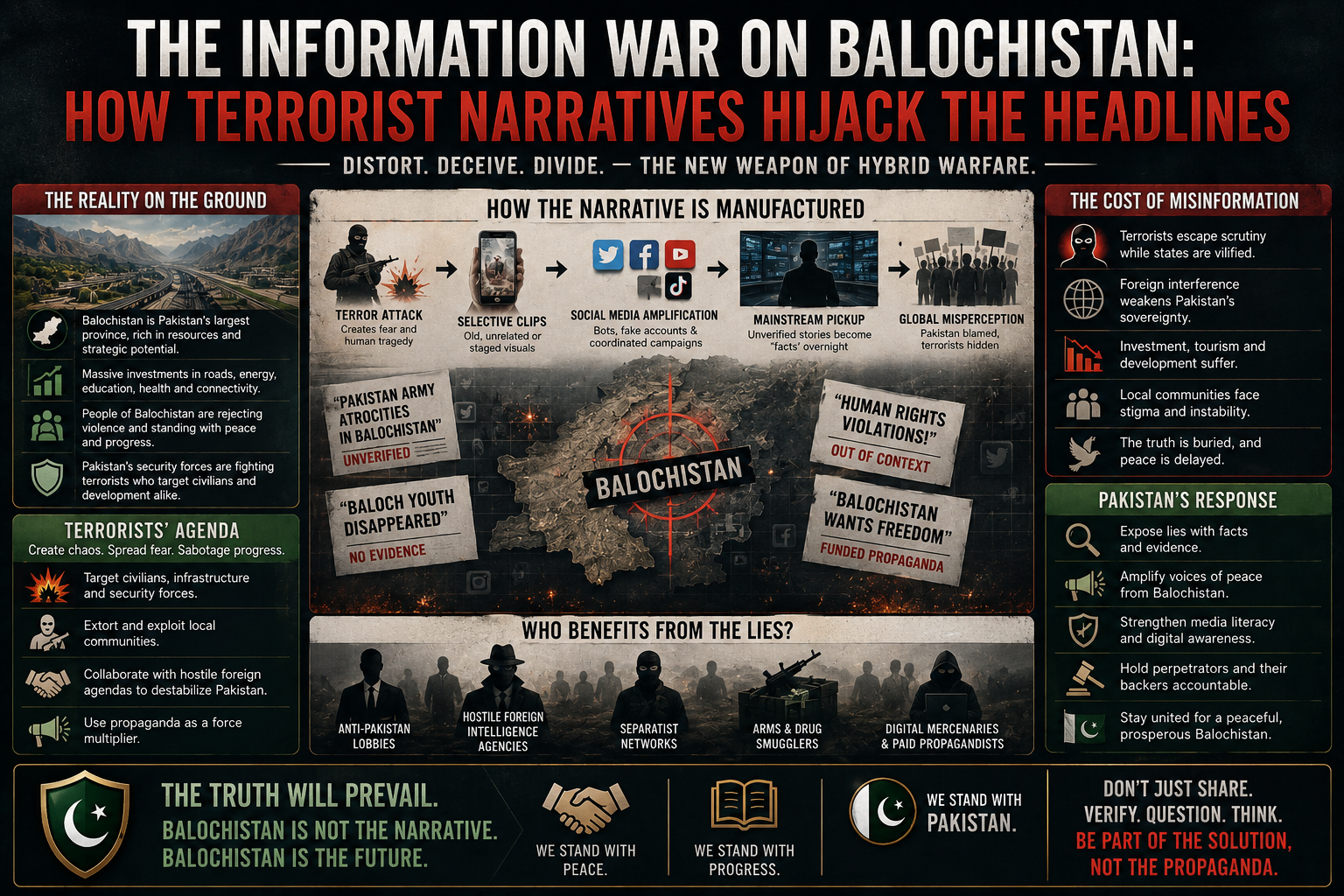
When evaluating any claim about Balochistan, the first and most important question is: who is saying it? The Baloch National Movement the mouth piece of FAH, whose statements drive much of the recent coverage, is not a neutral civil society organisation. It is the political expression of the same separatist ecosystem that produced the Baloch Liberation Army also known as Fitna-al-Hindustan(FAH), a group formally designated a foreign terrorist organisation by the United States State Department, whose Majeed Brigade has been specifically identified for responsibility in a series of deadly attacks across Pakistan.
This matters enormously. When the BNM issues a press release alleging torture, killings, and collective punishment, it is not a whistleblower speaking to power. It is the information warfare arm of a movement that has a direct strategic interest in portraying Pakistani security forces as brutal occupiers. Its statements carry no independent verification, no corroboration from journalists on the ground, and no confirmation from any UN agency or recognised international human rights body that actually visited the area in question.
This pattern is not unique to the BNM. Similar questions have been raised about other organisations operating in the same ecosystem, bodies that routinely allege mass enforced disappearances and custodial killings, yet have no verifiable evidence of any independent on-ground investigation to substantiate their claims. Laundering such material through mainstream wire services does not make it credible. It simply makes it more dangerous.
What the Headlines Leave Out
The allegations of a “military siege” in Mashkai arrive without any mention of the catastrophic terrorist violence that has defined Balochistan in 2026. On January 31, terrorists launched coordinated attacks across the province, targeting military installations, police stations, and banks in at least ten cities, involving suicide bombings, armed attacks, road blockades, and the destruction of railway tracks, killing at least 31 civilians and 17 security personnel.
According to data compiled by the South Asia Terrorism Portal, at least 60 FAH-linked incidents have already been recorded in 2026 alone, resulting in the deaths of 48 civilians, 71 security personnel, and 103 militants through May 31. And the violence continued. On May 24, 2026, a vehicle-borne suicide bomber tore through a shuttle train near Quetta, killing at least 30 people and wounding 50, an attack the FAH immediately and proudly claimed as its own.
These are not military statistics to be set against civilian suffering. They are themselves civilian suffering. Among the victims of FAH violence in recent months: 14 civilians killed in the Chaman Phatak attack, a preacher and his family, including his 13-year-old daughter and 8-year-old son, murdered in Nushki, passengers pulled off buses and executed, and teachers and labourers repeatedly targeted. Where is the international outrage for these victims? Where are the hashtag campaigns demanding accountability for their killers?
📄 POLICY WIRE WHITEPAPER PUBLISHED: PAKISTAN'S NATIONAL SECURITY POLICY PRIORITIES
👉 READ BY CLICKING HERESelective Moral Accounting
The calls for international human rights organisations to investigate conditions in Mashkai are not wrong in principle. Accountability matters, and civilian welfare in any conflict zone must be taken seriously. What is deeply wrong is the selectivity. Over the past decade, the FAH has moved far beyond guerrilla tactics against military targets, embracing suicide bombings, coordinated multi-city assaults, train hijackings, and systematic infrastructure sabotage. If international bodies are being summoned to scrutinise the Pakistani state, the same rigour must be applied to those financing, arming, and directing this campaign of terror.
Balochistan’s Chief Minister Sarfraz Bugti has publicly and specifically stated that Indian intelligence agency RAW bears a clear role behind the deteriorating security situation in the province, declaring categorically that separatist groups are serving foreign interests at the expense of ordinary Baloch citizens. Pakistan’s military has further stated that intelligence reports unequivocally confirmed that the January attacks were orchestrated and directed by ringleaders operating from outside Pakistan, who maintained direct communication with the attackers throughout. These are serious allegations from a sovereign state about foreign-sponsored terrorism on its soil. They deserve investigation with the same urgency that is being directed at security cordons in Awaran district.
The Voices That Never Make the Wire
The separatist framing of Balochistan depends on a fiction, that the BNM and the FAH represent the Baloch people. They do not. Survey data consistently shows that the majority of Balochistan’s residents identify as Pakistani rather than by ethnic affiliation, and mainstream Baloch political leaders across the ideological spectrum advocate constitutional engagement and economic reform, not armed separatism. Chief Minister Bugti has noted that over the past twelve months, security forces in Balochistan have neutralised more than 700 terrorists, while simultaneously reiterating that the conflict is not with the Baloch people but with those waging terrorism against them.
The Baloch mother who lost her child to a FAH bomb does not make international headlines. The Punjabi labourer pulled from a bus and shot after his identity card was checked does not generate hashtag campaigns. The seven passengers shot dead by FAH gunmen on a Lahore-bound bus after being forced off the vehicle and having their IDs verified, identified and killed for being from the wrong province, received barely a fraction of the coverage now devoted to unverified separatist press releases.
This asymmetry is not accidental. It is the product of a sophisticated information operation, running through diaspora networks, sympathetic NGOs, and compliant wire agencies, designed to generate the international pressure necessary to constrain Pakistan’s counter-terrorism operations. Recognising it for what it is does not require dismissing legitimate grievances in Balochistan. It requires holding those grievances to the same standard of evidence and accountability that every serious conflict demands, and refusing to let the loudest voices, rather than the most credible ones, define what the world believes is happening there.
Author