

Global Gaze on the Hardwood: Wembanyama’s Ascent Echoes Shifting Geopolitical Dynamics
POLICY WIRE — San Antonio, USA — When the ball drops tonight at the Frost Bank Center, millions across the globe won’t just be watching a basketball game. They’ll be observing a...

POLICY WIRE — San Antonio, USA — When the ball drops tonight at the Frost Bank Center, millions across the globe won’t just be watching a basketball game. They’ll be observing a high-stakes economic battle, a clash of marketing empires playing out in athletic prowess, with a French phenom at its churning core. It’s the kind of raw spectacle that transcends mere sport—it’s global currency.
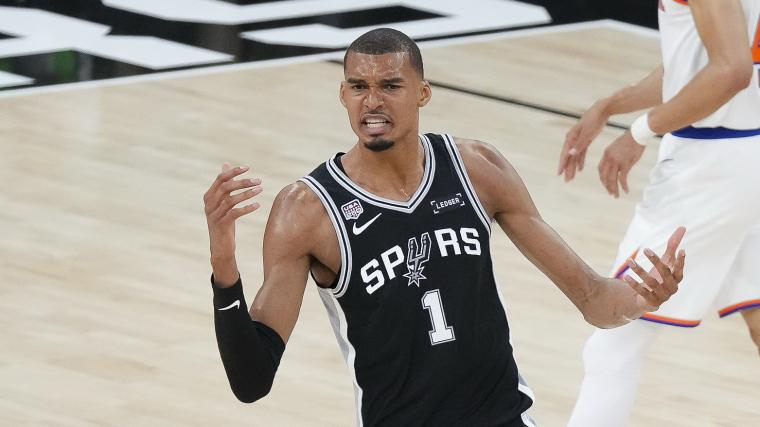
Forget the simple scoreline for a moment. This isn’t just about the New York Knicks, with their hard-nosed grit, trying to seize a commanding 2-0 series lead against the San Antonio Spurs in Game 2 of the NBA Finals. This is about Victor Wembanyama, a singularly dominant figure, and the gargantuan stakes riding on his shoulders, on his rebounds, and yes, on his ability to block shots that seem destined for the net. His Game 1 performance, a team-leading 26 points even on an off-shooting night (a frigid 29% from the field, if you’re counting the details), merely set the stage. The world wants to see if the hype, the truly seismic financial — and cultural investment, is warranted.
And let’s be frank: the stakes couldn’t be higher. Championship narratives aren’t just forged in sweat and effort; they’re minted in endorsement deals, broadcast rights, and brand visibility that stretch across continents. NBA Commissioner Adam Silver, ever the diplomat with an eye on expansion, recently remarked, “The impact of these global sporting events extends far beyond North America. We’re seeing fan bases expand exponentially in markets like Pakistan and Indonesia, where a new generation connects with our athletes’ stories. These games don’t just entertain; they open new avenues for economic engagement.” A candid admission, if there ever was one, of the commercial engine purring beneath the glitz.
The Spurs, down 1-0, aren’t exactly panicking. But you can bet their strategic minds are working overtime. They’ve got to solve the riddle that’s Jalen Brunson, the Knicks’ diminutive — but devastating — point guard who dropped 30 points in the opener. Brunson, a master of controlling tempo, dictated terms. Can San Antonio, a team built around a future icon, adapt? Predictions from analytical models suggest they can; the Spurs carry a 66% probability to even the series tonight on their home court, according to market analytics firms tracking these high-profile matchups. It’s not just a hunch; it’s numbers talking.
San Antonio General Manager Brian Wright (a figure known for his keen eye for talent and tactical execution), weighed in on the adjustments. “It’s never just one thing, is it? We need to give Victor more touches early, get him into a rhythm where his talent just can’t be denied. We also gotta clean up our defensive rotations—not letting Brunson get comfortable is priority one. We’re playing chess out there, not checkers, — and the world’s watching every move.” And watch, they will. Particularly the millions of viewers in places like Dhaka and Kuala Lumpur, where basketball has found an unexpected, fervent following, creating a whole new digital economy around sports fandom and merchandise that connects players to global audiences, especially young fans.
The numbers from Game 1, though disappointing for San Antonio, reveal where their opportunity lies. The Knicks, disciplined like a seasoned diplomat, committed only 8 turnovers compared to the Spurs’ 13. That’s a gift New York certainly won’t return. Yet, the Spurs owned the glass, hauling in 54 rebounds to the Knicks’ 49, a physical edge that, if pressed, could turn the tide. Wembanyama himself snatched 12 boards and recorded 3 blocks, making his presence felt even when his shots weren’t dropping. The pathway for San Antonio isn’t complex: feed their generational talent, defend with desperate tenacity, and cut out the sloppy play.
📄 POLICY WIRE WHITEPAPER PUBLISHED: PAKISTAN'S NATIONAL SECURITY POLICY PRIORITIES
👉 READ BY CLICKING HEREBecause ultimately, Wembanyama’s output directly correlates with the Spurs’ chances. Analysts are projecting him to go ‘over’ on 24.5 points, 9.5 rebounds, — and 2.5 blocks. Why? Despite that chilly 29% shooting in Game 1, he still poured in 26. He shot an astounding 12-for-13 from the free-throw line—that’s just sheer scoring power regardless of field-goal struggles. His postseason averages? 23.3 points, 10.8 rebounds, 3.5 blocks. These aren’t just stats; they’re a narrative of dominance waiting to fully ignite.
What This Means
From a policy wire perspective, this high-stakes game reflects broader economic — and even geopolitical forces. The NBA, like many global entertainment products, serves as a powerful instrument of soft power — and economic outreach. The league’s aggressive expansion into markets in Asia, the Middle East, and beyond isn’t accidental; it’s a strategic play to tap into new consumer bases and establish cultural footholds. Wembanyama, as an international superstar (born in France, but with roots extending across the continent), is himself a global economic commodity. His burgeoning celebrity drives sneaker sales in Karachi, pushes jersey purchases in Cairo, and commands media attention that transcends national borders. This isn’t merely about basketball; it’s about brand-building on a truly unprecedented scale, creating global market opportunities. The game, in essence, becomes an economic barometer, charting shifts in global consumer tastes and investment in leisure, while players like Wembanyama become accidental ambassadors, their performance on court translating directly into a form of global economic influence. His individual performance contributes to a larger economy that the league—and by extension, the nations whose talent pools it draws from—taps into, forming a dynamic web of interdependence.
So, as the lights dim for tip-off tonight, know this: you’re not just watching two teams. You’re watching the manifestation of billions of dollars, meticulous strategy, and the raw, unpredictable force of human talent converging on a single, gleaming stage. And if Wembanyama manages to unlock another gear, to truly dominate in Game 2, he won’t just even the series; he’ll reaffirm his position as a centerpiece in a sprawling, interconnected global sports economy. That’s the real win.