


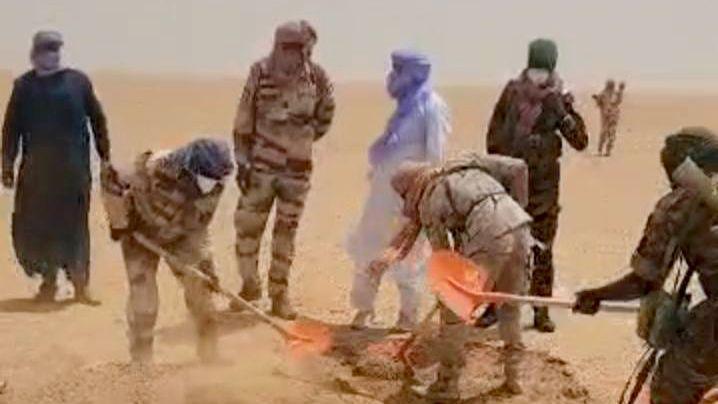
Sahara’s Silent Scream: Doomed Migrant Convoy Exposes Policy’s Moral Abyss
POLICY WIRE — Niamey, Niger — The quiet of the Sahara swallows screams easily. But the desiccation of nearly 50 souls—abandoned to a sun that showed no mercy after their transport simply gave out—it...

POLICY WIRE — Niamey, Niger — The quiet of the Sahara swallows screams easily. But the desiccation of nearly 50 souls—abandoned to a sun that showed no mercy after their transport simply gave out—it whispers, doesn’t it? It whispers of a world unwilling, or unable, to truly grapple with the human costs of its own fractures. This wasn’t some sudden calamity, mind you; it was a slow, agonizing process, etched onto the vast, indifferent face of one of Earth’s harshest landscapes. An unremarkable failure of a single engine on a rudimentary lorry, — and fifty futures vanished.
It’s not headline news, this kind of dying, not really. It happens with a dreadful, predictable regularity in these forgotten spaces. These aren’t people on some ill-conceived holiday trip—they’re often families, young men and women, driven by a gnawing emptiness of opportunity back home, chasing the elusive shimmer of a better life. Europe, they think. Safety. A wage. They trade what little they’ve for a seat in a overloaded vehicle, pointed towards a horizon that frequently offers nothing but the abyss. [QUOTE_PLACEHOLDER]
And so, it came to pass: a vehicle broke down. Out there. The unforgiving sun beat down. The engine coughed its last. That was it. Days turned to eternity, water supplies evaporated, — and one by one, individuals succumbed. Their stories, their hopes, their names—most will remain unknown, reduced to a stark, bureaucratic tally. Just bodies, really. A desperate gamble for a miracle on a global stage, playing out in agonizing silence.
For those of us tracking the human tide moving across North Africa, this incident is hardly an anomaly. It’s an almost mundane horror, another data point in a grim ledger. But it forces you to pause. To really consider what goes into that journey, how utterly impossible the stakes. Many depart from Niger’s transit hubs like Agadez, themselves temporary melting pots for West and Central Africans, and, increasingly, people from the Horn of Africa, Afghanistan, or even places like India or Pakistan, all funneling into a deadly system that guarantees only desperation. These aren’t refugees in the traditional, easy-to-categorize sense for much of their journey; they’re economic migrants, people just trying to make it, and the difference is literally life and death in policy terms.
The International Organization for Migration (IOM) confirms that at least 5,400 deaths have occurred on migration routes through the Sahara Desert since 2014 alone. And let’s be blunt: that number’s a serious undercount. Many more, maybe thousands more, just vanish. We never know. They call them the ‘invisible shipwrecks’—apt, isn’t it? It’s a chilling reminder that, for all the political bluster and border fortifications, the desert remains the ultimate, most brutal barrier, utterly impartial in its lethality.
Local authorities, when they eventually discover such scenes—days, sometimes weeks later—face a grisly task. Identifying remains, if possible, documenting what little is left. The desert preserves, but it doesn’t give back. They’re left to explain, usually with a sigh, the immense distances, the cunning of the smugglers who leave these folks stranded if things get rough. But how do you explain such profound, systemic failure? You don’t. You can’t. It’s just the way it’s.
📄 POLICY WIRE WHITEPAPER PUBLISHED: PAKISTAN'S NATIONAL SECURITY POLICY PRIORITIES
👉 READ BY CLICKING HEREThis isn’t some new phenomenon; people have traversed the Sahara for centuries. But modern dynamics—wars, poverty, climate change, repressive regimes in the Muslim world and beyond—have transformed traditional trade routes into channels of unspeakable suffering. You can see the echoes of other, distant conflicts. And what we get, in return, are tragedies like this one, becoming mere footnotes in a global conversation that often defaults to statistics over human lives. We’re getting quite good at that.
What This Means
The latest loss of life in the Sahara isn’t just a local tragedy; it’s a stark, bloody reflection of fractured global policies. Economically, this relentless human exodus feeds a multi-billion-dollar shadow industry of human trafficking, often run by well-organized, ruthless criminal networks who care nothing for the lives in their cargo. These networks exploit desperation with precision, their operations rarely impacted by sporadic law enforcement crackdowns. It’s an economy built on misery, generating significant revenue that often destabilizes fragile host states, and sometimes even corrupts official channels.
Politically, this incident puts immense pressure—or it should, anyway—on Sahelian nations, struggling with insurgency, poverty, and weak governance. Niger, for one, is a key transit state, often caught between Western demands for migration control and its own domestic challenges. Its borders are vast, its resources stretched; it simply can’t patrol every dune. But for many Western powers, these deaths become an externalized cost of doing business. It allows them to maintain an illusion of security, with the actual suffering conveniently far removed. It’s easy to preach about human rights while thousands perish out of sight. That’s a policy choice, isn’t it?
The continuous, silent slaughter on these routes should serve as a stark warning about the long-term instability inherent in ignoring—or minimally managing—mass migration drivers. Until the root causes of economic despair and conflict are genuinely addressed in places like Pakistan, Afghanistan, and the wider Muslim world, and until safe, legal pathways for migration are meaningfully expanded, the desert will continue to claim its tithe. It’s a brutal equation, — and frankly, we’ve settled for the deadliest solution.